Image: In the Constellation Cassiopeia
Jul 14, 2010
Image Credit: NASA/JPL-Caltech/UCLA

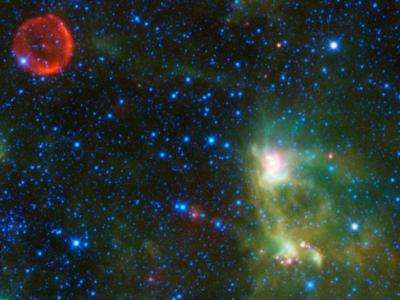
(PhysOrg.com) -- Tycho's Supernova, the red circle visible in the upper left part of the image, is SN 1572 is a remnant of a star explosion is named after the astronomer Tycho Brahe, although he was not the only person to observe and record the supernova.

When the supernova first appeared in November 1572, it was as bright as Venus and could be seen in the daytime.

Over the next two years, the supernova dimmed until it could no longer be seen with the naked eye. In the 1950s, the remnants of the supernova could be seen again with the help of telescopes.

When the star exploded, it sent out a into the surrounding material, scooping up and gas as it went, like a snow plow. An expanding shock wave traveled into the surroundings and a reverse shock was driven back in toward the remnants of the star.

Previous observations by NASA's indicate that the nature of the light that WISE sees from the supernova remnant is emission from dust heated by the shock wave.

To the right is a star-forming nebula of dust and gas, called S175. This cloud of material is about 3,500 light-years away and 35 light-years across. It is heated by radiation from the young, hot stars within it, and the dust within the cloud radiates .

Explore further: Unusual supernova is doubly unusual for being perfectly normal

add to favorites email to friend print save as pdf

Related Stories

Spitzer Spies Remnants of a Shy Star

May 15, 2006

Big stars usually aren't shy about anything, not even death. At the end of their lives, they throw explosive tantrums, called supernovae, flinging abundant amounts of hot gas and radiation into space. Remnants ...

Supernova remnant menagerie

Jun 07, 2005

A violent and chaotic-looking mass of gas and dust is seen in this Hubble Space Telescope image of a nearby supernova remnant. Denoted N 63A, the object is the remains of a massive star that exploded, spewing ...

Supernova 1987A: Fast Forward to the Past

Aug 18, 2005

Recent Chandra observations have revealed new details about the fiery ring surrounding the stellar explosion that produced Supernova 1987A. The data give insight into the behavior of the doomed star in the ...

Recommended for you

Three centaurs follow Uranus through the solar system

Jun 18, 2013

Astrophysicists from the Complutense University of Madrid have confirmed that Crantor, a large asteroid with a diameter of 70 km has an orbit similar to that of Uranus and takes the same amount of time to ...

Final curtain for Europe's deep-space telescope

Jun 17, 2013

The deep-space telescope Herschel took its final bow on Monday, climaxing a successful four-year mission to observe the birth of stars and galaxies, the European Space Agency (ESA) said.

Hubble spots a very bright contortionist

Jun 17, 2013

(Phys.org) —The contorted object captured by Hubble in this picture is IRAS 22491-1808, also known as the South America Galaxy. It is an ultra-luminous infrared galaxy (ULIRG) that emits a huge amount of ...

Study explains decades of black hole observations

Jun 14, 2013

(Phys.org) —A new study by astronomers at NASA, Johns Hopkins University and Rochester Institute of Technology confirms long-held suspicions about how stellar-mass black holes produce their highest-energy ...

User comments : 2

Adjust slider to filter visible comments by rank

Display comments: newest first

frajo
5 / 5 (1) Jul 15, 2010
Although not mentioned, SN 1752 is remarkable under a historical perspective.
It was the first one of quite a number of (to the naked eye) visible supernovae which was observed not only in China and other non-European regions of the world, but in Europe, too.
Especially SN 1054 which had been 4 times as bright as Venus, went unnoticed in the "dark ages" of Europe.
yyz
5 / 5 (1) Jul 15, 2010
SN 1572 and SN 1604(Kepler's Star) were the last naked eye supernovae observed in our galaxy and were important in the early development of astronomy. Besides being at odds with Aristotle's view of the immutable heavens, these supernova helped spur the production of (more) accurate charts of the night sky.

I found this post somewhat confusing. The supplied image was taken by the WISE orbiting infrared observatory and shows (besides SN 1572) the emission nebula S175 near the center and the open cluster King 1 (blue stars at lower left). Also, the supernova was detected at radio wavelengths in 1952 and optically in the mid 60s, marking the first sightings of SN 1572 since it faded from view in 1574. A somewhat better description and larger images are at the WISE site: http://wise.ssl.b...SNR.html

More news stories

Metamorphosis of moon's water ice explained

Using data gathered by NASA's Lunar Reconnaissance Orbiter (LRO) mission, scientists believe they have solved a mystery from one of the solar system's coldest regions—a permanently shadowed crater on the ...

Looking at sachet water consumption in Ghana

Many of West Africa's largest cities continue to lag in their provision of piped water to residents. Filling the service gap are plastic water sachets, which have become an important source of drinking water ...

LA to give every student an iPad; $30M order

Los Angeles' school system, the second largest in the United States, is ordering iPads for all its students, handing Apple a major success in its quest to make the tablet computer a replacement for textbooks.