Footloose glaciers crack up
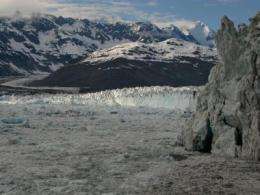
Glaciers that lose their footing on the seafloor and begin floating behave very erratically, according to a new study led by a Scripps Institution of Oceanography, UC San Diego researcher.
Floating glaciers produce larger icebergs than their grounded cousins and do so at unpredictable intervals, according to Scripps glaciologist Fabian Walter and colleagues in a paper to be published in the journal Geophysical Research Letters.
This study presents the first detailed observation of the transition from grounded to floating glaciers. Such a transition is currently taking place at Columbia Glacier, one of Alaska's many tidewater glaciers. Tidewater glaciers flow directly into the ocean, ending at a cliff in the sea, where icebergs are formed. Prior to this study, Alaskan tidewater glaciers were believed to be exclusively "grounded" (resting on the ocean floor), and unable to float without disintegrating.
However, Columbia Glacier unexpectedly developed a floating extension in 2007 that has endured far longer than researchers expected. The research team believes that this floating section may have been caused by the speed at which the glacier is receding. Columbia is one of the fastest receding glaciers in the world, having retreated 4 kilometers (2.49 miles) since 2004, and nearly 20 kilometers (12.43 miles) since 1980.
"We're seeing more tidewater glaciers retreat," Walter said. "As they retreat, they thin and that increases the likelihood that they'll come afloat."
The study, co-authored by U.S. Geological Survey (USGS) glaciologist and Scripps alumnus Shad O'Neel, is part of a larger effort to understand and include calving in large-scale glacier models, which are essential in producing accurate forecasts of sea-level rise. The research team conducted its study on Columbia Glacier by installing a seismometer, a sensor that measures seismic waves that are produced by shifts in geologic formations, including earthquakes, landslides, and glacier calving. They studied data collected from 2004-2005 and 2008-2009 that allowed them to compare the glacier's activity before and after it began floating.
The formation of icebergs, through a process known as "calving," is a leading source of additional water for the global ocean basin. As this study confirms, grounded glaciers and floating glaciers often show fundamentally different calving mechanics. However, iceberg calving is also one of the least understood processes involved in ice mass loss and consequential sea level rise. This study, which is funded by the National Science Foundation, sheds light on the process by comparing the size and frequency of icebergs calved by a glacier during both floating and grounded conditions.
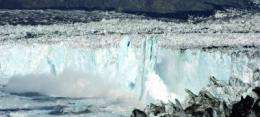
Calving occurs when fractures in the ice join up and cause a piece of ice to completely separate from the main glacier to form an iceberg. Unlike the floating glaciers, grounded glaciers calve icebergs nearly continuously, but they are generally quite small.
Through this study, scientists can begin to analyze the mechanics of the calving process in glaciers (both floating and grounded) and ice shelves, which will allow them to better understand and predict iceberg production from glaciers and ice sheets. These predictions, in turn, will provide a more accurate estimate of sea-level rise in the coming years.
Provided by University of California - San Diego


