'Hitchhiker' EPOXI: Next Stop, Comet Hartley 2
Jun 29, 2010
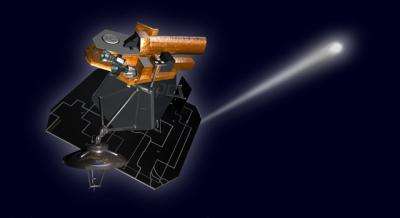
NASA's Deep Impact/EPOXI spacecraft flew past Earth on June 27, 2010, to get a boost from Earth’s gravity. It is now on its way to comet Hartley 2, depicted in this artist’s concept, with a planned flyby this fall. Image credit: NASA/JPL-Caltech

(PhysOrg.com) -- NASA's Deep Impact/EPOXI spacecraft flew past Earth Sunday (June 27) at approximately 3:03 p.m. Pacific time (6:03 p.m. Eastern time), as planned.

The spacecraft is now on its way to its appointment with comet Hartley 2 this fall. The members of the EPOXI team at NASA's Jet Propulsion Laboratory in Pasadena, Calif., are currently working with data returned from the to refine the spacecraft trajectory estimates.

EPOXI is an extended mission of the spacecraft. Its name is derived from its two tasked science investigations -- the Extrasolar Planet Observation and Characterization (EPOCh) and the Deep Impact Extended Investigation (DIXI). On Nov. 4, 2010, the mission will fly by Hartley 2 using all three of the spacecraft's instruments (two telescopes with digital imagers and an ).

The University of Maryland, College Park, is the principal investigator institution. JPL manages EPOXI for NASA's Science Mission Directorate, Washington. The spacecraft was built for NASA by Ball Aerospace & Technologies Corp., Boulder, Colo.

Explore further: Curiosity Mars rover drills second rock target

add to favorites email to friend print save as pdf

Related Stories

NASA Announces Deep Impact Future Mission Status

Jul 21, 2005

As NASA's Deep Impact flyby spacecraft prepares to execute its sixth trajectory correction maneuver, program managers at agency headquarters in Washington are investigating future options.

NASA Announces Another Comet Mission

Oct 31, 2006

NASA announced today that it has accepted the University of Maryland proposal to send the Deep Impact spacecraft on an extended mission to get a close-up look at Comet Boethin.

Deep Impact correction maneuver successful

May 16, 2005

Fifty-nine days before going head-to-head with comet Tempel 1, NASA's Deep Impact spacecraft successfully executed the second trajectory correction maneuver of the mission. The burn further refined the spacecraft's trajectory, or ...

Recommended for you

Proba-V opens its eyes

18 hours ago

(Phys.org) —Earth watcher Proba-V is in good health following its launch last week. The Vegetation imager has been switched on and the first image has been captured over western France.

Mice, gerbils perish in Russia space flight

May 19, 2013

A number of mice and eight gerbils sent into space in a Russian capsule destined to find out how well organisms can withstand extended flights perished during their journey, scientists said Sunday as the ...

Mars rover Opportunity examines clay clues in rock

May 18, 2013

(Phys.org) —NASA's senior Mars rover, Opportunity, is driving to a new study area after a dramatic finish to 20 months on "Cape York" with examination of a rock intensely altered by water.

User comments : 0

More news stories

Slow earthquakes: It's all in the rock mechanics

(Phys.org) —Earthquakes that last minutes rather than seconds are a relatively recent discovery, according to an international team of seismologists. Researchers have been aware of these slow earthquakes, ...

Child maltreatment increases risk of adult obesity

Children who have suffered maltreatment are 36% more likely to be obese in adulthood compared to non-maltreated children, according to a new study by King's College London. The authors estimate that the prevention or effective ...

New immune system discovered

(Medical Xpress)—A research team, led by Jeremy Barr, a biology post-doctoral fellow, unveils a new immune system that protects humans and animals from infection.

Lab sets a new record for creating heralded photons

(Phys.org) —Entanglement, by general consensus of physicists, is the weirdest part of quantum science. To say that two particles, A and B, are entangled means that they are actually two parts of an inseparable ...