Meteorologist's weather technology aids soldiers, civilians
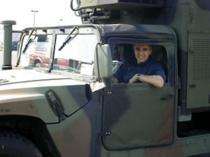
(PhysOrg.com) -- From battlefields to civilian settings, David Stauffer’s combination of weather and technology saves lives. Stauffer, a senior research associate and associate professor of meteorology at Penn State, and his research team helped develop the Meteorological Measuring Set - Profiler (MMS-P). The Profiler is an automated computerized weather forecast system that runs in the back of specially equipped Humvees to provide detailed "nowcast" information to the Army.
Another version of this system has been used to predict the spread of hazards in the air during major civilian events such as Super Bowls and the Torino Winter Olympics, the Beijing Summer Olympics and the Vancouver Winter Olympics. (Stauffer’s paper on the subject can be found at ams.confex.com/ams/pdfpapers/124777.pdf online.)
Using numerical models for weather prediction is common in many professions beyond the evening news and military efforts. Farmers use them to plan harvests, forest rangers to prevent and control wildfires. In summer and winter, utility companies rely on them to prepare for surges in energy use. Grocers increase inventory before snowstorms -- something they couldn’t do without such models. And since the volcanic eruption in Iceland in April, the models have been used by airport traffic control teams in Europe and Asia to monitor volcanic ash cloud movement in the atmosphere and keep aircraft safe.
“There are so many applications of weather,” Stauffer said. “One is the use of weather information on the battlefield.”
For many years, soldiers wetted the tip of their finger to get the general direction of the wind before firing their big guns. Weather balloons, or radiosondes, improved the technology, but if the wind was blowing in the wrong direction, it carried the radiosonde and its weather information away from the skirmish.
“As the balloon ascends, if it blows east and you’re firing west, it might not provide the best information for accuracy,” he said, “and today’s battlefields often include civilians.”
Now, in the age of computers, satellites and mathematical weather models, soldiers have access to richer and more varied information. The problem: boiling all that information down into an efficient and accurate system for the pressure-cooker environment of the battlefield.
Several years ago, the Army wanted a computer weather forecast system that could withstand sand, percussion and other battlefield factors and which could be up and running quickly. Stauffer and his Penn State team demonstrated a prototype version of the system at Fort Belvoir in Virginia, going up against other research teams competing for the MMS-P contract.
Penn State’s version beat out the others, with exceptionally high accuracy in predicting the test weather data and a superior design.
Smiths Detection, which manufactures detection and atmospheric measurement equipment and integrated systems for the military, built the MMS-P to Army specifications. It is designed to operate while the Humvee is moving, and the equipment is shielded against damage from percussion and vibration.
Gordon Wehri, deputy chief of the Target Acquisition Branch at Fort Sill, Okla., referred to the MMS-P as their “crown jewel” during a ceremony at Smiths Detection's Edgewood, Md., office in early May to commemorate the end of its full production cycle. Brigadier Gen. Thomas Cole, program executive officer for the Profiler, singled out Penn State’s role for its research and development of the software used in the system, and that its partnership with Smiths Detection is a fine example of how university research and technology can be transitioned into a successful operational system.
The idea behind the Profiler is simple: Use current and past weather data in a mathematical model to predict the future weather. The math behind it is not.
“Because of what we call the nonlinearities in the mathematics,” Stauffer explained, “we have to take very small time steps into the future, so we are computing the future weather conditions over a three-dimensional grid out to only a few seconds and then using that result to repeat the prediction and extend it further into the future. It’s actually a 'nowcast' keeping up with the clock and providing current detailed battlefield weather conditions. Algorithms were also developed to emulate what a human would do to reduce errors in a forecast while working in a conventional weather station.”
Soldiers decide when to turn the system on. After that, it runs itself, spitting out messages about weather in an approximately 98,000-square-mile area -- roughly the size of Wyoming -- at various levels up to 19 miles high. The grid is segmented into smaller squares -- about 2.5 miles on each side -- of detailed data, and the system updates the information every 15 minutes.
Stauffer and his team of research faculty and graduate students perform traditional basic research while also designing, coding and testing real-time operational weather and hazard prediction systems. The group has created specialized weather-model systems for the United States Marine Corps, the Defense Threat Reduction Agency and private companies.
In addition, Stauffer and his Penn State team conduct basic research in the areas of model development, atmospheric processes, uncertainty quantification, atmospheric transport and dispersion, data assimilation, and air quality, energy and aviation concerns.
Stauffer’s original Penn State Profiler team included Annette Gibbs, Robert Hart, Glenn Hunter, Anthony Schroeder and Nelson Seaman and later included Aijun Deng, Arthur Person, George Young, Jeff Zielonka and Karen Tinklepaugh.
The team continues to research and develop systems for worldwide military-defense applications.
“In today’s world,” Stauffer said, “our high-resolution weather and hazard prediction technologies are providing critical information to protect innocent people who may be in harm’s way.”
Provided by Pennsylvania State University


