Galaxy encounter fires up quasar
Jun 24, 2010
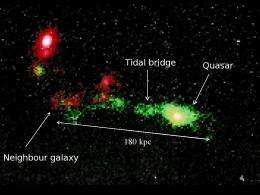
An image of the field around the type 2 quasar SDSS J0123+01 obtained with the OSIRIS tuneable filter on GTC. The red colour shows regions where light is emitted mainly by stars. The green colour shows emission from hot ionized gas. Yellow indicates a mixture of both. The image reveals the existence of a giant nebula of ionized gas which extends for 180 kiloparsecs (590000 light years) or 6 times the size of our galaxy, the Milky Way. The nebula encompasses a bridge of material that connects the quasar physically with the neighbouring galaxy it is interacting with. Credit: Montserrat Villar Martin (IAA-CSIC)

(PhysOrg.com) -- Using two of the world’s largest telescopes, an international team of astronomers have found evidence of a collision between galaxies driving intense activity in a highly luminous quasar. The scientists, led by Montserrat Villar Martin of the Instituto de Astrofisica de Andalucía-CSIC in Spain, used the Very Large Telescope (VLT) in Chile and the Gran Telescopio Canarias (GTC) on La Palma in the Canary Islands, to study activity from the quasar SDSS J0123+00. They publish their work in a paper in the journal Monthly Notices of the Royal Astronomical Society.

Several types of , known as active galaxies, emit enormous amounts of energy from their central region or nucleus, with the most luminous objects known as quasars. Most scientists argue that quasars contain a central black hole, with a mass of at least several million Suns.

The intense gravitational field created by the black hole drags material inexorably inwards. Before falling in, this material settles in an accretion disk where it becomes very hot and emits large amounts of energy responsible for most of the brightness of the quasar. Around the central quasar ‘engine’ is a torus (thick ring) opaque to the visible light emitted by the accretion disk. From a terrestrial perspective, if the torus is face-on then the radiation from the disk can be seen and the system is designated type 1, whereas in type 2 quasars the torus is edge-on and the radiation is concealed.

“Type 2 quasars are a family of still rather unknown galaxies”, explains Montserrat Villar-Martin, who led the research team, “which so far have been investigated mostly from a statistical point of view.

“The goal of our work is to study their individual characteristics in detail. In our study we have obtained some surprising results. For example, we have observed a giant nebula of ionized gas associated with SDSS J0123+00, and signs of an interaction with a nearby galaxy.

“This strengthens the idea that activity in galaxies is partly driven by the exchange of material between the active galaxies (or quasars) and their neighbours”.

Although type 2 are more difficult to detect, they are unique laboratories that let astronomers study the quasar environment in great detail, thanks to the dimming of the central radiation by the surrounding torus.

In the case of SDSS J0123+00, one of the most important results is the discovery of an extended, faint nebula of ionized gas around the entire galaxy. The nebula is about six times larger than our own Milky Way Galaxy and, according to the authors, is probably made of the debris of the interaction between SDSS J0123+00 and its neighbour.

This video is not supported by your browser at this time.

Part of the giant nebula is a bridge of material that connects the two galaxies. This strengthens the hypothesis that the quasar activity is triggered by the interaction between them, producing the accumulation of gas in the galactic central regions and providing material to feed the black hole. This process can also trigger the rapid formation of new stars.

The new results are the first based on images obtained with the tuneable filter of the Optical System for Imaging and low Resolution Integrated Spectroscopy (OSIRIS), the instrument installed on the GTC. The OSIRIS tuneable filter allows astronomers to observe objects in narrow windows across the spectrum of visible light from red to blue, something that with older systems would need more than five thousand narrow band filters.

Explore further: South Africa's new radio telescope reveals giant outbursts from binary star system

More information: The research will appear in a paper in Monthly Notices of the Royal Astronomical Society. A preprint can be seen at es.arxiv.org/abs/1006.1517

Related Stories

Galaxy 'hunting' made easy

Sep 14, 2007

Astronomers using ESO's Very Large Telescope have discovered in a single pass about a dozen otherwise invisible galaxies halfway across the Universe. The discovery, based on a technique that exploits a first-class ...

Chandra finds evidence for quasar ignition

Mar 23, 2006

New data from NASA's Chandra X-ray Observatory may provide clues to how quasars "turn on." Since the discovery of quasars over 40 years ago, astronomers have been trying to understand the conditions surrounding ...

Merging galaxies create a binary quasar (w/ Video)

Feb 03, 2010

Astronomers have found the first clear evidence of a binary quasar within a pair of actively merging galaxies. Quasars are the extremely bright centers of galaxies surrounding super-massive black holes, and ...

Quasar Dust in the Early Universe

Mar 26, 2010

(PhysOrg.com) -- Quasars are galaxies whose very bright cores are thought to contain massive black holes around which disks are actively accreting matter.

Recommended for you

4C+29.30: Black hole powered jets plow into galaxy

May 15, 2013

(Phys.org) —This composite image of a galaxy illustrates how the intense gravity of a supermassive black hole can be tapped to generate immense power. The image contains X-ray data from NASA's Chandra X-ray ...

A space-time magnifying glass

May 15, 2013

(Phys.org) —Bright arcs are smeared around the heart of galaxy cluster Abell S1077 in this image taken by the NASA/ESA Hubble space telescope. The arcs are stretched images of distant galaxies distorted ...

Orion's hidden fiery ribbon

May 15, 2013

(Phys.org) —This dramatic new image of cosmic clouds in the constellation of Orion reveals what seems to be a fiery ribbon in the sky. This orange glow represents faint light coming from grains of cold ...

User comments : 1

Adjust slider to filter visible comments by rank

Display comments: newest first

yyz
4 / 5 (1) Jun 24, 2010
A galaxy-quasar connection for real. At the distance of this system (given as z=0.399), gravitational interactions of this type are fairly common. The distance between the quasar and the galaxy is estimated to be 100,000 parsecs.

More news stories

Chinese, Indian airlines face EU pollution fines

Eight Chinese and two Indian airlines face fines of up to several million euros for not paying for their greenhouse gas emissions during flights within the bloc, the European Commission said on Friday.

Alaska volcano shoots ash 15,000 feet into the air

(AP)—One of Alaska's most restless volcanoes has shot an ash cloud 15,000 feet into the air in an ongoing eruption that has drawn attention from a nearby community but isn't expected to threaten air traffic.

Fracking risks to ground water assessed

(Phys.org) —Extraction of "unconventional" gas from sedimentary rocks such as shale could provide a clean energy source and help some regions to become energy independent, but concerns have been raised ...

Bright explosion on the Moon

For the past 8 years, NASA astronomers have been monitoring the Moon for signs of explosions caused by meteoroids hitting the lunar surface. "Lunar meteor showers" have turned out to be more common than anyone ...

US seizes Bitcoin operator accounts

US authorities seized the accounts of a Bitcoin digital currency exchange operator, claiming it was functioning as an "unlicensed money service business," court documents showed Friday.

Temporal processing in the olfactory system

The neural machinery underlying our olfactory sense continues to be an enigma for neuroscience. A recent review in Neuron seeks to expand traditional ideas about how neurons in the olfactory bulb might encode information about ...