Birds reduce their heating bills in cold climates
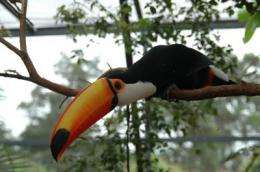
The evolution of bird bills is related to climate according to latest research by the University of Melbourne, Australia and Brock University, Canada.
By examining bill sizes of a diverse range of bird species around the world, researchers have found that birds with larger bills tend to be found in hot environments, whilst birds in colder environments have evolved smaller bills.
The study led by Dr Matt Symonds of the Department of Zoology at the University of Melbourne and Dr Glenn Tattersall of the Department of Biological Sciences at Brock University provides evidence that maintaining body temperature in a bird's natural environment may have shaped the evolution of bird bills.
The size and shape of these distinctive structures are usually explained by their role in feeding and mate attraction. However, previous research shows bird bills have a third, less appreciated function, as organs of heat exchange.
Dr Glenn Tattersall says we know, from our thermal imaging studies that birds like toucans and geese can lose a large amount of their body heat through their bills.
"Unlike humans they don't sweat but can use their bills to help reduce their body temperature if they overheat."
"We then wondered whether this function had evolutionary consequences, and sought to compare bill sizes across a whole range of species," says Dr Tattersall.
The 214 species examined comprised diverse groups including toucans, African barbets and tinkerbirds, Australian parrots, grass finches, Canadian gamebirds, penguins, gulls and terns.
"Across all species, there were strong links between bill length and both latitude, altitude and environmental temperature," Dr Matt Symonds says. "Species that have to deal with colder temperatures have smaller bills."
"This suggests that there is an evolutionary connection between the size of the birds' bills and their role in heat management," he says.
Although it's possible that large bills have evolved to help shed heat loads and prevent overheating in hot climates, we think it's more likely that cold temperatures impose a constraint on the size of bird beaks," Dr Tattersall says.
"It simply might be too much of a liability to carry around a big radiator of heat energy in a cold environment."
The research validates a 133-year-old ecological theory called Allen's rule, which predicts that animal appendages like limbs, ears, and tails are smaller in cold climates in order to minimize heat loss.
Dr Symonds says Allen's rule has never been tested with this large a group of animals and was more anecdotal.
"This is the first rigorous study of its kind to test this theory and to show that bird bills have evolved in this manner."
More information: The paper is published online this week in the journal American Naturalist and will be in the journal's August 2010 edition.
Provided by University of Melbourne


