Hubble captures bubbles and baby stars (w/ Video)
Jun 22, 2010
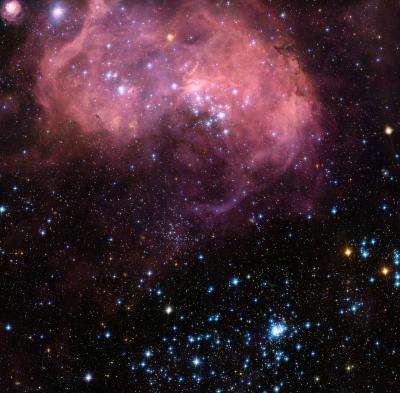
This broad vista of young stars and gas clouds in our neighboring galaxy, the Large Magellanic Cloud, was captured by the NASA/ESA Hubble Space Telescope's Advanced Camera for Surveys. This region is named LHA 120-N 11, informally known as N11, and is one of the most active star formation regions in the nearby Universe. This picture is a mosaic of ACS data from five different positions and covers a region about six arcminutes across. Credit: NASA, ESA and Jesús Maíz Apellániz (Instituto de Astrofísica de Andalucía, Spain)

A spectacular new NASA/ESA Hubble Space Telescope image — one of the largest ever released of a star-forming region — highlights N11, part of a complex network of gas clouds and star clusters within our neighbouring galaxy, the Large Magellanic Cloud. This region of energetic star formation is one of the most active in the nearby Universe.

The contains many bright bubbles of glowing gas. One of the largest and most spectacular has the name LHA 120-N 11, from its listing in a catalogue compiled by the American astronomer and astronaut Karl Henize in 1956, and is informally known as N11. Close up, the billowing pink clouds of glowing gas make N11 resemble a puffy swirl of fairground candy floss.

From further away, its distinctive overall shape led some observers to nickname it the Bean Nebula. The dramatic and colourful features visible in the nebula are the telltale signs of . N11 is a well-studied region that extends over 1000 light-years. It is the second largest star-forming region within the Large Magellanic Cloud and has produced some of the most massive stars known.

It is the process of star formation that gives N11 its distinctive look. Three successive generations of stars, each of which formed further away from the centre of the nebula than the last, have created shells of gas and dust. These shells were blown away from the newborn stars in the turmoil of their energetic birth and early life, creating the ring shapes so prominent in this image.

This video is not supported by your browser at this time.
This zoom sequence begins with a very wide-field view of the southern sky including both the Milky Way and the two Magellanic Clouds. We then close in on a bright region in the outer part of the Large Magellanic Cloud. This is the rich star formation region N11. As the zoom finishes the full majesty of this complex of gas, dust and young stars is revealed in a very detailed picture from the NASA/ESA Hubble Space Telescope. Credit: NASA/ESA, ESO/Digitized Sky Survey 2, Akira Fujii and Eckhard Slawik. Acknowledgment: Davide De Martin

Beans are not the only terrestrial shapes to be found in this spectacular high resolution image from the /ESA . In the upper left is the red bloom of nebula LHA 120-N 11A. Its rose-like petals of gas and dust are illuminated from within, thanks to the radiation from the massive hot stars at its centre. N11A is relatively compact and dense and is the site of the most recent burst of star development in the region.

Other star clusters abound in N11, including NGC 1761 at the bottom of the image, which is a group of massive hot young stars busily pouring intense ultraviolet radiation out into space. Although it is much smaller than our own galaxy, the Large Magellanic Cloud is a very vigorous region of star formation. Studying these stellar nurseries helps astronomers understand a lot more about how stars are born and their ultimate development and lifespan.

Both the Large Magellanic Cloud and its small companion, the Small Magellanic Cloud, are easily seen with the unaided eye and have always been familiar to people living in the southern hemisphere. The credit for bringing these galaxies to the attention of Europeans is usually given to Portuguese explorer Fernando de Magellan and his crew, who viewed it on their 1519 sea voyage. However, the Persian astronomer Abd Al-Rahman Al Sufi and the Italian explorer Amerigo Vespucci recorded the Large Magellanic Cloud in 964 and 1503 respectively.

Explore further: Galaxy's Ring of Fire

Related Stories

Hubble Observes Infant Stars in Nearby Galaxy

Jan 08, 2007

This new image taken with NASA's Hubble Space Telescope depicts bright, blue, newly formed stars that are blowing a cavity in the center of a star-forming region in the Small Magellanic Cloud.

New stars shed light on the past

Jan 08, 2007

This new image taken with the Advanced Camera for Surveys onboard the NASA/ESA Hubble Space Telescope depicts bright blue newly formed stars that are blowing a cavity in the centre of a fascinating star-forming ...

Celestial Season's Greetings from Hubble

Dec 19, 2006

Swirls of gas and dust reside in this ethereal-looking region of star formation imaged by NASA's Hubble Space Telescope. This majestic view, located in the Large Magellanic Cloud (LMC), reveals a region where ...

Wispy Dust and Gas Paint Portrait of Starbirth

Aug 23, 2006

This active region of star formation in the Large Magellanic Cloud (LMC), as photographed by NASA's Hubble Space Telescope, unveils wispy clouds of hydrogen and oxygen that swirl and mix with dust on a canvas ...

Recommended for you

Galaxy's Ring of Fire

May 18, 2013

Johnny Cash may have preferred this galaxy's burning ring of fire to the one he sang about falling into in his popular song. The "starburst ring" seen at center in red and yellow hues is not the product of ...

4C+29.30: Black hole powered jets plow into galaxy

May 15, 2013

(Phys.org) —This composite image of a galaxy illustrates how the intense gravity of a supermassive black hole can be tapped to generate immense power. The image contains X-ray data from NASA's Chandra X-ray ...

A space-time magnifying glass

May 15, 2013

(Phys.org) —Bright arcs are smeared around the heart of galaxy cluster Abell S1077 in this image taken by the NASA/ESA Hubble space telescope. The arcs are stretched images of distant galaxies distorted ...

User comments : 3

Adjust slider to filter visible comments by rank

Display comments: newest first

yyz
5 / 5 (1) Jun 22, 2010
Examining the enlarged image above, I was pleasantly surprised to see a smattering of distant galaxies below and to the lower left of the pink ionized cloud N11. While this nebula lies 180,000 ly from us in the Large Magellanic Cloud, these galaxies are many millions of light years more distant. Also, Bok globules and pillars are easy to spot within N11, all signs of current star formation here.

A 2002 Hubble closeup of the stellar cocoon N11A, "A rose blooming in space", is available here: http://www.spacet...210a.jpg

Simply amazing!
Au-Pu
not rated yet Jun 23, 2010
I was impressed with the effectiveness of the zoom image.
What was very irritating was the constantly appearing black square in the center with its rotating spokes and internal numbers.
Surely it can be eradicated in future images
jsa09
not rated yet Jun 23, 2010
@Au-pu took me a while to figure out what you meant. The problem you had has nothing to do with the zoom at all. The problem you mentioned is entirely related to the speed of the download of the video file.

Once you have watched it once you probably should look at it again and see it without all that browser information letting you know that your computer is awake and not broken.

More news stories

Heat-related deaths in Manhattan projected to rise

Residents of Manhattan will not just sweat harder from rising temperatures in the future, says a new study; many may die. Researchers say deaths linked to warming climate may rise some 20 percent by the 2020s, ...

Mice, gerbils perish in Russia space flight

A number of mice and eight gerbils sent into space in a Russian capsule destined to find out how well organisms can withstand extended flights perished during their journey, scientists said Sunday as the ...

Kinks and curves at the nanoscale

One of the basic principles of nanotechnology is that when you make things extremely small—one nanometer is about five atoms wide, 100,000 times smaller than the diameter of a human hair—they are going ...

Honeybees trained in Croatia to find land mines

(AP)—Mirjana Filipovic is still haunted by the land mine blast that killed her boyfriend and blew off her left leg while on a fishing trip nearly a decade ago. It happened in a field that was supposedly ...