Dinosaur-chewing mammals leave behind oldest known tooth marks
Jun 16, 2010
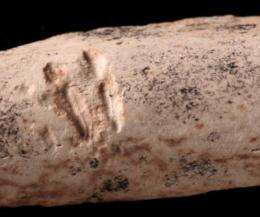
This is a close-up of the tooth marks gouged in the rib bone of a large dinosaur by a mammal that lived 75 million years ago. Credit: Nicholas Longrich/Yale University

Paleontologists have discovered the oldest mammalian tooth marks yet on the bones of ancient animals, including several large dinosaurs. They report their findings in a paper published online June 16 in the journal Paleontology.

Nicholas Longrich of Yale University and Michael J. Ryan of the Cleveland Museum of Natural History came across several of the bones while studying the collections of the University of Alberta Laboratory for Vertebrate and the Royal Tyrrell Museum of Palaeontology. They also found additional bones displaying tooth marks during fieldwork in Alberta, Canada. The bones are all from the Late Cretaceous epoch and date back about 75 million years.

The pair discovered tooth marks on a femur bone from a Champsosaurus, an aquatic reptile that grew up to five feet long; the rib of a dinosaur, most likely a hadrosaurid or ceratopsid; the femur of another large dinosaur that was likely an ornithischian; and a lower from a small marsupial.

The researchers believe the marks were made by mammals because they were created by opposing pairs of teeth—a trait seen only in mammals from that time. They think they were most likely made by multituberculates, an extinct order of archaic mammals that resemble rodents and had paired upper and lower incisors. Several of the bones display multiple, overlapping bites made along the curve of the bone, revealing a pattern similar to the way people eat corn on the cob.

The animals that made the marks were about the size of a squirrel and were most likely gnawing on the bare bones for minerals rather than for meat, said Longrich. "The bones were kind of a nutritional supplement for these animals."

There are likely many other instances of mammalian tooth marks on other bones that have yet to be identified, including older examples, said Longrich. "The marks stood out for me because I remember seeing the gnaw marks on the antlers of a deer my father brought home when I was young," he said. "So when I saw it in the fossils, it was something I paid attention to."

But he points out that the Late Cretaceous creatures that chewed on these bones were not nearly as adept at gnawing as today's rodents, which developed that ability long after dinosaurs went extinct.

Explore further: Actor Johnny Depp immortalized in ancient fossil find

More information: Paper: DOI:10.1111/j.1475-4983.2010.00957.x

Related Stories

Edmonton city site was dinosaur dining room

Jun 29, 2007

A dinosaur bone bed in southwest Edmonton that served as a feeding area for the direct ancestor of Tyrannosaurus rex has revealed that two dinosaurs, thought to have lived in different eras, actually lived ...

Scientists announce new horned dinosaur

May 28, 2010

Michael J. Ryan, Ph.D., a scientist at The Cleveland Museum of Natural History, has announced the discovery of a new horned dinosaur, Medusaceratops lokii. Approximately 20 feet long and weighing more than 2 ...

Fused nasal bones helped tyrannosaurids dismember prey

May 18, 2007

New evidence may help explain the brute strength of the tyrannosaurid, says a University of Alberta researcher whose finding demonstrates how a fused nasal bone helped turn the animal into a "zoological superweapon."

Recommended for you

The eloquence of the otoliths

May 16, 2013

Fish fossils that are about 23 million years old give unprecedented insight into the evolutionary history of the gobioid order, one of the most species-rich groups among the modern bony fishes.

Light cast on lifestyle and diet of first New Zealanders

May 16, 2013

(Phys.org) —A University of Otago-led multidisciplinary team of scientists have shed new light on the diet, lifestyles and movements of the first New Zealanders by analysing isotopes from their bones and teeth.

mtDNA study shows Minoans came from Europe not Africa

May 15, 2013

(Phys.org) —A new study conducted by a team of American and Greek researchers has found that the people of the ancient Minoan civilization living on the island of Crete most likely came from Europe. In ...

User comments : 3

Adjust slider to filter visible comments by rank

Display comments: newest first

kevinrtrs
2 / 5 (3) Jun 17, 2010
Just how does the researcher know that the bite marks are the same age as the bone? Why couldn't the marks have been made much later, seeing that the animal was already dead for some unspecified time?
How would one go about establishing the age of those toothmarks?
Dance
5 / 5 (1) Jun 20, 2010
kevinrtrs says

"How would one go about establishing the age of those toothmarks?"

Indeed monsieur follow up on that thought. How do you suppose one would go about establishing the age of toothmarks on bone? Perhaps there are effects that occur to bone while it is alive that are different from those effects that occur to bone after a creature has died.
Use your brain man and question instead of living locked up in your imagined world.
Ethelred
5 / 5 (1) Jun 23, 2010
Just how does the researcher know that the bite marks are the same age as the bone?


Its a reasonable assumption. Based on the concept that the animals actually had a REASON to chew on the bones. That is, there must have been something edible left to bother with.

Unless of course you are aware of a reason for thinking that the bones where frozen and then thawed millenia later. A group of dinosaurs with large walk in freezers perhaps. Aliens from the Hollow Earth is another possibility.

Ethelred

More news stories

Evolution of lying

(Phys.org) —Ultimately, our ability to convincingly lie to each other may have evolved as a direct result of our cooperative nature.

Bold action, big money needed to curb Asia floods

Asia's flood-prone megacities should fund major drainage, water recycling and waste reduction projects to stem deluges and secure clean supply for their booming populations, experts said Sunday.

Honeybees trained in Croatia to find land mines

(AP)—Mirjana Filipovic is still haunted by the land mine blast that killed her boyfriend and blew off her left leg while on a fishing trip nearly a decade ago. It happened in a field that was supposedly ...

Mice, gerbils perish in Russia space flight

A number of mice and eight gerbils sent into space in a Russian capsule destined to find out how well organisms can withstand extended flights perished during their journey, scientists said Sunday as the ...