A turn-off for cancer: Scientists discover an ancient 'switch' in plants that could halt cancer metastasis
Jun 07, 2010
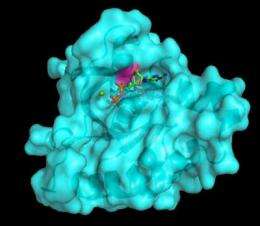
An ROP protein binds to a GDP molecule. The area colored in pink indicates where the fat molecule binds. Credit: AFTAU

Although plants and animals are very different organisms, they share a surprising number of biological mechanisms. A plant biologist at Tel Aviv University says that one of these mechanisms may be the answer for turning off cancer growth in humans.

Prof. Shaul Yalovsky, of the Molecular Biology and Ecology of Plants Department at Tel Aviv University, has identified a "switch" that can turn on cell growth in plants. Now, in a laboratory setting, he can apply the mechanism to reshape cells, grow new tissues, and respond to bacterial or viral invaders.

The switch is actually a fat molecule that modulates a group of proteins called ROPs. Reported in the scientific journal , Prof. Yalovsky's research group, in collaboration with Prof. Yoav Henis and Dr. Joel Hirsch of TAU's Departments of Neurobiology and Biochemistry, has determined that this fat molecule is required for ROP activity. Proteins very similar to ROPs exist in humans and provide chemical signals that tell cancer when to metastasize. Now that they know how to regulate ROPs in plants, the researchers believe they are one step away from turning this ROP-like switch off in humans -- a process which could prevent .

An ancient secret revealed

"We've stumbled upon an ancient mechanism that regulates the function of these proteins, proteins which are found in both plants and humans," says Prof. Yalovsky, explaining that this mechanism already regulates the to pathogen invaders in the human body. ROP-like proteins are also involved in and development of nerve cells in the brain.

"When these proteins are turned 'on,' they can initiate processes like cell division and growth," says Prof. Yalovsky. "Through our , these proteins could be manipulated in humans to speed up tissue healing, or turned off to slow or stop the growth of tumors."

ROPs bind to a small molecule called GTP, which then breaks up into another molecule called GDP. When bound to GDP, ROPs become inactive, a known concept in the plant sciences community. Going one step further, Prof. Yalovsky has created a second type of mutant molecule that prevents ROP proteins from binding to the GTP molecule, creating an inhibitory effect.

A new line of defense

The team's research could also be applied in agriculture to reduce the need for chemical pesticides, they say. The mutant molecule they've devised induces plants to respond as though they are being attacked by pathogens. They then create a biological defense that protects them from infection.

In the research paper, the Tel Aviv University scientists describe how these mutations and mechanisms work, providing a new mechanism to control metastasis in cancer, or stop the deterioration of certain in the brain. And in a broader sense, the researchers have created a long-desired platform to test the function of proteins.

"It is common for plant and animal geneticists to identify proteins, but remain unaware of their functions. We now have a mechanism to test our hypotheses," adds Prof. Yalovsky.

Explore further: Researcher admits mistakes in stem cell study

Related Stories

Protein power for Jack and the beanstalk

May 17, 2010

Plant geneticists are on a determined quest -- to control auxin, a powerful plant growth hormone. Auxin tells plants how to grow, where to lay down roots, how to make tissues, and how to respond to light and gravity. Knowing ...

Researchers root out new and efficient crop plants

Jul 30, 2008

A part of the global food crisis is the inefficiency of current irrigation methods. More irrigated water evaporates than reaches the roots of crops, amounting to an enormous waste of water and energy.

A switch between life and death

Aug 28, 2006

Cells in an embryo divide at an amazing rate to build a whole body, but this growth needs to be controlled. Otherwise the result may be defects in embryonic development or cancer in adults. Controlling growth requires that ...

How plants learned to respond to changing environments

Jul 12, 2007

A team of John Innes centre scientists lead by Professor Nick Harberd have discovered how plants evolved the ability to adapt to changes in climate and environment. Plants adapt their growth, including key steps in their ...

Finding the Achilles' heel of cancer

Dec 10, 2009

A never-approved drug developed to prevent the death of nerve cells after a stroke can efficiently kill cancer cells while keeping normal cells healthy and intact, an international team led by a Tel Aviv University ...

Recommended for you

Researcher admits mistakes in stem cell study

May 23, 2013

A blockbuster study in which US researchers reported that they had turned human skin cells into embryonic stem cells contained errors, its lead author has acknowledged. ...

Scientists discover how rapamycin slows cell growth

May 23, 2013

University of Montreal researchers have discovered a novel molecular mechanism that can potentially slow the progression of some cancers and other diseases of abnormal growth. In the May 23 edition of the prestigious journal ...

Unlocking secrets of cell reproduction

May 23, 2013

Research published in Open Biology today identifies, for the first time, nearly all the genes required for reproduction of a cell in a living organism.

What the smallest infectious agents reveal about evolution

May 22, 2013

Radically different viruses share genes and are likely to share ancestry, according to research published in BioMed Central's open access journal Virology Journal this week. The comprehensive phylogenomic analysis compar ...

User comments : 0

More news stories

EU bans three pesticides harmful to bees

The European Commission said Friday that it will ban for two years beginning in December pesticides blamed for killing the bees that pollinate food and fruit crops.

Yahoo, pay-TV operators among Hulu bidders

Online video site Hulu is again up for sale, with Yahoo and pay TV operators DirecTV and Time Warner Cable among the seven bidders, according to a person with direct knowledge of the matter.

Heart failure accelerates male 'menopause'

Heart failure accelerates the aging process and brings on early andropausal syndrome (AS), according to research presented today at the Heart Failure Congress 2013. AS, also referred to as male 'menopause', was four times ...

Radiation leak at Japan lab; small impact expected

An atomic research lab in northern Japan has reported a radiation leak that may have affected about 50 people, though none were hospitalized and no impact was expected outside the facility, the lab's operator ...