Ecologists Link Early Malnutrition, Later Arthritis in Moose
(PhysOrg.com) -- As a 150-pound person ages, the aches and pains of osteoarthritis -- a degenerative and progressively crippling joint disease -- often become an unpleasant fact of life. Think how the same condition hurts a 1,000-pound moose.
In a report just published in Ecology Letters online, Michigan Technological University wildlife ecologists Rolf O. Peterson and John A.Vucetich; Thomas Drummer a professor of mathematics at Michigan Tech; and colleagues in Minnesota and Ohio describe a link between malnutrition early in a moose’s life and osteoarthritis as the animal ages.
“I’ve long thought that there was a nutritional link to the increase in osteoarthritis in moose on Isle Royale—a wilderness island national park in northwestern Lake Superior—as the population of the animals grew in the 1960s and 1970s,” says Peterson, who hold the Robbins Chair in Sustainable Management of the Environment. He even hypothesized this nutritional link in a paper published in the Journal of Wildlife Diseases in 1988, a paper that the scientist says was largely ignored.
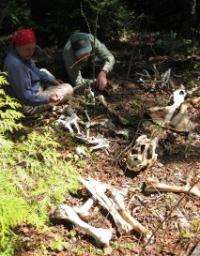
Three generations of wildlife ecologists have been studying the moose of Isle Royale and their primary predators, wolves, for more than 50 years. A key factor in the study has been the discovery and analysis of the bones of moose that die on Isle Royale.
During the first two decades of the study, the scientists found increasing evidence of osteoarthritis in moose bones on Isle Royale, mostly in the animals’ hip joints and lower spine. This type of arthritis is identical to the kind that affects humans and many other mammals.
Unlike the damaged and partial skeletons usually recovered from archeological digs, the bones of moose that die in the wilderness setting of Isle Royale usually reveal details such as gender, age and degree of osteoarthritis. And they often include metatarsal leg bones, which are extremely sensitive to prenatal nutrition.
“After birth, the mass of a moose increases 30-fold, but when a moose is born, the metatarsus is already half grown,” Peterson explains. That gives them a leg up for running fast to escape their predators, the wolves.
Matching the length of a moose’s metatarsal bone with the degree of osteoarthritis found in the hip joints and spine provided Peterson and his team with their best evidence of a nutritional link to osteoarthritis.
They found that the moose with the shortest metatarsal bones—indicating poor early nutrition—were the ones more likely to develop osteoarthritis later in their lives. They also learned that during the years when the moose were most numerous coincided with the highest observed rates of osteoarthritis in moose born during that time. As the moose population declined, improving the availability of adequate nutrition, osteoarthritis declined among the better-nourished moose as they aged.
“This physiological association also has ecological implications,” Peterson wrote. “The debilitating effects of osteoarthritis would inhibit a moose’s ability to kick or dodge a lunging wolf. Consequently, the incidence of osteoarthritis is associated with the rate at which wolves kill moose on Isle Royale.”
The ecologists’ findings on osteoarthritis in the moose of Isle Royale have implications for understanding arthritis in humans, Peterson went on to say. Studies of humans and other animals have increasingly linked many chronic adult diseases with nutritional deficiencies early in life. “Our study suggests the need to consider more carefully whether osteoarthritis is like other late-onset pathologies, including heart disease, diabetes and hypertension, that appear to have risk factors established early in life,” he said. “The apparent link between early nutrition and osteoarthritis indicates that the cause of osteoarthritis is more complex than commonly assumed.”
Provided by Michigan Technological University


