Doping graphene

Jun 01, 2010
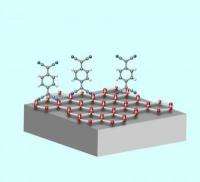
Dopant chemicals adhere to a graphene sheet, modifying its properties for the development of ultra small and fast electronic devices. Credit: American Physical Society

An organic molecule that has been found to be effective in making silicon-based electronics may be viable for building electronics on sheets of carbon only a single molecule thick. Researchers at the Max Planck Institute for Solid State Research in Stuttgart report the advance in a paper appearing online in the journal Physical Review B on June 1.

Ultrathin carbon layers known as show promise as the basis for a host of extremely small and efficient electronic devices. But in order to create a useful component, the electronic properties of materials like silicon or graphene must be tailored through a doping process.

Typically, silicon-based devices are doped by replacing some of the atoms in a silicon crystal with various dopant atoms or molecules . In graphene, on the other hand, dopants are generally deposited on top of the carbon sheet rather than taking the place of some of the . Materials such as gold, bismuth and have been used to dope graphene with varying degrees of success.

Now, Max Planck Institute researchers have found that the compound F4-TCNQ (tetrafluoro-tetracyanoquinodimethane), which has been proven effective for producing LEDs in silicon, seems to fit the bill for graphene as well. F4-TCNQ forms stable layers on graphene that are fairly robust under exposure to elevated levels of heat and light, and can control graphene electrical properties in ways that suggest it may be a good dopant choice.

In a Viewpoint article in the current issue of APS Physics, Alexei Fedorov of the Lawrence Berkeley National Laboratory describes the challenges of creating electronic devices built of graphene and recent attempts to identify doping materials to do the job.

Explore further: Hybrid material as gold-leaf substitute

More information: Charge neutrality and band-gap tuning of epitaxial graphene on SiC by molecular doping, C. Coletti, C. Riedl, D. S. Lee, B. Krauss, L. Patthey, K. von Klitzing, J. H. Smet, and U. Starke, Phys. Rev. B 81, 235401 (2010) - Published June 01, 2010, Download PDF (free)

Provided by American Physical Society

5 /5 (6 votes)

Related Stories

Producing graphene layers using crystallization

Mar 02, 2010

(PhysOrg.com) -- Ever since it's relatively recent discovery, graphene has generated a great deal of interest. Graphene is extracted from graphite in many cases, and consists of a sheet of carbon atoms bound together in a ...

Seeing Moire in Graphene

Apr 27, 2010

(PhysOrg.com) -- Researchers at the National Institute of Standards and Technology and the Georgia Institute of Technology have demonstrated that atomic scale moiré patterns, an interference pattern ...

A huge step toward mass production of graphene

Mar 10, 2010

Scientists have leaped over a major hurdle in efforts to begin commercial production of a form of carbon that could rival silicon in its potential for revolutionizing electronics devices ranging from supercomputers ...

AMO Manufactures First Graphene Transistors

Feb 08, 2007

In the scope of his innovative project ALEGRA the AMO nanoelectronics group of Dr. Max Lemme was able to manufacture top-gated transistor-like field-effect devices from monolayer graphene.

Recommended for you

Hybrid material as gold-leaf substitute

Jun 18, 2013

(Phys.org) —A team of researchers headed by Professor Raffaele Mezzenga has created a hybrid material out of gold and milk proteins that looks like a wafer-thin gold leaf. Thanks to its properties, it could ...

Antioxidant with a long shelf life

Jun 17, 2013

(Phys.org) —Scientists from ETH Zurich have developed a nanomaterial that protects other molecules from oxidation. Unlike many such active substances in the past, the ETH-Zurich researchers' antioxidant ...

Fast pollutant degradation by nanosheets

Jun 17, 2013

(Phys.org) —Waste from textile and paint industries often contains organic dyes such as methylene blue as pollutants. Photocatalysis is an efficient means of reducing such pollution, and molybdenum trioxide ...

Unzipped nanotubes unlock potential for batteries

Jun 13, 2013

(Phys.org) —Researchers at Rice University have come up with a new way to boost the efficiency of the ubiquitous lithium ion (LI) battery by employing ribbons of graphene that start as carbon nanotubes.

Nanoparticle opens the door to clean-energy alternatives

Jun 13, 2013

(Phys.org) —Cheaper clean-energy technologies could be made possible thanks to a new discovery. Research team members led by Raymond Schaak, a professor of chemistry at Penn State University, have found ...

User comments : 1

Adjust slider to filter visible comments by rank

Display comments: newest first

Quantum_Conundrum
5 / 5 (1) Jun 01, 2010
Weeee...

I'm all for 100 core, 100ghz processors in our PCs.

Woot!

More news stories

Sound waves precisely position nanowires

(Phys.org) —The smaller components become, the more difficult it is to create patterns in an economical and reproducible way, according to an interdisciplinary team of Penn State researchers who, using ...

Hybrid nanostructures: Getting to the core

Material scientists expect the new multifunctional properties of hybrid nanostructures will transform the development of high-performance devices, including batteries, high-sensitivity sensors and solar cells. ...