Small but super: Lightweight, handy magnets for portable NMR spectrometers
May 31, 2010

(PhysOrg.com) -- High-resolution nuclear magnetic resonance (NMR) spectrometry is one of the most powerful analytical tools for the precise determination of molecular structures and dynamics. To attain a high resolution, very strong magnetic fields are required, which are produced by superconducting electromagnets.

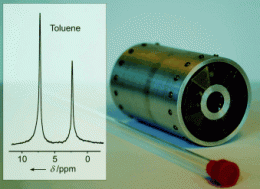
Federico Casanova and his co-workers at the RWTH In Aachen (Germany) have now developed a light, that is suitable for NMR and fits in the palm of your hand. As the researchers report in the journal , this could represent the cornerstone for portable, high-resolution NMR instruments.

In the 1960s and 1970s, NMR spectrometers used permanent magnets, which were not as massive as the superconducting magnets used today. With modern, improved permanent magnets, it should theoretically be possible to build handy, robust devices. This would make it possible to obtain NMR spectra that are about a third as sensitive as those obtained with standard-sized superconducting magnets. “This would be an acceptable concession for a small and portable NMR system,” says Casanova. “However, there is one problem: As the magnet gets smaller, the dimensions of the homogenous (uniform) also decrease, making the sample volume smaller. Reduction of the sample volume affects the signal-to-noise ratio.”

The Aachen team has now developed a small permanent magnet weighing only 500 g with an unusually homogenous magnetic field that allows a standard-sized NMR tube to be used. Their success is due to a Halbach array: individual magnetic blocks are assembled into a cylinder so that the direction of their magnetization is tuned to produce an especially homogenous field within the cylinder.

The researchers connect three Halbach rings whose diameter is optimized to compensate for the distortion of the magnetic field at the ends of the cylindrical inner chamber. In this way a sufficiently large homogenous magnetic field is produced inside the cylinder, which is large enough for a standard NMR tube. To even out the inhomogeneities originating from the granularity of the magnetic material, each ring consists of trapezoidal magnetic blocks with gaps in between. Inside the gaps are rectangular magnetic blocks that can be displaced radially to mechanically adjust (“shim”) the magnetic field.

“Spectra we obtained show that our miniature magnet is suitable for high-resolution NMR spectroscopy with standard-sized sample tubes,” reports Casanova. “It would be easy to transport together with the spectrometer. This could allow high-resolution NMR spectroscopy to develop into a portable analytical technique for use on samples in the field.”

Explore further: Method developed for adding omega-3 fatty acids to foods

More information: Federico Casanova, et al. Small Magnets for Portable NMR Spectrometers, Angewandte Chemie International Edition 2010, 49, No. 24, 4133-4135, dx.doi.org/10.1002/anie.201000221

Related Stories

Portable High-Resolution NMR Sensor Unveiled

Apr 11, 2005

Homeland security experts may soon be getting a valuable new tool for identifying the chemical constituents in suspicious substances. A portable device makes it possible for the first time ever to take high-resolution ...

Magnetic Resonance Now Also Comes In Tiny Quantities

Sep 29, 2009

(PhysOrg.com) -- It is now possible to analyse very small samples using Nuclear Magnetic Resonance. Thanks to a specially constructed detector, a 'stripline', greater sensitivity can be achieved while maintaining the same ...

Pocket-sized magnetic resonance imaging

Jul 01, 2008

The term “MRI scan” brings to mind the gigantic, expensive machines that are installed in hospitals. But research scientists have now developed small portable MRI scanners that perform their services in ...

'NMR on a chip' features magnetic mini-sensor

Feb 19, 2008

A super-sensitive mini-sensor developed at the National Institute of Standards and Technology can detect nuclear magnetic resonance (NMR) in tiny samples of fluids flowing through a novel microchip. The prototype ...

Recommended for you

New method for producing clean hydrogen

11 hours ago

Duke University engineers have developed a novel method for producing clean hydrogen, which could prove essential to weaning society off of fossil fuels and their environmental implications.

Making ice-cream more nutritious with meat left-overs

19 hours ago

Food industries are now turning meat left-over into high-protein content ingredients for food supplements, or to be added to processed food. But a EU-wide regulation covering them is still lacking.

Non-wetting fabric drains sweat

May 20, 2013

(Phys.org) —Waterproof fabrics that whisk away sweat could be the latest application of microfluidic technology developed by bioengineers at the University of California, Davis.

Protein study suggests drug side effects are inevitable

May 20, 2013

A new study of both computer-created and natural proteins suggests that the number of unique pockets – sites where small molecule pharmaceutical compounds can bind to proteins – is surprisingly small, meaning drug side ...

Attacking MRSA with metals from antibacterial clays

May 17, 2013

In the race to protect society from infectious microbes, the bugs are outrunning us. The need for new therapeutic agents is acute, given the emergence of novel pathogens as well as old foes bearing heightened antibiotic resistance.

User comments : 2

Adjust slider to filter visible comments by rank

Display comments: newest first

maxcypher
not rated yet May 31, 2010
How much do the permanent magnets in standard NMR spectrometers weigh?
wolfkeeper
not rated yet May 31, 2010
How much do the permanent magnets in standard NMR spectrometers weigh?


They don't have permanent magnets for this at the moment. They have to use superconducting magnets. They're a bit of a pain.

More news stories

New method for producing clean hydrogen

Duke University engineers have developed a novel method for producing clean hydrogen, which could prove essential to weaning society off of fossil fuels and their environmental implications.

Protein study suggests drug side effects are inevitable

A new study of both computer-created and natural proteins suggests that the number of unique pockets – sites where small molecule pharmaceutical compounds can bind to proteins – is surprisingly small, meaning drug side ...

Beautiful 'flowers' self-assemble in a beaker

By simply manipulating chemical gradients in a beaker of fluid, materials scientists at Harvard have found that they can control the growth behavior of crystals to create precisely tailored structures—such ...

Attacking MRSA with metals from antibacterial clays

In the race to protect society from infectious microbes, the bugs are outrunning us. The need for new therapeutic agents is acute, given the emergence of novel pathogens as well as old foes bearing heightened antibiotic resistance.

If you can remember it, you can remember it wrong

(Medical Xpress)—Native peoples in regions where cameras are uncommon sometimes react with caution when their picture is taken. The fear that something must have been stolen from them to create the photo ...

Encouraging signs for bee biodiversity

Declines in the biodiversity of pollinating insects and wild plants have slowed in recent years, according to a new study. Researchers led by the University of Leeds and the Naturalis Biodiversity Centre in the Netherlands ...

B vitamins could delay dementia

(Medical Xpress)—Despite spending billions of dollars on research and development, drug companies have been unable to come up with effective treatments for dementia and Alzheimer's Disease (AD). Now, A. ...