Small Near-Earth Object Probably a Rocket Part
May 28, 2010
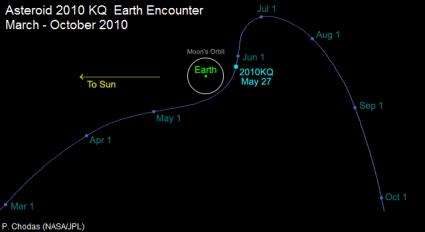
Graphic depicting the trajectory of near-Earth object 2010 KQ. Image credit: NASA/JPL

(PhysOrg.com) -- Scientists at NASA's Near-Earth Object Program Office at NASA's Jet Propulsion Laboratory in Pasadena, Calif., have determined that a small object that safely passed Earth on May 21 is more than likely an upper-stage of a rocket that carried a spacecraft on an interplanetary trajectory.

"The of this object is very similar to that of the Earth, and one would not expect an object to remain in this type of orbit for very long," said Paul Chodas, a scientist at NASA's Program Office at the Jet Propulsion Laboratory in Pasadena, Calif.

Observations by astronomer S.J. Bus, using the NASA-sponsored Infrared Telescope Facility in Mauna Kea, Hawaii, indicate that 2010 KQ's spectral characteristics do not match any of the known types, and the object's absolute magnitude (28.9) suggests it is only a few meters in size.

2010 KQ was discovered by Richard Kowalski at the NASA-sponsored Catalina Sky Survey in the mountains just north of Tucson, Ariz., on May 16. Five days later, it made its closest approach to Earth at a distance just beyond the moon's orbit. The object is departing Earth's neighborhood but will be returning in 2036.

"At present, there is a 6 percent probability that 2010 KQ will enter our atmosphere over a 30-year period starting in 2036," said Chodas. "More than likely, additional observations of the object will refine its orbit and impact possibilities. Even in the unlikely event that this object is headed for impact with Earth, whether it is an asteroid or rocket body, it is so small that it would disintegrate in the atmosphere and not cause harm on the ground."

detects, tracks and characterizes asteroids and comets passing close to using both ground- and space-based telescopes. The Near-Earth Object Observations Program, commonly called "Spaceguard," discovers these objects, characterizes a subset of them, and plots their orbits to determine if any could be potentially hazardous to our planet.

Explore further: NASA's STEREO detects a CME from the sun

Related Stories

Asteroid to Make Rare Close Flyby of Earth

Jan 24, 2008

Scientists are monitoring the orbit of asteroid 2007 TU24. The asteroid, believed to be between 150 meters (500 feet) and 610 meters (2,000 feet) in size, is expected to fly past Earth on Jan. 29, with its ...

NASA Statement on Student Asteroid Calculations

Apr 17, 2008

The Near-Earth Object Program Office at NASA's Jet Propulsion Laboratory in Pasadena, Calif., has not changed its current estimates for the very low probability (1 in 45,000) of an Earth impact by the asteroid ...

Radar Clicks Asteroid's Pic

Apr 30, 2010

(PhysOrg.com) -- Near-Earth asteroid 2005 YU55 was "imaged" by the Arecibo Radar Telescope in Puerto Rico on April 19. Data collected during Arecibo's observation of 2005 YU55 allowed the Near-Earth Object ...

NASA Refines Asteroid Apophis' Path Toward Earth

Oct 07, 2009

(PhysOrg.com) -- Using updated information, NASA scientists have recalculated the path of a large asteroid. The refined path indicates a significantly reduced likelihood of a hazardous encounter with Earth ...

NASA Scientists Get First Images of Earth Flyby Asteroid

Jan 28, 2008

Scientists at NASA's Jet Propulsion Laboratory in Pasadena, Calif., have obtained the first images of asteroid 2007 TU24 using high-resolution radar data. The data indicate the asteroid is somewhat asymmetrical ...

Recommended for you

NASA's STEREO detects a CME from the sun

10 hours ago

On 5:24 a.m. EDT on May 17, 2013, the sun erupted with an Earth-directed coronal mass ejection or CME, a solar phenomenon that can send billions of tons of solar particles into space that can reach Earth ...

Nine-year-old Mars rover passes 40-year-old record

18 hours ago

While Apollo 17 astronauts Eugene Cernan and Harrison Schmitt visited Earth's moon for three days in December 1972, they drove their mission's Lunar Roving Vehicle 19.3 nautical miles (22.210 statute miles ...

Bright explosion on the Moon

19 hours ago

For the past 8 years, NASA astronomers have been monitoring the Moon for signs of explosions caused by meteoroids hitting the lunar surface. "Lunar meteor showers" have turned out to be more common than anyone ...

User comments : 1

Adjust slider to filter visible comments by rank

Display comments: newest first

yyz
5 / 5 (1) May 28, 2010
Spectra of this object is consistent with UV-aged titanium dioxide paint. A possible ID as the fourth stage of the Russian Proton rocket that launched Luna 23 has been made. More details here: http://lcogt.net/...tted-ftn

More news stories

Chinese, Indian airlines face EU pollution fines

Eight Chinese and two Indian airlines face fines of up to several million euros for not paying for their greenhouse gas emissions during flights within the bloc, the European Commission said on Friday.

Alaska volcano shoots ash 15,000 feet into the air

(AP)—One of Alaska's most restless volcanoes has shot an ash cloud 15,000 feet into the air in an ongoing eruption that has drawn attention from a nearby community but isn't expected to threaten air traffic.

Fracking risks to ground water assessed

(Phys.org) —Extraction of "unconventional" gas from sedimentary rocks such as shale could provide a clean energy source and help some regions to become energy independent, but concerns have been raised ...

Bright explosion on the Moon

For the past 8 years, NASA astronomers have been monitoring the Moon for signs of explosions caused by meteoroids hitting the lunar surface. "Lunar meteor showers" have turned out to be more common than anyone ...

Earth's iron core is surprisingly weak, researchers say

The massive ball of iron sitting at the center of Earth is not quite as "rock-solid" as has been thought, say two Stanford mineral physicists. By conducting experiments that simulate the immense pressures deep in the planet's ...

US seizes Bitcoin operator accounts

US authorities seized the accounts of a Bitcoin digital currency exchange operator, claiming it was functioning as an "unlicensed money service business," court documents showed Friday.