Astronomers Discover Clue to Origin of Milky Way Gas Clouds
May 26, 2010
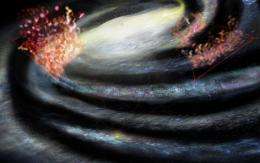
Artist's conception shows Milky Way regions studied, with hydrogen clouds more abundant in region above area where central bar merges with spiral arm. Bright point at bottom center is location of our Solar System. CREDIT:Bill Saxton, NRAO/AUI/NSF

A surprising discovery that hydrogen gas clouds found in abundance in and above our Milky Way Galaxy have preferred locations has given astronomers a key clue about the origin of such clouds, which play an important part in galaxy evolution.

"We've concluded that these clouds are gas that has been blown away from the Galaxy's plane by supernova explosions and the fierce winds from young stars in areas of intense ," said H. Alyson Ford of the University of Michigan, whose Ph.D thesis research from Swinburne University formed the basis for this result. The team, consisting of Ford and collaborators Felix J. Lockman, of the National Radio Astronomy Observatory (NRAO), and Naomi Mclure-Griffiths of CSIRO Astronomy and Space Science, presented their findings to the American Astronomical Society's meeting in Miami, Florida.

The astronomers studied in two distinct regions of the Galaxy. The clouds they studied are between 400 and 15,000 light-years outside the disk-like plane of the Galaxy. The disk contains most of the Galaxy's stars and gas, and is surrounded by a "halo" of gas more distant than the clouds the astronomers studied.

"These clouds were first detected with the National Science Foundation's Robert C. Byrd Green Bank Telescope, and are quite puzzling. They are in a transitional area between the disk and the halo, and their origin has been uncertain," Lockman explained. The research team used data from the Galactic All-Sky Survey, made with CSIOR's Parkes radio telescope in Australia.

When the astronomers compared the observations of the two regions, they saw that one region contained three times as many hydrogen clouds as the other. In addition, that region's clouds are, on average, twice as far above the Galaxy's plane.

The dramatic difference, they believe, is because the region with more clouds lies near the tip of the Galaxy's central "bar," where the bar merges with a major spiral arm. This is an area of intense star formation, containing many young stars whose strong winds can propel gas away from the region. The most massive stars also will explode as supernovae, blasting material outward. In the other region they studied, star formation activity is more sparse.

"The properties of these clouds show clearly that they originated as part of the Milky Way's disk, and are a major component of our Galaxy. Understanding these clouds is important in understanding how material moves between the Galaxy's disk and its halo, a critical process in the evolution of ," Lockman said.

The clouds consist of neutral , with an average mass equal to that of about 700 Suns. Their sizes vary greatly, but most are about 200 light-years across. The astronomers studied about 650 such clouds in the two widely-separated regions of the Galaxy.

Explore further: Hubble reveals the ring nebula's true shape

add to favorites email to friend print save as pdf

Related Stories

New Hydrogen Clouds in the M81 Group of Galaxies

Jan 10, 2008

A composite radio-optical image shows five new clouds of hydrogen gas discovered using the National Science Foundation's Robert C. Byrd Green Bank Telescope (GBT). The spiral galaxy M81 and its satellite, ...

Huge 'Superbubble' of Gas Blowing Out of Milky Way

Jan 13, 2006

Astronomers using the National Science Foundation's Robert C. Byrd Green Bank Telescope (GBT) in West Virginia have discovered a huge "superbubble" of hydrogen gas rising nearly 10,000 light-years above the ...

Chandra Peers at Cosmic Super Bubbles

Aug 31, 2007

Using the Chandra X-ray Observatory, astronomers explored a particular region of clouds and gas where stars are forming in one of the Milky Way's closest galactic neighbors.

No stars in the clouds

Jan 10, 2006

A team of astronomers from the University of Pittsburgh and the Universitäts-Sternwarte München in Munich, Germany, announced today in a paper presented at the meeting of the American Astronomical Society in Washington, ...

Smoking galaxy revealed

Mar 17, 2006

Where there's smoke, there's fire - even in outer space. A new infrared image from NASA's Spitzer Space Telescope shows a burning hot galaxy whose fiery stars appear to be blowing out giant billows of smoky ...

Amazing Andromeda Galaxy

Oct 03, 2006

The many "personalities" of our great galactic neighbor, the Andromeda galaxy, are exposed in this new composite image from NASA's Galaxy Evolution Explorer and the Spitzer Space Telescope.

Recommended for you

Hubble reveals the ring nebula's true shape

20 hours ago

(Phys.org) —The Ring Nebula's distinctive shape makes it a popular illustration for astronomy books. But new observations by NASA's Hubble Space Telescope of the glowing gas shroud around an old, dying, ...

A hidden population of exotic neutron stars

May 23, 2013

(Phys.org) —Magnetars – the dense remains of dead stars that erupt sporadically with bursts of high-energy radiation - are some of the most extreme objects known in the Universe. A major campaign using ...

User comments : 1

Adjust slider to filter visible comments by rank

Display comments: newest first

yyz
5 / 5 (2) May 26, 2010
Many spiral galaxies highly inclined to our line of sight (so-called edge-on galaxies) also exhibit gas clouds lying above and below the disk component. Supernovae and intense star formation have been proposed as the mechanism that drives this gas into galactic haloes, which then eventually fall back towards the disk and adds to the mixing of 'metals' in the interstellar medium. This current study of extraplanar gas clouds in the Milky Way helps strengthen the association of these clouds with supernovae/star-forming regions in all disk galaxies.

More news stories

Dark, massive asteroid to fly by Earth on May 31

It's 1.7 miles long. Its surface is covered in a sticky black substance similar to the gunk at the bottom of a barbecue. If it impacted Earth it would probably result in global extinction. Good thing it is ...

Source of life running out: water scientists

The majority of people on Earth people will face severe water shortages within a generation or two if pollution and waste continues unabated, scientists warned at a conference in Bonn Friday.

ACOG: Hormone therapy not recommended to prevent CHD

(HealthDay)—Menopausal hormone therapy should not be used for prevention of coronary heart disease, according to a Committee Opinion from the American College of Obstetricians and Gynecologists (ACOG) published ...

Storm chasers: born to be wild?

(HealthDay)—We've all seen them: the surfers who race to the beach when a hurricane hits, the guy who decides to ride out the storm in his overmatched boat, the tornado chasers who fearlessly steer their ...