The Far Infrared Galaxy
May 24, 2010
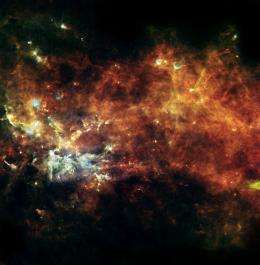
A Herschel false three-color image (blue=70 microns, green=160 microns, red=250 microns) of a region of the Milky Way galaxy with a giant stellar nursery in constellation of Vulpecula. Launched one year ago, Herschel's first results were announced last week, and the corresponding papers released to a forthcoming special issue of the journal Astronomy and Astrophysics. Credit: ESA, NASA, and the Herschel HiGal Team

(PhysOrg.com) -- Our Milky Way galaxy, like other spiral galaxies, has copious amounts of dust in its spiral arms. The dust absorbs starlight, thereby blocking our optical views, but at the same time it re-radiates the absorbed energy at far-infrared wavelengths.

One consequence is that, ironically, the many stellar birthplaces found in molecular clouds throughout the galaxy have rarely been studied at the wavelengths where the dust emits at its brightest.

The Herschel is a 3.5-meter, cryogenically cooled orbiting telescope, launched last year, with cameras and spectrometers that cover the full far infrared electromagnetic band -- the four octaves of light from the short wavelength infrared just longward of the visible to the submillimeter. Several satellite observatories over the past few decades have successfully begun to probe this mysterious range, but all have lacked Herschel's large collecting area, complete wavelength coverage, and a full complement of instruments, leaving many questions unanswered.

Last week the journal accepted for publication an entire issue's worth of papers with the first results from Herschel, with papers co-authored by CfA astronomers Joe Hora, Tim van Kampen, Eric Keto, Gary Melnick, Phil Myers, Tom Robitaille, Howard Smith, Tony Stark, Volker Tolls, and Qizhou Zhang. We reported on extragalactic results last week. Here we cite one set of papers about our own galaxy, the first results from a complete far-infrared map of the plane of the central third of the Milky Way. The images obtained so far from this study have revealed for the first time massive clouds of very cold dust and gas (only tens of degrees kelvin above absolute zero), apparently nurturing the very earliest embryos of future stars.

Explore further: South Africa's new radio telescope reveals giant outbursts from binary star system

add to favorites email to friend print save as pdf

Related Stories

Seeing the Invisible

May 17, 2010

(PhysOrg.com) -- Astronomers, like physicians, use as much of the electromagnetic spectrum as they can, from X-ray to radio wavelengths, to examine their subjects the with the most suitable diagnostics.

Astrophysicists map the Milky Way's 4 spiral arms

Jan 05, 2009

Iowa State University's Martin Pohl is part of a research team that has developed the first complete map of the Milky Way galaxy's spiral arms. The map shows the inner part of the Milky Way has two prominent, symmetric spiral ...

Herschel Opens Its Infrared Eyes

Jun 29, 2009

(PhysOrg.com) -- The Herschel Space Observatory has snapped its first picture since blasting into space on May 14, 2009. The mission, led by the European Space Agency with important participation from NASA, ...

Hiding Out Behind the Milky Way

Apr 07, 2010

(PhysOrg.com) -- A leggy cosmic creature comes out of hiding in this new infrared view from NASA's Wide-field Infrared Survey Explorer, or WISE.

Akari's observations of galaxy M101

Sep 07, 2007

M101 is a spiral galaxy, 170 000 light-years in diameter. AKARI’s new observations reveal differing populations of stars spread across its spiral arms.

Galactic survey reveals a new look for the Milky Way

Aug 16, 2005

The Milky Way, it turns out, is no ordinary spiral galaxy. According to a massive new survey of stars at the heart of the galaxy by Wisconsin astronomers, including professor of astonomy Edward Churchwell and professor of ...

Recommended for you

Galaxy's Ring of Fire

2 hours ago

Johnny Cash may have preferred this galaxy's burning ring of fire to the one he sang about falling into in his popular song. The "starburst ring" seen at center in red and yellow hues is not the product of ...

4C+29.30: Black hole powered jets plow into galaxy

May 15, 2013

(Phys.org) —This composite image of a galaxy illustrates how the intense gravity of a supermassive black hole can be tapped to generate immense power. The image contains X-ray data from NASA's Chandra X-ray ...

A space-time magnifying glass

May 15, 2013

(Phys.org) —Bright arcs are smeared around the heart of galaxy cluster Abell S1077 in this image taken by the NASA/ESA Hubble space telescope. The arcs are stretched images of distant galaxies distorted ...

User comments : 0

More news stories

Galaxy's Ring of Fire

Johnny Cash may have preferred this galaxy's burning ring of fire to the one he sang about falling into in his popular song. The "starburst ring" seen at center in red and yellow hues is not the product of ...

Alaska volcano shoots ash 15,000 feet into the air

(AP)—One of Alaska's most restless volcanoes has shot an ash cloud 15,000 feet into the air in an ongoing eruption that has drawn attention from a nearby community but isn't expected to threaten air traffic.

Chinese, Indian airlines face EU pollution fines

Eight Chinese and two Indian airlines face fines of up to several million euros for not paying for their greenhouse gas emissions during flights within the bloc, the European Commission said on Friday.

US psychiatry gets makeover in new manual

The latest makeover to a massive psychiatric tome honored by some, reviled by others and even called the "Bible" of mental disorders is being released Saturday with a host of new changes.

Morocco to harness the wind in energy hunt

Morocco is ploughing ahead with a programme to boost wind energy production, particularly in the southern Tarfaya region, where Africa's largest wind farm is set to open in 2014.