New method to make gallium arsenide solar cells
May 20, 2010 by Lin Edwards report
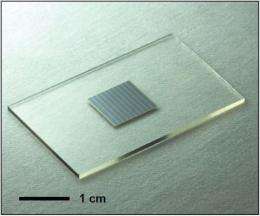
Image of a printed GaAs solar cell with a size ~10 x 10 mm2 on a glass substrate, with simple, metal grid contacts. Image copyright: Nature, DOI:doi:10.1038/nature09054

(PhysOrg.com) -- A new "transfer-printing" method of making light-sensitive semiconductors could make solar cells, night-vision cameras, and a range of other devices much more efficient, and could transform the solar industry.

Scientists at the University of Illinois at Urbana-Champaign have developed a new and cheaper way of producing microchips of (GaAs), a compound semiconductor that responds to light. Gallium arsenide is about twice as effective as silicon in converting incident solar radiation to light, with a theoretical conversion rate of up to 40 percent, and has for that reason been used in solar cells in space crafts.

The problem with GaAs is its expense and the need for wafers to be grown in precisely controlled conditions. The wafers are sliced for use, but only the surfaces are used and the rest is essentially wasted. Now the Illinois research team, led by materials scientist John Rogers, has developed an alternative and potentially much more cost-effective technique involving growing stacks of layers of GaAs alternating with aluminum arsenide (AlAs).

When the stack is complete, the scientists then chemically etch away the AlAs layers using hydrofluoric acid, leaving the films of GaAs, which they then peel off and stamp onto another substrate such as glass, silicon, or plastic using a silicon-based soft rubber stamp. Rogers and his colleagues have been working on perfecting the technique for around ten years.
Semiconductor manufacturing technique holds promise for solar energy
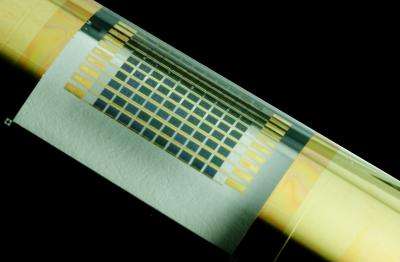
This is a flexible array of gallium arsenide solar cells. Gallium arsenide and other compound semiconductors are more efficient than the more commonly used silicon. Credit: John Rogers

They have learned that if they press the stamp on the stack and lift it quickly it picks up only the top film. They then transfer the GaAs to the substrate by stamping it onto the surface and peeling the stamp back slowly. They could then build the devices such as , semiconductor field effect transistors and , and near-infrared imaging devices on the substrates. The method yields large quantities of high quality GaAs films, leaving the original wafer for reuse to grow more films.

Using their technique, which is described in the journal Nature, the researchers succeeded in mass-producing tiny solar cells about 500 micrometers in diameter, and they also produced components for mobile phones and infrared-imaging devices.

Rogers said GaAs has a great deal of potential in the future, and the team is now developing commercially viable that will be able to generate electricity for about $1 per watt.
Semiconductor manufacturing technique holds promise for solar energy
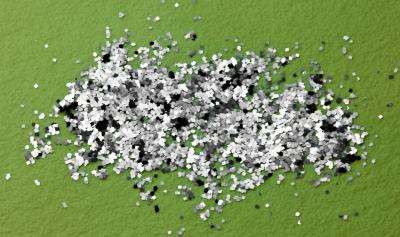
A pile of gallium arsenide solar cells is manufactured in stacks and then peeled apart layer by layer. They can be integrated into a number of electronic devices. Credit: John Rogers


Explore further: Atomic-scale investigations solve key puzzle of LED efficiency

More information: Jongseung Yoon, GaAs photovoltaics and optoelectronics using releasable multilayer epitaxial assemblies, Nature, Volume: 465, Pages: 329-333, Date published: 20 May 2010, DOI:doi:10.1038/nature09054

Related Stories

Photoluminescence in nano-needles

Apr 22, 2008

Silicon is the workhorse among semiconductors in electronics. But in opto-electronics, where light signals are processed along with electronic signals, a semiconductor that is capable of emitting light is needed, which silicon ...

Recommended for you

Promising doped zirconia

May 17, 2013

Materials belonging to the family of dilute magnetic oxides (DMOs)—an oxide-based variant of the dilute magnetic semiconductors—are good candidates for spintronics applications. This is the object of ...

Nanocrystals grow from liquid interface

May 17, 2013

An international collaboration of scientists has discovered a unique crystalizing behavior at the interface between two immiscible liquids that could aid in sustainable energy development.

User comments : 4

Adjust slider to filter visible comments by rank

Display comments: newest first

akotlar
5 / 5 (2) May 20, 2010
I knew when I clicked on it that the article would have nothing to do with solar cell production because this is PhysOrg.

I don't understand you would choose a title that intimates an article about some novel production of gallium arsenide solar cells when the article is actually speaking to gallium arsenide production.

How about "New method to make gallium arsenide supercomputers on a chip!" makes as much sense.
Scientifica
1 / 5 (1) May 20, 2010
I love solar power. Saves so much on the electric bill!
Jimee
2 / 5 (2) May 20, 2010
Given the inaccurate journalism, this approach does look promising.
Alizee
1 / 5 (1) May 23, 2010
I don't understand you would choose a title that intimates an article about some novel production of gallium arsenide solar cells when the article is actually speaking to gallium arsenide production.
I don't understand your lack of understanding, if the whole article is about production of GaAs solar cells including pictures.

More news stories

A quantum simulator for magnetic materials

Physicists understand perfectly well why a fridge magnet sticks to certain metallic surfaces. But there are more exotic forms of magnetism whose properties remain unclear, despite decades of intense research. ...

Engineers pioneer flat spray-on optical lens

A University of British Columbia engineer and a team of U.S. researchers have made a breakthrough utilizing spray-on technology that could revolutionize the way optical lenses are made and used.

Researchers forward quest for quantum computing

Research teams from UW-Milwaukee and the University of York investigating the properties of ultra-thin films of new materials are helping bring quantum computing one step closer to reality.

How do cold ions slide

Things not always run smoothly. It may happen, actually, that when an object slides on another, the advancement may occur through a 'stop and go' series in the characteristic manner which scientists call ...

Controlling mood through the motions of mitochondria

(Medical Xpress)—Regulating the distribution of power in neurons is done by a system that makes the national electric grid look simple by comparison. Each neuron has several thousand mitochondria confined ...

Google Drive sports new view and scan enhancements

(Phys.org) —Google Drive has a new look and functions. The makeover in Google Drive features scanning and interface enhancements that put the user into "card" mode. The enhancements make it easy for the ...

Future doctors unaware of their obesity bias

Two out of five medical students have an unconscious bias against obese people, according to a new study by researchers at Wake Forest Baptist Medical Center. The study is published online ahead of print in the Journal of ...