An island as a reflection of the world
(PhysOrg.com) -- Nematodes, which are tiny worms, can be found in virtually every ecosystem throughout the world, and count as one of the most biologically diverse groups in the animal kingdom. The biologists recently succeeded in drawing up an evolutionary tree of these animals which explains their global proliferation. They were helped in their efforts by studies conducted on the island of Réunion.
The worm Pristionchus pacificus was frequently introduced onto the island as a "stowaway", whereupon it achieved a substantial degree of genetic diversity, and enabling it to adapt quickly to new habitats. Just why this particular species is so successful throughout the world is a subject which the scientists are keen to explore more closely at their new field station. "To achieve this, we need to consider population genetics and evolutionary ecology as well," says Ralf Sommer, Director at the Tübingen-based Institute. (Biological Journal of the Linnean Society, 2010)
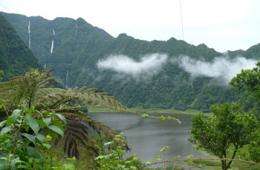
In the wild, P. pacificus enters into a fascinating alliance with beetles from the scarab beetle family, which includes the May bug, dung beetle and rose chafer. The young worms attach to a beetle and enter into dormancy, waiting for the beetle to die. When the host dies, the worms resume their development and feed on the microbes, colonising the decomposing carcass. This behaviour was discovered several years ago by Matthias Herrmann, entomologist and nematode expert in Sommer’s department. The Tübingen-based biologists have already travelled all over the world studying this close relative of the very well-studied Caenorhabditis elegans in all its diversity. For the past two years they have also been studying the nematodes on Réunion, an island in the Indian Ocean of less than 1000 square kilometres. The interactions of the species under investigation can be recorded in precise detail in this manageable terrain - ideal conditions for studying population genetics and their dynamics. Herrman is on the look-out for species of beetle that cannot be found anywhere else in the world, as well as those that have been introduced onto the island. "Many of them could be home to unique nematodes," says the scientist.
The developmental biologists from Tübingen initially examined the genes of 96 nematodes that were found to exist on the island. The scientists were able to classify the samples into four distinct species; 76 isolates belonged to the species P. pacificus. In order to compare how they were inter-related and to uncover possible differences between them and other global P. pacificus isolates, the biologists analysed the genetic material in the animals’ mitochondria. What they discovered was astounding: it turned out that the specimens discovered on Réunion represent a large proportion of the entire genetic diversity of this nematode - anywhere in the world. "This indicates that the worms settled on the island on numerous separate occasions since it was formed two to three million years ago," says Ralf Sommer. The analyses conducted to date also imply that the worms arrived on the island after they had already taken up residence on their respective host beetles.
The close association between P. pacificus and the beetles previously presented the researchers with several problems. By the time they had transported the material gathered on Réunion back to Germany, the beetles had long since died. And it was no longer the original worms that were living in them - but their offspring. However, since the beginning of the year, the scientists have been able to carry out their initial analyses on the island itself: in January they inaugurated a "container lab" in the harbour town of Le Port.
The six-metre-long field station enables the Institute’s researchers to conduct long-term studies on the island - a significant step, as in future the scientists from Tübingen want to add population-genetic studies on Réunion to the other studies that they are carrying out world-wide. "It’s important to us to find out whether phenotypical differences, which we previously observed in P. pacificus strains living a considerable distance apart also occur in a local context," says Sommer. This could shed light on how natural variation between individuals affects the evolution of a species. The scientists also want to find out how certain characteristics change in the course of time, and as a function of environmental conditions on the island.
More information: Matthias Herrmann, Simone Kienle, Jacques Rochat, Werner E. Mayer, Ralf J. Sommer, Haplotype diversity of the nematode Pristionchus pacificus on Réunion in the Indian Ocean suggests multiple independent invasions. Biological Journal of the Linnean Society, April 20, 2010
Provided by Max-Planck-Gesellschaft


