4G wireless technology slowly starts out in Scandinavia
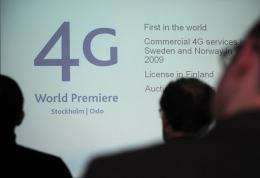
Launched in the capitals of tech-savvy Sweden and Norway in December, fourth generation wireless technology is getting off to a slow start in Scandinavia, analysts say.
They think it is still a couple of years away from overcoming the obstacles to it catching on worldwide.
"The real kick-start should be around 2012-2013," telecom analyst Greger Johansson of Stockholm firm Redeye told AFP.
The roll-out of 4G networks -- up to 10 times faster than today's high-speed third generation technology -- is being slowed by the need for compatible hardware and massive investments.
Another problem, analysts say, is timing.
The new technology is appearing on the scene as the world is still aching from the global financial crisis.
Operators remain far more wary of opening their wallets to the next big technological splash than they were when the last generation technology widely hit markets in 2003.
Also slowing the technological migration is the fact that operators have yet to develop a good method of cashing in on consumers accessing ultra-high-speed Internet networks through computers and phones.
TeliaSonera, the partly state-owned Swedish-Finnish firm behind the world's first commercial 4G network, estimated that out of almost 400,000 potential 4G consumers in downtown Stockholm and Oslo, just around a thousand have so far subscribed.
And for those consumers, 4G still means only an ultra-rapid computer Internet connection -- allowing the almost instantaneous display of webpages, fast transfers of even the largest files, and swift video streaming.
"As for the (4G-compatible) phones, we say 'Forget it for now'," TeliaSonera's vice-president of mobility services Lars Klasson said.
"We're a small market and the phone makers are waiting for the big ones like the US or Japan" to launch widespread 4G networks before making compatible phones, he explained.
Indeed, the US, where operators Verizon and At&T have begun rolling out 4G networks, should see the first few 4G compatible phones hit the market this year.
And Japan's NTT Docomo is also in the process of installing a 4G network in the country.
But in Europe, cost-conscious mobile operators, who have only recently invested in 3G, would rather raise the standards of their already top-notch third generation networks rather than splurge on 4G.
To roll out a fourth-generation network costs around two billion euros (2.47 billion dollars) per 50 million inhabitants -- a cost the companies, which also have to spend to acquire the 4G licences, are not eager to take on.
"If the regulators try to maximise their licensing revenues, it would be at the expense of investments in networks and infrastructure," said Klasson.
While his company had been forced to dish out about 50 million euros for its 4G license in Sweden, the license in neighbouring Finland had cost just one million euros in Finland, he pointed out.
TeliaSonera, which will not give details on its 4G customer numbers, is gradually rolling out the network to some 25 Swedish and five Norwegian cities.
But like other operators, the company is not only facing the problem of towering initial costs: it also needs to come up with a sound, profitable business model linking customer use of the costly network to billing.
"So far, operators have been pretty clever with offering fixed prices," said Mats Granryd, who heads up the Nordic country division of Swedish telecommunications equipment giant Ericsson, which is building TeliaSonera's 4G network.
"But if they continue with a flat fee, the use is going to be disconnected from the bill and the industry will suffocate. They need to move away from that," he insisted.
On the other hand, "customers are very attached to controlling their costs," said Urban Nyblom, a customer trend analyst for Ericsson.
"Operators will have to meet them in the middle," he told AFP.
Regardless of the obstacles it faces, the super-fast 4G technology will eventually conquer world markets to meet consumer needs, analysts say.
In just the few years since it became possible to transfer data on mobile phones, data traffic has caught up with voice traffic and now surpasses it, according to Ericsson.
According to IT and communications consultancy Idate, 400 million people will be using 4G by 2015.
That number corresponds to those who currently have access to third generation mobile broadband services through their phones or laptops, Ericsson said.
The Swedish giant forecast the number of people using mobile broadband to access the Internet will soar from around 400 million today to some 3.5 billion by 2015.
(c) 2010 AFP


