Fragile archive of 500-year-old 'filofaxes' goes online
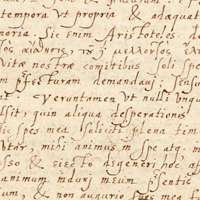
(PhysOrg.com) -- A remarkable archive of antique manuscripts which opens a window on to the experiences, hopes, fears and interests of people who lived during the 15th to 18th centuries has been put online.
The University of Cambridge Scriptorium Project features thousands of pages taken from 20 different handwritten "miscellanies", some of which date back as far as the Wars of the Roses.
Likened by some to filofaxes, the books were used to record snippets of information that people had read, been told, or overheard, at a time when paper was a scarce and expensive commodity.
The collection includes a notebook in which Edward VI wrote down various Biblical passages and a miscellany kept by William Rawley, chaplain to Francis Bacon, in which he recorded Bacon's sayings and a number of his (rather bad) jokes.
Perhaps more significantly, however, it features copious amounts of material reflecting the day-to-day lives of other people. Recipes, accounts, sonnets, quotations, prayers, sermons, legal tips and medical instructions were all added to the compendia as they were passed down through the generations.
Over a period of decades, their owners recorded everything from poems by Shakespeare and Milton, to plague remedies, laundry lists, or, in one case, the contents of their fish pond. As a result, the books provide an insight into sections of the population of whom we would know far less without them, not least the women of the era.
In many cases, the originals, which come from libraries, universities and country homes in different parts of England, are too fragile to be read by hand. The digitisation will make their contents freely accessible to people anywhere in the world, while also preserving them for future generations.
The Scriptorium Project was carried out by researchers in the University's Faculty of English and was funded by a grant from the Arts and Humanities Research Council. Further details about the project can also be found in a new article in the University's research magazine, Research Horizons.
Dr Richard Beadle, who led the project team, said: "Miscellanies of this sort have not always received the treatment or attention that they deserve. But as Scriptorium shows, they in fact give us a fascinating view of early modern life and open up a whole new side of the period's literature and culture for people to explore."
"The cost of paper at the time meant that it was quite normal for books to be re-used, but the people who wrote in these miscellanies were also in some sense speaking to posterity. By contributing to these collections, they may have felt that they were somehow giving themselves a life that stretched beyond their own."
The website features browsable and searchable digital facsimiles of each manuscript, with accompanying descriptions, transcriptions and bibliographies. The longest is a 17th century alchemical manuscript from King's College, Cambridge, which is about 400 pages long, while the shortest is the book that belonged to Edward VI and contains just 26 leaves.
This opens with a dedication from the young King to his uncle, the Duke of Somerset, who was Protector of England during the first part of Edward's short reign. Thereafter, the book contains a series of Biblical passages against idolatry which Edward copied out in his own hand, probably as part of his schooling.
One of the most varied items in the collection is a late 15th-century household record, now owned by Cambridge University Library, which was probably the property of a family in Southwell, Nottinghamshire. Its contributors recorded supposed cures for the plague, legal formulae and, at one stage, a dietary regimen for the week. Monday's entry recommends, among other things, "gruel, boiled meat for my lord or lady, puddings, or a calf head".
Many of the miscellanies were so frail that the project team had to develop painstaking techniques to avoid damaging them during photography.
The website also includes a complete and interactive online course in deciphering medieval and early modern handwriting as well as further resources for manuscript studies.
"The idea is to enable other researchers to decipher their own manuscripts even if they have not encountered early modern handwriting before," Dr. Beadle added. "Hopefully this project will help to open up the literature, history, theology and philosophy of this period to a new generation of students and scholars all over the world."
More information: scriptorium.english.cam.ac.uk/
Provided by University of Cambridge


