Researchers study knife-wielding robots (w/ Video)
May 10, 2010 by Lin Edwards report
Researchers study knife-wielding robots (w/ Video)
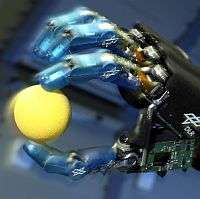
Image credit: German Aerospace Center

(PhysOrg.com) -- Many people have dreamed of robots helping around the house, vacuuming the carpets, making the beds, and chopping vegetables in the kitchen. Now a new study has found such robots could pose a danger to humans if they use sharp implements such as steak knives.

The researchers were from the Institute of Robotics and Mechatronics, which is a branch of DLR, the German Aerospace Center at Wessling. They used a 14 kg DLR Lightweight Robot III capable of holding a range of knives, scissors, a scalpel, and a screwdriver. The articulated arm has a reach of 1.1 meters, and is moderately flexible, and unlike other robots is fitted with position sensors and torque sensors in every joint.

The aims of the experiments were to determine what would happen if domestic robots were trained to use bladed tools commonly found in the home and accidentally struck human soft tissue, and to develop a collision detection system to limit injuries. The results showed in some scenarios when the safety system was turned off the robots inflicted wounds that could have been lethal.

This video is not supported by your browser at this time.

The robot arm was programmed to use the tools to cut, puncture, and stab at different speeds. Tests were carried out on a leg of pork and a lump of silicone, materials simulating human soft tissue. The robot used different maneuvers to strike the materials. Limited tests were also carried out on the arm of a human volunteer (leader of the research team, Sami Haddadin), and in this case a safety system including a prototype collision detector developed by the research team was turned on to limit injuries.

When the robot was used with the silicone and pork leg the safety system was turned off and the puncture and stab wounds produced by the arm were deep and in some cases would have been serious enough to be lethal if made on a living subject. With the safety system turned on the depth of cuts was reduced and sometimes were prevented altogether.

The research is believed to be the first to study injuries from bladed tools, although there have been studies of injuries that could be inflicted by robots bumping into people. The paper was presented last week by scientists Sami Haddadin, Gerd Hirzinger and Alin Albu-Schaffer at the IEEE International Conference on Robotics and Automation (ICRA 2010) in Alaska.

This video is not supported by your browser at this time.

The scientists say they have reservations about ever training robots to use knives and other bladed tools in the home, but their research and the safety system they developed will help researchers to develop safer robots.

Explore further: Congress gets mixed advice on regulating drones

Related Stories

Care-O-bot 3: Always at your service

Jul 01, 2008

Who doesn’t long for household help at times? Service robots will soon be able to relieve us of heavy, dirty, monotonous or irksome tasks. Research scientists have now presented a new generation of household ...

Futuristic robots, friend or foe?

Apr 22, 2008

A leading robotics expert will outline some of the ethical pitfalls of near-future robots to a Parliamentary group today at the House of Commons. Professor Noel Sharkey from the University of Sheffield will explain that robots ...

Real-life robots obey Asimov’s laws

Sep 08, 2008

(PhysOrg.com) -- European researchers have developed technology enabling robots to obey Asimov’s golden rules of robotics: to do no harm to humans and to obey them.

Recommended for you

Congress gets mixed advice on regulating drones

May 17, 2013

(AP)—The growing use of unmanned surveillance "eyes in the sky" aircraft raises a thicket of privacy concerns, but the U.S. Congress is getting mixed advice on what, if anything, to do about it.

Makr Shakr uses three arms for drink-recipe collabs

May 15, 2013

(Phys.org) —We're told it's the wave of the future. Design, make, enjoy. Beyond home-based 3-D printers, there will be new machines and display screens and apps that will invite you to have day to day products ...

Nokia unveils metallic smartphone, stock tumbles (Update)

May 14, 2013

Nokia Corp. on Tuesday unveiled its first Lumia smartphone with a metal cover, low-light camera features and new social network apps. But the new model failed to impress investors, who sent the company's stock down more than ...

User comments : 3

Adjust slider to filter visible comments by rank

Display comments: newest first

lengould100
not rated yet May 10, 2010
So what would such a sensor-equiped robot be good for? Caressing blocks of cheese? No, the answer, just as with humans, is to trust that the machine can distinguish correctly every time what should be cut from what shouldn't.
GPG
not rated yet May 10, 2010
trekgeek1
5 / 5 (2) May 10, 2010
No big deal, here are some alternate article titles:
1.)Researchers study knife wielding monkeys.
2.)Researchers study knife wielding babies.
3.)etc.

Anything is dangerous with a knife, robots shouldn't be any different. There are plenty of non-knife activities that a robot could do that could kill you. Teaching them to use sharp objects is necessary and no more dangerous than teaching them to turn on a stove.

And to all soon to come terminator comments. Robots will be used to murder and for evil, we already know that. As long as there are technologies and criminals, somebody will use them for evil. This is just something we need to accept if we want robots to improve our lives. If someone can hack a computer browser, they can disable safety protocols on robots.

More news stories

Congress gets mixed advice on regulating drones

(AP)—The growing use of unmanned surveillance "eyes in the sky" aircraft raises a thicket of privacy concerns, but the U.S. Congress is getting mixed advice on what, if anything, to do about it.

Makr Shakr uses three arms for drink-recipe collabs

(Phys.org) —We're told it's the wave of the future. Design, make, enjoy. Beyond home-based 3-D printers, there will be new machines and display screens and apps that will invite you to have day to day products ...

RIM unveils cheaper BlackBerry (Update 2)

Research In Motion unveiled a lower-cost BlackBerry aimed at consumers in emerging markets on Tuesday, and said it will offer its once-popular BlackBerry Messenger service on iPhones and devices running Google's ...

Heat-related deaths in Manhattan projected to rise

Residents of Manhattan will not just sweat harder from rising temperatures in the future, says a new study; many may die. Researchers say deaths linked to warming climate may rise some 20 percent by the 2020s, ...

Kinks and curves at the nanoscale

One of the basic principles of nanotechnology is that when you make things extremely small—one nanometer is about five atoms wide, 100,000 times smaller than the diameter of a human hair—they are going ...