Engineers Diagnosing Voyager 2 Data System (Update)
May 18, 2010
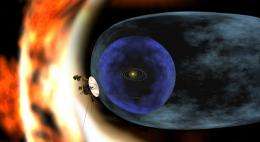
This artist's rendering depicts NASAs Voyager 2 spacecraft as it studies the outer limits of the heliosphere - a magnetic 'bubble' around the solar system that is created by the solar wind. Image credit: NASA/JPL-Caltech

(PhysOrg.com) -- One flip of a bit in the memory of an onboard computer appears to have caused the change in the science data pattern returning from Voyager 2, engineers at NASA's Jet Propulsion Laboratory said Monday, May 17. A value in a single memory location was changed from a 0 to a 1.

Updated May 17, 2010 at 5:00 PT.

One flip of a bit in the memory of an onboard computer appears to have caused the change in the science data pattern returning from Voyager 2, engineers at NASA's Jet Propulsion Laboratory said Monday, May 17. A value in a single memory location was changed from a 0 to a 1.

On May 12, engineers received a full memory readout from the flight data system computer, which formats the data to send back to Earth. They isolated the one bit in the memory that had changed, and they recreated the effect on a computer at JPL. They found the effect agrees with data coming down from the spacecraft. They are planning to reset the bit to its normal state on Wednesday, May 19.

May 06, 2010

Engineers have shifted NASA's Voyager 2 spacecraft into a mode that transmits only spacecraft health and status data while they diagnose an unexpected change in the pattern of returning data. Preliminary engineering data received on May 1 show the spacecraft is basically healthy, and that the source of the issue is the flight data system, which is responsible for formatting the data to send back to Earth. The change in the data return pattern has prevented mission managers from decoding science data.

The first changes in the return of data packets from Voyager 2, which is near the edge of our , appeared on April 22. Mission team members have been working to troubleshoot and resume the regular flow of science data. Because of a planned roll maneuver and moratorium on sending commands, engineers got their first chance to send commands to the spacecraft on April 30. It takes nearly 13 hours for signals to reach the spacecraft and nearly 13 hours for signals to come down to NASA's Deep Space Network on Earth.

Voyager 2 launched on August 20, 1977, about two weeks before its twin spacecraft, Voyager 1. The two spacecraft are the most distant human-made objects, out at the edge of the heliosphere, the bubble the sun creates around the solar system. Mission managers expect Voyager 1 to leave our solar system and enter in the next five years or so, with Voyager 2 on track to enter interstellar space shortly afterward. Voyager 1 is in good health and performing normally.

"Voyager 2's initial mission was a four-year journey to Saturn, but it is still returning data 33 years later," said Ed Stone, Voyager project scientist at the California Institute of Technology in Pasadena. "It has already given us remarkable views of Uranus and Neptune, planets we had never seen close-up before. We will know soon what it will take for it to continue its epic journey of discovery."

The original goals for the two Voyager were to explore Jupiter and Saturn.

As part of a mission extension, Voyager 2 also flew by Uranus in 1986 and Neptune in 1989, taking advantage of a once-in-176-year alignment to take a grand tour of the outer planets. Among its many findings, Voyager 2 discovered Neptune's Great Dark Spot and 450-meter-per-second (1,000-mph) winds. It also detected geysers erupting from the pinkish-hued nitrogen ice that forms the polar cap of Neptune's moon Triton. Working in concert with Voyager 1, it also helped discover actively erupting volcanoes on Jupiter's moon Io, and waves and kinks in Saturn's icy rings from the tugs of nearby moons.

is about 13.8 billion kilometers, or 8.6 billion miles, from Earth. is about 16.9 billion kilometers (10.5 billion miles) away from Earth.

Explore further: Dark, massive asteroid to fly by Earth on May 31

Related Stories

Voyager Spacecraft Mark Thirty Years of Flight

Aug 20, 2007

NASA's two venerable Voyager spacecraft are celebrating three decades of flight as they head toward interstellar space. Their ongoing odysseys mark an unprecedented and historic accomplishment.

Voyager Celebrates 20-Year-Old Valentine to Solar System

Feb 15, 2010

(PhysOrg.com) -- Twenty years ago on February 14, NASA's Voyager 1 spacecraft had sailed beyond the outermost planet in our solar system and turned its camera inward to snap a series of final images that would ...

MIT instrument studies edge of sun's bubble

Jul 08, 2008

The Voyager 1 and 2 spacecraft have traveled beyond the edges of the bubble in space where the sun's constant outward wind of particles and radiation slams into the interstellar medium that pervades our galaxy. ...

The Stars My Destination

Nov 10, 2009

The Voyager spacecraft are now in the outermost layer of the heliosphere, traveling toward interstellar space - the first man-made spacecraft to travel such a vast distance from Earth.

Recommended for you

Dark, massive asteroid to fly by Earth on May 31

17 hours ago

It's 1.7 miles long. Its surface is covered in a sticky black substance similar to the gunk at the bottom of a barbecue. If it impacted Earth it would probably result in global extinction. Good thing it is ...

Research team explains 'Lazarus' comets

21 hours ago

Astronomers from the University of Antioquia have discovered a graveyard of comets. These once-dormant comets, dubbed by astronomers as "The Lazarus comets," are now rejuvenated.

NASA ships sensors for seafaring satellite to France

21 hours ago

(Phys.org) —Three NASA-built instruments that are integral components of the next in a series of U.S./European ocean altimetry satellites have arrived in France for integration with their spacecraft in ...

Trip into space with DiCaprio costs $1.55m

22 hours ago

Leonardo DiCaprio is going to get closer to stars of a different kind as he heads into space aboard the Virgin Galactic, and a well-heeled bidder at the Cannes Film Festival has paid 1.2 million euros (1.5 million) to be ...

User comments : 3

Adjust slider to filter visible comments by rank

Display comments: newest first

kevinrtrs
2.2 / 5 (6) May 07, 2010
Voyager 2 has now acquired self-awareness and is refusing to co-operate with human beings treating it like a piece of junk metal....;-)))

Maybe it was struck on the "brain" by some space debris and now it's a bit wonky.
MrTryk
not rated yet Jul 13, 2010
Anyone remember the article, I think was posted on this site, referencing voyager 1 or 2 sending back data that appeared to be intentionally reformatted to send us a signal. Last I remember they were trying to decode it. Did they figure out that it was just a malfunction??
yyz
5 / 5 (2) Jul 13, 2010
@MrTryk, Looks like a stray particle caused the onboard electronics to glitch in Voyager 2. They're back to a nominal mission: http://news.disco...tch.html

More news stories

Galaxies fed by funnels of fuel

(Phys.org) —Computer simulations of galaxies growing over billions of years have revealed a likely scenario for how they feed: a cosmic version of swirly straws.

Source of life running out: water scientists

The majority of people on Earth people will face severe water shortages within a generation or two if pollution and waste continues unabated, scientists warned at a conference in Bonn Friday.

Dark, massive asteroid to fly by Earth on May 31

It's 1.7 miles long. Its surface is covered in a sticky black substance similar to the gunk at the bottom of a barbecue. If it impacted Earth it would probably result in global extinction. Good thing it is ...

Drones may violate international law

(Phys.org) —As President Obama gives a speech on national security—including defending U.S. use of drones to combat terrorism—Leila Sadat, JD, international law expert and professor of law at Washington University in ...