How do supermassive black holes get so big?
Apr 26, 2010 by Lisa Zyga weblog
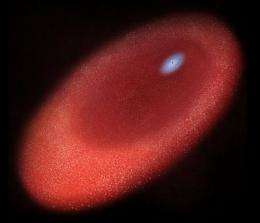
This illustration of the black hole in Andromeda shows an old lopsided stellar disk (red) orbiting a black hole (black dot). An inner ring of younger stars (light blue) also orbits the black hole. The stellar disks may drag swirling gas close enough to the black hole to be consumed. Credit: A. Field, NASA, ESA.

(PhysOrg.com) -- At the center of most galaxies lie supermassive black holes that can grow to become more than a billion times larger than our Sun. However, astrophysicists don’t fully understand the formation and evolution of supermassive black holes - specifically, how swirling gas from the galaxy loses its large angular momentum to allow it to be consumed by the black hole.

In a new study, astrophysicists Philip Hopkins and Eliot Quataert from the University of California, Berkeley, have proposed an explanation for how gas loses its and successfully crosses the last 30 light years to the black hole. Their idea stems from previous observations that the in the center of the is orbited by an old lopsided stellar disk. Hopkins and Quataert suggest that when gas flows toward a black hole, it initially forms this stellar disk due to gravitational instabilities.

Eventually, the stellar disk grows in size to stretch over a distance of dozens of light years from the center of the galaxy. Once it becomes large enough, its eccentric shape pulls unevenly on the incoming gas. This torque causes different gas streams to collide, reducing the gas’ momentum and allowing it to flow close enough to the black hole (less than one light year) to allow the black hole’s gravity to dominate and swallow the gas. The researchers’ simulations showed that this process could enable to consume several solar masses of gas each year, which could have helped Andromeda’s black hole to gain much of its mass.

Since Andromeda is not a unique galaxy, other supermassive black holes may also have orbiting stellar disks that transport the angular momentum of gas to the black hole’s vicinity, helping to “feed” the black hole. In addition, the eccentric stellar disk’s self-gravitational forces might reveal insight into and the cosmic X-ray background.

Explore further: Unusual supernova is doubly unusual for being perfectly normal

More information: Philip Hopkins and Eliot Quataert. “The Nuclear Stellar Disk in Andromeda: A Fossil from the Era of Black Hole Growth.” Monthly Notices of the Royal Astronomical Society. Available at arXiv:1002.1079v2 [astro-ph.CO].
Via: New Scientist

Related Stories

Chandra data reveal rapidly whirling black holes

Jan 10, 2008

A new study using results from NASA's Chandra X-ray Observatory provides one of the best pieces of evidence yet that many supermassive black holes are spinning extremely rapidly. The whirling of these giant ...

Cygnus X-1: Still a 'Star' After All Those Years

Aug 28, 2009

Since its discovery 45 years ago, Cygnus X-1 has been one of the most intensively studied cosmic X-ray sources. About a decade after its discovery, Cygnus X-1 secured a place in the history of astronomy when ...

Black Hole Blows Bubble Between The Stars

Aug 11, 2005

A team of astronomers from The Netherlands and the UK has discovered a vast "jet-powered bubble" formed in the gas around a black hole in the Milky Way.

An Intriguing, Glowing Galaxy

May 14, 2009

A supermassive black hole may be responsible for the glowing appearance of galaxy 3C 305, located about 600 million light years away in the constellation Draco. Composite data from NASA’s Chandra X-ray Observatory ...

Galaxy Collision Switches on Black Hole

Dec 10, 2009

(PhysOrg.com) -- This composite image of data from three different telescopes shows an ongoing collision between two galaxies, NGC 6872 and IC 4970.

Recommended for you

Dusty surprise around giant black hole

1 hour ago

(Phys.org) —ESO's Very Large Telescope Interferometer has gathered the most detailed observations ever of the dust around the huge black hole at the centre of an active galaxy. Rather than finding all of ...

Three centaurs follow Uranus through the solar system

Jun 18, 2013

Astrophysicists from the Complutense University of Madrid have confirmed that Crantor, a large asteroid with a diameter of 70 km has an orbit similar to that of Uranus and takes the same amount of time to ...

Final curtain for Europe's deep-space telescope

Jun 17, 2013

The deep-space telescope Herschel took its final bow on Monday, climaxing a successful four-year mission to observe the birth of stars and galaxies, the European Space Agency (ESA) said.

Hubble spots a very bright contortionist

Jun 17, 2013

(Phys.org) —The contorted object captured by Hubble in this picture is IRAS 22491-1808, also known as the South America Galaxy. It is an ultra-luminous infrared galaxy (ULIRG) that emits a huge amount of ...

User comments : 1

Adjust slider to filter visible comments by rank

Display comments: newest first

in7x
5 / 5 (5) Apr 26, 2010
Damn illustrations.

http://www.spacet...ic0512e/

More news stories

Dusty surprise around giant black hole

(Phys.org) —ESO's Very Large Telescope Interferometer has gathered the most detailed observations ever of the dust around the huge black hole at the centre of an active galaxy. Rather than finding all of ...

NASA image: Rare clear view of Alaska

(Phys.org) —On most days, relentless rivers of clouds wash over Alaska, obscuring most of the state's 6,640 miles (10,690 kilometers) of coastline and 586,000 square miles (1,518,000 square kilometers) ...

Have you had your cereal today?

Cereals are grasses that produce grains, the bulk of our food supply. Carnegie's Plant Biology Department is releasing genome-wide metabolic complements of several cereals including rice, barley, sorghum, and millet. Along ...