How cobras form hood flares

Apr 20, 2010 by Lin Edwards report
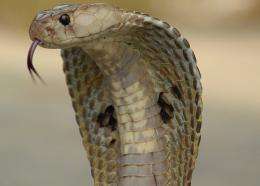
Indian Spectacled Cobra. Image credit: Wikipedia.

(PhysOrg.com) -- Cobras, and several other groups of unrelated snakes, form a menacing hood flare by expanding the sides of their necks as part of a defensive display. Now scientists in the US have identified the groups of muscles the snakes use to produce the effect.

The researchers, Bruce Young from the University of Massachusetts, and Kenneth Kardong from Washington State University, wanted to examine what they called an “intriguing problem in evolutionary biology,” and find out how snakes produce a hood. They knew both rib bones and muscles were involved in the process, but wanted to find out how the ribs were able to rotate into the position required.

They did this by implanting tiny electrodes into the muscles in a cobra’s neck to allow them to measure the electrical activity in all the muscles as the flared its neck to form a hood. Professor Young said the surgery was quite risky because cobras can wake while under , which he said could be “disconcerting”.

They found the hooding process begins at the head and extends downwards through the actions of eight sets of muscles, with a set of axial muscles along the ribs being the primary erector muscles that lift the hood. Another set of muscles that connect the ribs to the skin keep the hood skin taut, and a third set of muscles between the ribs spread the load. The eight sets are also found in non-hooding snakes.

They discovered that keeping the hood erect requires continuous . It relaxes when the event prompting the display is ended, partly by passive recoil of the costovertebral ligaments, and partly due to active muscle contractions of a further set of axial muscles.

Professor Kardong said the hood evolved through “co-opting” of the ribs, and is an example of how evolution remodels existing systems. In this case there has been a change in the control over the muscles involved, he said.

The findings are reported in the . The research team now hope to study how other hooding snakes produce their display.

Explore further: Bird's playlist could signal mental strengths and weaknesses

More information: The functional morphology of hooding in cobras, First published online April 16, 2010, Journal of Experimental Biology 213, 1521-1528 (2010), doi:10.1242/jeb.034447

Related Stories

Here's venom in your eye: Spitting cobras hit their mark

Jan 22, 2009

Spitting cobras have an exceptional ability to spray venom into eyes of potential attackers. A new study published in Physiological and Biochemical Zoology reveals how these snakes maximize their chances of hitting the ta ...

Superfast muscles in songbirds

Jul 09, 2008

Certain songbirds can contract their vocal muscles 100 times faster than humans can blink an eye – placing the birds with a handful of animals that have evolved superfast muscles, University of Utah researchers ...

Frog muscles survive big sleep

May 10, 2007

A rare Australian frog that burrows underground for a summer siesta resurfaces more than nine months later in just as good a shape as before its rest, according to UQ research.

Recommended for you

Do songbirds hold key to stuttering?

37 minutes ago

A tiny Australian songbird may hold the answer to discovering the biological source of stuttering, which affects 3 million Americans and is notoriously difficult to treat.

Getting to the bottom of the zombie ant phenomenon

3 hours ago

(Phys.org) —While unraveling a dramatic case of mind control, biologist David Hughes is taking calls from Hollywood—and gaining new insights into the role behavior plays in spreading disease.

Coral reefs 'ruled by earthquakes and volcanoes'

4 hours ago

(Phys.org) —Titanic forces in the Earth's crust explain why the abundance and richness of corals varies dramatically across the vast expanse of the Indian and Pacific Oceans, a world-first study from the ...

User comments : 0

More news stories

Do songbirds hold key to stuttering?

A tiny Australian songbird may hold the answer to discovering the biological source of stuttering, which affects 3 million Americans and is notoriously difficult to treat.

Coral reefs 'ruled by earthquakes and volcanoes'

(Phys.org) —Titanic forces in the Earth's crust explain why the abundance and richness of corals varies dramatically across the vast expanse of the Indian and Pacific Oceans, a world-first study from the ...

Coccoliths thrive despite ocean acidification

Ocean acidification is damaging some marine species while others thrive, say scientists. An international team studied the effect of ocean acidification on plankton in the North Sea over the past forty years, ...

Costs to treat stroke in America may double by 2030

Costs to treat stroke are projected to more than double and the number of people having strokes may increase 20 percent by 2030, according to the American Heart Association/American Stroke Association.