Cluster takes first look at acceleration processes driving aurora
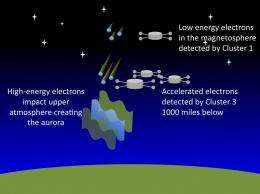
(PhysOrg.com) -- Using the Cluster spacecraft, scientists from University College London (UCL) have made the first direct observations of charged particles that lead to some of the brightest aurora. Dr Colin Forsyth presented the results at the RAS National Astronomy Meeting (NAM2010) in Glasgow.
The aurora, or northern and southern lights, are caused by highly energetic charged particles, normally held in space by Earth’s magnetic field, colliding with Earth’s upper atmosphere. As these high-energy particles collide with molecules in the atmosphere they lose energy, causing the atmospheric molecules to glow and heating the atmosphere. The result of is spectacular displays of shimmering curtains of red, green and blue light normally seen above the polar regions, but occasionally seen as far south as northern England.
Despite their frequent occurrence, there are still many questions regarding the physical processes behind the aurora. The particles that excite the aurora are accelerated up to high energies in a region extending to around 50 000 km (31 000 miles) above the atmosphere. By understanding the accelerating processes in this region, scientists hope to further understand the aurora.
Launched in 2000, the joint European Space Agency (ESA) and NASA Cluster mission consists of four identical spacecraft flying in a close formation around the Earth. Each spacecraft carries a suite of instruments to study the charged particles and electromagnetic fields in the space environment around the Earth known as the magnetosphere. The multi-point perspective of the Cluster spacecraft allows scientists build up a 3D picture of the magnetosphere.
Dr. Colin Forsyth has been leading an international team hoping to directly measure the acceleration of charged particles above the aurora. At NAM2010, Dr. Forsyth will present data from the Plasma Electron And Currents Experiment (PEACE), built by UCL’s Mullard Space Science Laboratory, showing this acceleration in action.
“The Cluster spacecraft have been manoeuvred such that one of them was at a higher altitude than the others when they passed over the auroral regions” said Dr. Forsyth. “We were then able to simultaneously measure the particle energies at different heights and thus their acceleration. These exciting new results will give us new insight into the accelerating processes and the transfer of energy from the magnetosphere into the atmosphere”.
These new observations are the first step in understanding the processes behind the aurora and its impact on the atmosphere. Dr. Forsyth and his team aim to link these and similar observations to observations of large-scale processes in the magnetosphere and detected on the ground in the auroral regions. This could be a key factor in understanding how energy from the magnetosphere affects Earth’s atmosphere.
Provided by Royal Astronomical Society


