Traditional Inuit knowledge combines with science to shape weather insights
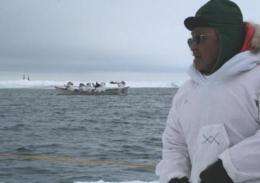
Using skills passed down through generations, Inuit forecasters living in the Canadian Arctic look to the sky to tell by the way the wind scatters a cloud whether a storm is on the horizon or if it's safe to go on a hunt.
Thousands of miles away in a lab tucked in Colorado's Rocky Mountains, scientists take data measurements and use the latest computer models to predict weather. They are two practices serving the same purpose that come from disparate worlds.
But in the past 20 years, something has run amok with Inuit forecasting. Old weather signals don't seem to mean what they used to. The cloud that scatters could signal a storm that comes in an hour instead of a day.
Now researchers are combining indigenous environmental knowledge with modern science to learn new things about what's happening to the Arctic climate.
"It's interesting how the western approach is often trying to understand things without necessarily experiencing them," said Elizabeth Weatherhead, a research scientist with the University of Colorado at Boulder's Cooperative Institute for Research in Environmental Sciences. "With the Inuit, it's much more of an experiential issue, and I think that fundamental difference brings a completely different emphasis both in defining what the important scientific questions are, and discerning how to address them."
For years, researchers had heard reports of unpredictable weather coming in from Arctic communities. But the stories didn't seem to match up with the numbers. By scientific measurement, weather around the world appeared to be growing more persistent with less variation. The disparity left scientists scratching their heads, said Weatherhead.
"I had been hearing about this problem from other environmental statisticians for a number of years," said Weatherhead, who also works closely with the National Oceanic and Atmospheric Administration's Earth System Research Laboratory in Boulder, Colo., and who is chief author on a new study on the subject. "But the Inuit used a different language than what we statisticians used, and none of us could really figure out what matched up with their observations."
That's where Shari Gearheard, a scientist with CU-Boulder's National Snow and Ice Data Center, also part of CIRES, comes in. Gearheard lives in Clyde River, Nunavut, Canada, an Inuit community on eastern Baffin Island, and for the past 10 years has been working with Inuit hunters and elders to document their knowledge of the environment and environmental change.
Weather has a special importance in Arctic environments, where a reliable forecast can mean the difference between life and death. There are members of the Inuit community who possess the skills to predict the weather, but that knowledge is dying off as both the culture and climate change, according to the scientists.
"The impacts of that are a loss of confidence in those forecasters and concerns about incorrect forecasts," said Gearheard. Forecasters don't want to send somebody out to go hunting if they're going to be unsafe and be in poor weather conditions."
Gearheard meticulously collects the stories told to her by the Inuit and makes systematic records of indigenous environmental knowledge. Through this, patterns begin to emerge, she said.
Of special importance were changes experienced by the Inuit during the spring, a time of transition for many environmental processes. During spring, the Inuit would notice that the top layer of the snow melted during the day and then would refreeze at night, forming a crust.
"In fact, in a lot of places, the season is named after a particular process by the Inuit," said Gearheard. "In cases like this where the Inuit are not seeing that process anymore, it is an indicator to them that something had changed."
Gearheard's records created a resolution of detail for Arctic weather observation that, by bringing the two studies together, gave Weatherhead the information she needed to bridge indigenous knowledge with scientific knowledge. "What was incredibly helpful was Shari's detailed description of what they were experiencing on what sort of timescales," said Weatherhead. "That really allowed us to start focusing on our statistical tests and try to find exactly what matched their observations."
Statistical analysis of day-to-day temperatures at Baker Lake, Nunavut, showed that in May and June the persistence of temperature had recently declined, matching Inuit reports of greater unpredictability at that season. "People hadn't previously looked at persistence in this way," said CIRES fellow Roger Barry, also director of the World Data Center for Glaciology at the National Snow and Ice Data Center at CU-Boulder and a study co-author along with Gearheard.
What they found was a scientific story more in line with what people were witnessing on the ground. Weather along the Arctic latitudes was behaving more unpredictably than in other parts of the world.
"That's an incredibly important parameter to care about," said Weatherhead. "The way I try to describe it to some people is if we get an inch of rain out at my house in the month of July, I don't need to turn on the sprinklers. But if we get an inch of rain on July 1, and no rain after that, my lawn is dead.
"Ecosystems have evolved under a certain type of pattern. So if that is changing, that could be just as important as a small increase in temperature or some of the other changes we're talking about," Weatherhead said.
The new study helps scientists refine and test climate models, while also providing such models with a new category of information to consider, said Weatherhead. And Gearheard's work with the Inuit is demonstrating the value of indigenous environmental knowledge to modern climate science.
"When we first started talking about this, indigenous knowledge didn't have the place it does now in research," Gearheard said. "It's growing. People are becoming more familiar with it, more respectful of it."
Weatherhead and Gearheard said they are intrigued by the insights that incorporate indigenous knowledge and climate studies, but they don't want to stop there. The new study has sparked an interest in the type of environmental knowledge other communities could provide to climate scientists, from ranchers and farmers to indigenous groups. "When you treat these perspectives as different forms of evidence or knowledge and see where that takes you, that is when exciting stuff happens," said Gearheard.
More information: The study appears this month in the journal Global Environmental Change.
Provided by University of Colorado at Boulder


