Online e-expo features more than 100 university robotics labs
Apr 07, 2010 by Lisa Zyga report
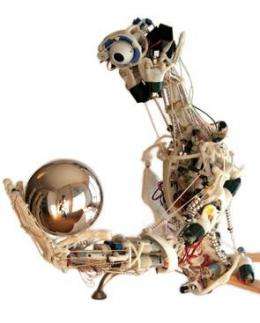
One of the robots at EXPO21xx: ECCCEROBOT (Embodied Cognition in a Compliantly Engineered Robot), which was designed by researchers at the AI Lab at the University of Zurich. Credit: University of Zurich.

(PhysOrg.com) -- In an effort to bring together the top academic robotics labs under one roof, a project called EXPO21XX has created an online exhibition to showcase the diversity in today's robotics research. At one website, robotics researchers and enthusiasts can view the projects underway in more than 100 university robotics labs from around the world.

EXPO21XX, which has been providing electronic exhibitions (or e-expos) since 2001 for a variety of industries, launched the virtual University Robotics Platform in 2008. The e-expos offer a convenient and free alternative to the conventional expo by taking advantage of the internet and the latest multimedia technology.

Similar to a real-life expo, EXPO21XX’s e-expos are organized into halls, corridors, and individual stands. The University Robotics Platform, for example, is located in e-Hall05 of the Automation e-expo (where there are currently 37 e-Halls).

On the Universities Robotics Platform, you can learn about many different robotics projects that don’t always make it to the news headlines (and some that do). For example, visitors can watch videos of the following robots:

*A robotic jaw that simulates human chewing behavior, which was designed by researchers at the Mechatronics and Robotics Research Group at Massey University in New Zealand.

*A that uses Facebook, which was designed by researchers the Interactive Robots and Media Laboratory at the United Arab Emirates University.

*A robot that performs stereotactic , which implants an electrode in the brain for a therapy called that could help treat Parkinson’s disease. The robot was designed by researchers at the Institute for Robotics and Cognitive Systems at the University of Luebeck in Germany.

*A giant six-legged ant-like robot that skitters across the ground and flips itself over to walk “upside down.” The was developed by researchers at the Active Structures Laboratory at the Université Libre de Bruxelles in Brussels, Belgium, for gait studies.

*A brain-actuated robotic wheelchair constructed by researchers at the Neurotechnology Lab at the University of Zaragoza in Spain. The wheelchair is being designed to provide people with severe neuromuscular disabilities with a certain degree of mobility.

Prominent among the presenters is Prof. Peter Bock of George Washington University (Computer Science) who was invited to publish a complete presentation of the functionality of ALISA (Adaptive Learning Image and Signal Analysis) and the results from his recent funded projects with Bosch and then DTRA (Defense Threat Reduction Agency of the DOD).

The Universities Robotics Platform continues to grow, with a few stands currently being reserved for additional universities. If you want to get a glimpse of the future, this is definitely worth checking out.

Visit the site at www.expo21xx.com/automation21xx/university.htm

Explore further: Robots learn to take a proper handoff by following digitized human examples

Related Stories

Robots from 33 Countries Clash at RoboCup 2007

Jun 14, 2007

Nearly 300 teams from 33 countries are gearing up to compete at RoboCup 2007 Atlanta, the world’s most renowned competition for research robotics, at the Georgia Institute of Technology July 3-10.

Recommended for you

Microsoft readies new Xbox as entertainment hub

1 hour ago

Microsoft offers a glimpse Tuesday at a new-generation Xbox as videogame consoles evolve into home entertainment centers and adapt to competition from smartphones and tablets.

Finnish start-up launches smartphone to rival giants

17 hours ago

A group of ex-Nokia employees who quit over the company's decision to abandon the planned MeeGo operating system in favour of Windows presented their own smartphone on Monday, hoping to rival the sector's ...

NEC phone is liquid-cooled and gender-specific

23 hours ago

(Phys.org) —Pink is the color of princess fairy-tale gowns, magic slippers, upscale cupcake icing, and everything else favorable to girls who just want to be girls. "Ladyphones" appear to be concepts for ...

Expectations high for next Xbox

May 20, 2013

It's almost time for a new Xbox. Eight years have passed since Microsoft unveiled the Xbox 360, double the amount of time between the original Xbox debut in 2001 and its high-definition successor's launch ...

Congress gets mixed advice on regulating drones

May 17, 2013

(AP)—The growing use of unmanned surveillance "eyes in the sky" aircraft raises a thicket of privacy concerns, but the U.S. Congress is getting mixed advice on what, if anything, to do about it.

User comments : 0

More news stories

NEC phone is liquid-cooled and gender-specific

(Phys.org) —Pink is the color of princess fairy-tale gowns, magic slippers, upscale cupcake icing, and everything else favorable to girls who just want to be girls. "Ladyphones" appear to be concepts for ...

Finnish start-up launches smartphone to rival giants

A group of ex-Nokia employees who quit over the company's decision to abandon the planned MeeGo operating system in favour of Windows presented their own smartphone on Monday, hoping to rival the sector's ...

Expectations high for next Xbox

It's almost time for a new Xbox. Eight years have passed since Microsoft unveiled the Xbox 360, double the amount of time between the original Xbox debut in 2001 and its high-definition successor's launch ...

No new H7N9 cases in China for a week

No new human cases of the H7N9 virus have been recorded in China for a week, national health authorities said, for the first time since the outbreak began in March.

Slow pokes: Acupuncture helps hypothermic turtles

Two endangered sea turtles that are shells of their former selves after getting stranded on Cape Cod during a cold spell are getting some help easing back into the wild—from an acupuncturist.