Fiber Optical Transmission In Demand Of Higher Capacity
Apr 02, 2010 by John Messina weblog
Fiber Optical Transmission In Demand Of Higher Capacity
Nippon Telegraph and Telephone Corp have successfully demonstrated an ultra-high capacity optical transmission of 69.1 terabits per second over a single 240 km long optical fiber.

(PhysOrg.com) -- With the increasing high volume content over the internet, such as multimedia and high definition images, new transmission methods need to be found to handle the increasing data demand. Nippon Telegraph and Telephone Corp (NTT) have successfully demonstrated an ultra-high capacity optical transmission of 69.1 terabits per second over a single 240 km long optical fiber.

NTT was able to achieve 69.1 Tb/s transmission by applying wavelength division multiplex (WDM) of 432 wavelengths with a capacity of 171 Gb/s. This is the highest optical transmission ever recorded in the transmission field. This technology will prove beneficial in the construction of high-capacity optical backbones for the future.

In NTT’s experimental setup, a 171Gb/s signal per wavelength is generated by the combination of the 16 QAM format (quadrature amplitude modulation) with polarization division multiplexing in the transmitter. The 16 QAM signal is generated by combining two QPSK (Quadrature phase-shift keying) signals with an amplitude ratio of 2:1 in the QAM modulator. Four hundred and thirty from 1527 to 1620 nm with a wavelength spacing of 25 GHz are multiplexed to generate a 69.1 Tb/s signal.
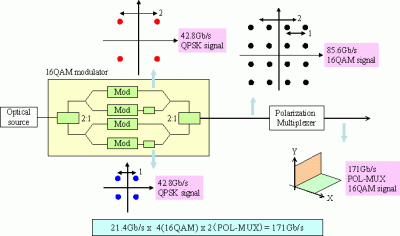
Generation of 171 Gb/s signal using 16 QAM format and polarization division multiplexing. Credit: Nippon Telegraph and Telephone Corporation.

The receiver uses coherent detection and digital signal processing. The 16 QAM signal is demodulated by using a new algorithm without deploying pilot-less processing. The signal processing is also used equalize the wavelength distortion caused by the chromatic dispersion and the polarization mode dispersion that occurs during optical transmission.
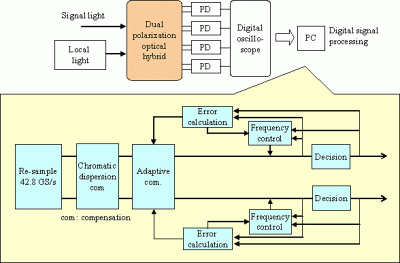
Digital coherent signal processing is deployed in the receiver. Credit: Nippon Telegraph and Telephone Corporation.

NTT’s objective is to construct an optical backbone network with high-capacity and long-distance transmission based on rates over 100 Gb/s per wavelength and over 10 Tb/s per fiber. This will lead to an optical backbone network that is more cost effective and have greater performance.

Explore further: Google eyes emerging markets networks

More information: www.ntt.co.jp/news2010/1003e/100325a.html

Related Stories

Data transport via fibre-optic network could be faster still

Dec 07, 2006

Due to the explosive growth in data transport the need for a greater utilisation of the bandwidth of fibre-optic networks is increasing. Dutch researcher Erwin Verdurmen examined how the transmission capacity of the glass ...

Recommended for you

Google eyes emerging markets networks

May 24, 2013

Google has become deeply involved in a series of projects to build and operate wireless networks in emerging markets including sub-Saharan Africa and Southeast Asia, a report said Friday.

Internet cable from Cuba to Jamaica comes online

May 21, 2013

A new branch of the Venezuela-to-Cuba undersea fiber-optic cable has reportedly come online, linking the island to nearby Jamaica, increasing Cuba's potential international communications bandwidth and providing a backup ...

Carlos Slim company to buy US mobile phone firm

May 20, 2013

Mexican phone giant America Movil, owned by billionaire Carlos Slim, announced Monday that its US unit reached a deal to acquire US mobile phone company Start Wireless Group.

User comments : 0

More news stories

Yahoo, pay-TV operators among Hulu bidders

Online video site Hulu is again up for sale, with Yahoo and pay TV operators DirecTV and Time Warner Cable among the seven bidders, according to a person with direct knowledge of the matter.

Radiation leak at Japan lab; small impact expected

An atomic research lab in northern Japan has reported a radiation leak that may have affected about 50 people, though none were hospitalized and no impact was expected outside the facility, the lab's operator ...