ARS Publishes Guide for Remote Solar Water Pumps
Mar 29, 2010 By Don Comis
ARS Publishes Guide for Remote Solar Water Pumps
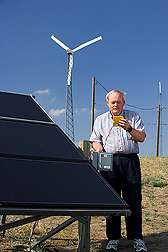
A guide to choosing a solar water pump for remote (off-grid) applications, like this one, has been published by ARS agricultural engineer Brian Vick and colleagues.

(PhysOrg.com) -- A guide to choosing a solar water pump for remote (off-grid) applications has been published by Agricultural Research Service (ARS) scientists.

For this guide, agricultural engineer Brian Vick and colleagues drew on the ARS Conservation and Production Research Laboratory’s 31 years of testing stand-alone water pumps. The laboratory is located near Bushland, Texas.

Vick found that for pumps with motors rated less than 1,500 watts, solar is usually the best choice. With current technology and costs, or a hybrid wind/solar pump is usually best for power needs of 1,500 watts or more.

Vick and colleagues tested three major pump types: diaphragm, helical and centrifugal. Diaphragm and helical pumps can maintain almost the same maximum flow rate over a large range of pumping depths. Because maximum flow rate increases with increasing power, centrifugal pumps can pump more water than diaphragm or helical pumps, although a photovoltaic (PV) array rated at a higher power may be required, especially at deeper pumping depths.

Powered with a 160-watt PV array, most diaphragm pumps sold today can draw sufficient water from wells 100 feet deep or less to supply 75 head of cattle. Some recently designed diaphragm pumps can draw from as deep as 230 feet, but can only supply sufficient quantities of water for 30 head of cattle.

ARS research indicates that if more water is needed or a deeper well is required, a pump type other than a diaphragm—and a PV array of more than 160 watts—is recommended.

The researchers also recommend using a controller on all pumps. For irrigation, they recommend the centrifugal pump with a hybrid wind/solar power system.

Their guide offers case studies in the Bushland area, where wells are more than 230 feet deep. One example is a four-person household, for which they recommend a helical pump powered by a 500-watt PV array. To supply water to 150 head of beef cattle, they would use a helical pump powered by a 640 watt PV array.

The guide, published by the American Solar Energy Society in 2009, is available online.

Explore further: Should we let wunderkinds drop out of high school?

Provided by USDA Agricultural Research Service

4 /5 (1 vote)
add to favorites email to friend print save as pdf

Related Stories

Pump design could give new hope to heart patients

Apr 12, 2007

A new counter-flow heart pump being developed by Queensland University of Technology has the potential to revolutionise future designs of the mechanical heart. Lead researcher Associate Professor Andy Tan said the heart pump's ...

U.S. scientists develop better heat pump

Jan 18, 2007

U.S. homeowners might soon see their electric bills decreasing thanks to an integrated heat pump system developed by the Oak Ridge National Laboratory.

Smart Miniature Pump

May 06, 2008

Medicines sometimes have to be administered in extremely small quantities. Just a few tenths of a milliliter may be sufficient to give the patient the ideal treatment. Micro-pumps greatly facilitate the dosage ...

Recommended for you

AP probe further strains Obama, press rapport

May 20, 2013

Reports emerged last week that the Department of Justice had secretly obtained two months' worth of phone records of journalists at The Associated Press as part of a larger investigation into a failed al-Qaida ...

Pakistan adopts Chinese rival GPS satellite system

May 18, 2013

Pakistan is set to become the fifth Asian country to use China's domestic satellite navigation system which was launched as a rival to the US global positioning system, a report said Saturday.

British children's on-screen reading overtakes books

May 16, 2013

For the first time, British children are reading more on computers and other electronic devices than they are reading books, magazines, newspapers and comics, according to a study of nearly 35,000 youngsters ...

User comments : 0

More news stories

Green conversion of heat to electricity

Soon, it will be possible to produce electricity from heat over 30 degrees emitted from a waste incinerator, refinery, or data processor. The start-up Osmoblue has just confirmed the feasibility of this new ...

Game system castAR debuts at Maker Faire

(Phys.org) —Two tech talents, formerly employees at video game publisher Valve, have been working on their own vision in the form of game-ready glasses. Their company, Technical Illusions, will seek to ...

If you can remember it, you can remember it wrong

(Medical Xpress)—Native peoples in regions where cameras are uncommon sometimes react with caution when their picture is taken. The fear that something must have been stolen from them to create the photo ...

B vitamins could delay dementia

(Medical Xpress)—Despite spending billions of dollars on research and development, drug companies have been unable to come up with effective treatments for dementia and Alzheimer's Disease (AD). Now, A. ...