Blueprint for 'artificial leaf' mimics Mother Nature
Mar 25, 2010
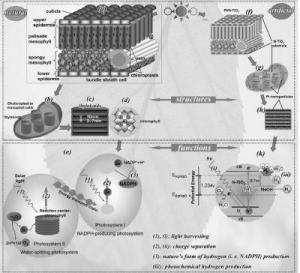
This is part of the recipe for an artificial leaf, which draws on Mother Nature's secrets, and could use sunlight and water to produce fuel. Credit: Tongxiang Fan, Ph.D.

Scientists today presented a design strategy to produce the long-sought artificial leaf, which could harness Mother Nature's ability to produce energy from sunlight and water in the process called photosynthesis. The new recipe, based on the chemistry and biology of natural leaves, could lead to working prototypes of an artificial leaf that capture solar energy and use it efficiently to change water into hydrogen fuel, they stated.

Their report was scheduled for the 239th National Meeting of the American Chemical Society (ACS), being held here this week. It was among more than 12,000 scientific reports scheduled for presentation at the meeting, one of the largest scientific gatherings of 2010.

"This concept may provide a new vista for the design of artificial photosynthetic systems based on biological paradigms and build a working prototype to exploit sustainable energy resources," Tongxiang Fan, Ph.D. and colleagues Di Zhang, Ph.D. and Han Zhou, Ph.D., reported, They are with the State Key Lab of Matrix Composites at Shanghai Jiaotong University, Shanghai, China.

Fan pointed out that using sunlight to split water into its components, hydrogen and oxygen, is one of the most promising and sustainable tactics to escape current dependence on coal, oil, and other traditional fuels. When burned, those fuels release carbon dioxide, the main . Combustion of hydrogen, in contrast, forms just water vapor. That appeal is central to the much-discussed "," and some auto companies, such as Toyota, have developed hydrogen-fueled cars. Lacking, however, is a cost-effective sustainable way to produce hydrogen.

With that in mind, Fan and co-workers decided to take a closer look at the leaf, nature's photosynthetic system, with plans to use its structure as a blueprint for their next generation of artificial systems. Not too surprisingly, the structure of green leaves provides them an extremely high light-harvesting efficiency. Within their architecture are structures responsible focusing and guiding of solar energy into the light-harvesting sections of the leaf, and other functions.

The scientists decided to mimic that natural design in the development of a blueprint for artificial leaf-like structures. It led them to report their recipe for the "Artificial Inorganic Leaf" (AIL), based on the natural leaf and titanium dioxide (TiO2) — a chemical already recognized as a photocatalyst for hydrogen production.

The scientists first infiltrated the leaves of Anemone vitifolia - a plant native to China - with titanium dioxide in a two-step process. Using advanced spectroscopic techniques, the scientists were then able to confirm that the structural features in the leaf favorable for light harvesting were replicated in the new TiO2 structure. Excitingly, the AIL are eight times more active for hydrogen production than TiO2 that has not been "biotemplated" in that fashion. AILs also are more than three times as active as commercial photo-catalysts. Next, the scientists embedded nanoparticles of platinum into the leaf surface. Platinum, along with the nitrogen found naturally in the leaf, helps increase the activity of the artificial leaves by an additional factor of ten.

In his ACS presentation, Fan reported on various aspects of Artificial Inorganic Leaf production, their spectroscopic work to better understand the macro- and microstructure of the photocatalysts, and their comparison to previously reported systems. The activity of these new "leaves", are significantly higher than those prepared with classic routes. Fan attributes these results to the hierarchical structures derived from natural leaves:

"Our results may represent an important first step towards the design of novel artificial solar energy transduction systems based on natural paradigms, particularly based on exploring and mimicking the structural design. Nature still has much to teach us, and human ingenuity can modify the principles of natural systems for enhanced utility."

Explore further: Attacking MRSA with metals from antibacterial clays

Related Stories

Renewable hydrogen energy - an answer to the energy crisis

Apr 19, 2007

Harvesting solar energy to produce renewable, carbon free and cost effective hydrogen as an alternative energy source is the focus of a new £4.2 million research programme at Imperial College London, it is announced.

Turning sunlight into liquid fuels (Video)

Mar 11, 2009

(PhysOrg.com) -- For millions of years, green plants have employed photosynthesis to capture energy from sunlight and convert it into electrochemical energy. A goal of scientists has been to develop an artificial ...

How size matters: The beauty of nature explained

Dec 12, 2007

The beauty of nature is partly due to the uniformity of leaf and flower size in individual plants, and scientists have discovered how plants arrive at these aesthetic proportions.

Artificial Leaves Generate Power by Pumping Water

Aug 03, 2009

(PhysOrg.com) -- Natural leaves constantly lose water through evaporation, as the water in their veins is pumped up to the top of the tree. This process, called transpiration, could also create a mechanical ...

Recommended for you

Attacking MRSA with metals from antibacterial clays

May 17, 2013

In the race to protect society from infectious microbes, the bugs are outrunning us. The need for new therapeutic agents is acute, given the emergence of novel pathogens as well as old foes bearing heightened antibiotic resistance.

Keeping fruit, vegetables and cut flowers fresh longer

May 15, 2013

New technology offers the promise of reducing billions of dollars of losses that occur each year from the silent, invisible killer of fruits, vegetables and cut flowers—a gas whose effects are familiar to everyone who has ...

Why don't beetles freeze in the winter?

May 14, 2013

For 37 years, Queen's University Biochemistry professor Peter Davies has been unraveling the mystery of why some organisms including insects and fish don't freeze in the winter. His research into insect antifreeze protein ...

The molecular basis of strawberry aroma

May 13, 2013

You know that summer is here when juicy red strawberries start to appear on the shelves. In Germany, this seasonal fruit has never been more popular: on average 3.5 kilos per head were consumed in 2012—a ...

A new dimension for 3-D protein structures

May 13, 2013

(Phys.org) —3D structures of biological molecules like proteins directly affect the way they behave in our bodies. EPFL scientists have developed a new infrared-UV laser method to more accurately determine ...

User comments : 4

Adjust slider to filter visible comments by rank

Display comments: newest first

TheWalrus
not rated yet Mar 25, 2010
Minor correction (unless I'm wrong): Tongxiang is (probably) the surname. Chinese names put the surname first. So, the reference to "Fan" is like referring to "John" when you mean "Dr. Smith."
hedagi
not rated yet Mar 26, 2010
So far so good! The big hurdle Tongxiang & Co. will face is to keep their leaves alive after so many chemical aggressions (titanium, nano-particles) to them. For if their leaves died, would they be able to collect any hydrogen bubbles? Finally I wonder whether Tongxiang & Co. are aware that there is a chap – Nocera by name – that has been on this at the MIT during the last 25 years; he's even founded a start-up!
Quantum_Conundrum
not rated yet Mar 26, 2010
...are they seriously considering making solor power using platinum? Anyone checked the PRICE of platinum lately?

$1609.00 per ounce today...

Or an average of:

$1595.28 over the past month.

If they averaged 1/10th of an ounce of platinum per meter of the artificial leaf, then that would be $159 per square meter in platinum raw material costs alone.
pikey
not rated yet May 08, 2010
Costs, always costs.We cannot eat nor drink profitability.

More news stories

Attacking MRSA with metals from antibacterial clays

In the race to protect society from infectious microbes, the bugs are outrunning us. The need for new therapeutic agents is acute, given the emergence of novel pathogens as well as old foes bearing heightened antibiotic resistance.

Beautiful 'flowers' self-assemble in a beaker

By simply manipulating chemical gradients in a beaker of fluid, materials scientists at Harvard have found that they can control the growth behavior of crystals to create precisely tailored structures—such ...

Making gold green: New non-toxic method for mining gold

Northwestern University scientists have struck gold in the laboratory. They have discovered an inexpensive and environmentally benign method that uses simple cornstarch—instead of cyanide—to isolate gold from raw materials ...

Galaxy's Ring of Fire

Johnny Cash may have preferred this galaxy's burning ring of fire to the one he sang about falling into in his popular song. The "starburst ring" seen at center in red and yellow hues is not the product of ...

US seizes Bitcoin operator accounts

US authorities seized the accounts of a Bitcoin digital currency exchange operator, claiming it was functioning as an "unlicensed money service business," court documents showed Friday.