A cracked comet

Mar 24, 2010
A cracked comet
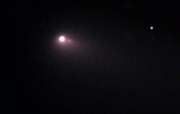
C2007 Q3 Siding Spring as imaged by Nick Howes using the Faulkes Telescope North

(PhysOrg.com) -- A leading amateur astronomer has made a major astronomical discovery thanks to a sophisticated educational telescope project led by Cardiff University astronomers.

Amateur astronomer, Nick Howes, has taken the first pictures showing a split in the icy nucleus of C2007 C3 using a remote-controlled telescope through the Faulkes Telescope Project based in the School of Physics and Astronomy.

The project offers access to a pair of remotely controlled telescopes, located on the Hawaiian island of Maui, and at Siding Spring in Australia - via the Internet.

Using the Faulkes Telescope North in Maui, Nick imaged the faint comet in glorious detail, producing a set of six images that showed a secondary condensation trailing the main nucleus. This appears to be a mountain-sized chunk of ice that has broken away from the giant “dirty snowball” that forms the nucleus of a comet.

A second set of images obtained the following day (Friday 19th March) clearly showed that the new fragment is still trailing the comet. It is now hoped that astronomers will follow up Nick’s discovery using instruments such as . Nick obtained the images whilst sat at his desk in work in Wiltshire, operating the £5M Hawaiian telescope over the Internet.

Dr Paul Roche, School of Physics and Astronomy, who is the Director of the Faulkes Telescope Project said: “We are delighted that Nick was able to capture dramatic images which appear to show that the comet’s nucleus is disintegrating.

“What this illustrates is what is achievable when amateur astronomers can get their hands on such a powerful telescope. We hope to involve schools in observing this comet over the next few weeks, so that we can see what happens to this new fragment.”

It’s hoped that this discovery will help encourage others to use the telescope for research and to help make new scientific discoveries. Last year, another amateur astronomer, working with several UK schools and the Faulkes Telescope Project, discovered the fastest-rotating asteroid in the Solar system.

More than 200 UK schools have used the telescopes to help in science lessons, often gathering data that is used by university researchers.

Dr Roche added: “As well as this project allows researchers from the University to help schools access professional equipment, and learn more about how modern science is really done.

“We hope this discovery will help encourage others to use the Faulkes Telescopes and lead to even more scientific discoveries.”

The Faulkes Telescope Project was launched in March 2004 by the Dill Faulkes Educational Trust, as a way of helping to inspire school students to study science and maths.

Explore further: NASA builds unusual testbed for analyzing X-ray navigation technologies

add to favorites email to friend print save as pdf

Related Stories

Aussie astronomers prepare for smash hit

Jun 28, 2005

Astronomers at Australia's national radio and optical observatories will watch as a probe released from a spacecraft slams into a comet about 133 million km away at a speed of nearly 37,000 km/h (10.2 km per second). The cos ...

Computer program makes night sky searchable

Jun 27, 2007

Computer science PhD candidate Dustin Lang has embarked on his own Star Trek as part of astronometry.net, a collaboration between computer scientists at U of T and astronomers at New York University.

Spitzer Telescope Sees Trail of Comet Crumbs

May 11, 2006

NASA's Spitzer Space Telescope has snapped a picture of the bits and pieces making up Comet 73P/Schwassman-Wachmann 3, which is continuing to break apart on its periodic journey around the sun. The new infrared ...

The unfolding space telescope

Jul 27, 2005

A novel suitcase-sized telescope could revolutionise the way we see the Earth and other planets. ESA has supported the work of a group of students in developing the Dobson Space Telescope, being tested this month aboard ESA's ...

Comet Collision 'Armageddon' Unlikely

Sep 12, 2005

The chances of the Earth being hit by a comet from beyond Pluto - a la Armageddon - are much lower than previously thought, according to new research by an ANU astronomer.

The great cometary show

Jan 19, 2007

Comet McNaught, the Great Comet of 2007, is no more visible for observers in the Northern Hemisphere. It does put an impressive show in the South, however, and observers in Chile, in particular at the Paranal ...

Recommended for you

Galaxy's Ring of Fire

May 18, 2013

Johnny Cash may have preferred this galaxy's burning ring of fire to the one he sang about falling into in his popular song. The "starburst ring" seen at center in red and yellow hues is not the product of ...

User comments : 0

More news stories

Power of US tornado dwarfs Hiroshima bomb

Wind, humidity and rainfall combined precisely to create Monday's massive killer tornado in Oklahoma. The awesome amount of energy released dwarfed the power of the atomic bomb that leveled Hiroshima.

NASA's BARREL mission launches 20 balloons

(Phys.org) —In Antarctica in January, 2013 – the summer at the South Pole – scientists released 20 balloons, each eight stories tall, into the air to help answer an enduring space weather question: ...

If you can remember it, you can remember it wrong

(Medical Xpress)—Native peoples in regions where cameras are uncommon sometimes react with caution when their picture is taken. The fear that something must have been stolen from them to create the photo ...

B vitamins could delay dementia

(Medical Xpress)—Despite spending billions of dollars on research and development, drug companies have been unable to come up with effective treatments for dementia and Alzheimer's Disease (AD). Now, A. ...

Reducing caloric intake delays nerve cell loss

Activating an enzyme known to play a role in the anti-aging benefits of calorie restriction delays the loss of brain cells and preserves cognitive function in mice, according to a study published in the May ...