New gecko species discovered in Cambodia
Mar 24, 2010
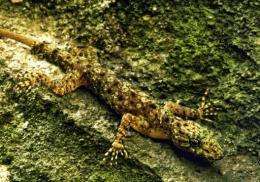
This undated handout picture released by the conservationist group Fauna and Flora International (FFI) shows a new species of gecko named Cnemaspis neangthyi. The gecko was discovered in the foothills of the Cardamom Mountains in Cambodia's southwest.

A new species of gecko has been discovered in the foothills of the Cardamom Mountains in Cambodia's southwest, scientists announced Wednesday.

The new gecko, named Cnemaspis neangthyi, is olive coloured with light blotches containing a central black dot, conservationist group Fauna and Flora International (FFI) said in a statement.

Geckoes are a type of lizard found in warm regions, and are known for their distinctive chirping noises.

FFI said the Cardamom Mountains, where the forests are well preserved and largely unexplored, are home to many found nowhere else in the world.

"There are likely many more species to be discovered in the Cardamom Mountains," said FFI researcher Neang Thy, after whom the gecko has been named.

The greater Cardamoms cover over two million hectares of and shelter at least 62 threatened animal species, many of which are found only in Cambodia, the group said.

It warned that the Cardamom forests, a key area for biodiversity conservation in Asia, are increasingly under pressure from development.

Explore further: White tiger mystery solved

add to favorites email to friend print save as pdf

Related Stories

New family of gecko discovered

May 22, 2008

Researchers at the University of Minnesota’s Bell Museum of Natural History and Pennsylvania’s Villanova University have discovered a new family of gecko, the charismatic large-eyed lizard popularized by car insurance ...

Genetic study finds treasure trove of new lizards

Mar 04, 2009

(PhysOrg.com) -- University of Adelaide research has discovered that there are many more species of Australian lizards than previously thought, raising new questions about conservation and management of Australia's ...

10 percent of world's major species at threat: report

Sep 29, 2009

Almost 10 percent of the world's mammals, birds, reptiles, amphibians and fish are in danger of extinction due to climate change and other factors, according to an Australian report released Tuesday.

Scientists find 56 new species in Papua New Guinea

Mar 25, 2009

Jumping spiders, a tiny chirping frog and an elegant striped gecko are among 56 species believed new to science discovered during a Conservation International (CI) Rapid Assessment Program (RAP) expedition ...

Recommended for you

Bittersweet: Bait-averse cockroaches shudder at sugar

6 hours ago

Sugar isn't always sweet to German cockroaches, especially to the ones that avoid roach baits. In a study published May 24 in the journal Science, North Carolina State University entomologists show the ne ...

White tiger mystery solved

8 hours ago

White tigers today are only seen in zoos, but they belong in nature, say researchers reporting new evidence about what makes those tigers white. Their spectacular white coats are produced by a single change ...

Scientists announce Top 10 New Species from 2012

15 hours ago

An amazing glow-in-the-dark cockroach, a harp-shaped carnivorous sponge and the smallest vertebrate on Earth are just three of the newly discovered top 10 species selected by the International Institute for ...

User comments : 0

More news stories

White tiger mystery solved

White tigers today are only seen in zoos, but they belong in nature, say researchers reporting new evidence about what makes those tigers white. Their spectacular white coats are produced by a single change ...

Controlling mood through the motions of mitochondria

(Medical Xpress)—Regulating the distribution of power in neurons is done by a system that makes the national electric grid look simple by comparison. Each neuron has several thousand mitochondria confined ...