Amphibious caterpillars discovered in Hawaii (w/ Video)
Mar 23, 2010 By Amina Khan
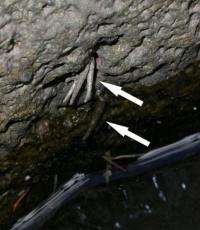
Hyposmocoma cone case-bearing larvae (arrows) resting communally, hiding in small holes on dry rocks downstream above and under the water line.

Moths of the Hawaiian genus Hyposmocoma are an oddball crowd: One of the species' caterpillars attacks and eats tree snails. Now researchers have described at least a dozen different species that live underwater for several weeks at a time.

"I couldn't believe it," said study co-author Daniel Rubinoff, an evolutionary biologist at the University of Hawaii at Honolulu, of the first time he spotted a submerged caterpillar. "I assumed initially they were terrestrial ... how were they holding their breath?"

Each of the 12 species lives in and along streams running down the mountains on several different islands of Hawaii, said Rubinoff, who has studied Hyposmocoma, a group of more than 350 moth species, for more than seven years.

They usually eat algae or lichen, and build silk cases -- which one species even adorns with bird feathers -- for shelter and camouflage. They spin silk drag lines to withstand the high pressure of fast flood waters.

This video is not supported by your browser at this time.
Aquatic burrito case-bearing Hyposmocoma larva in stream returning to the substrate with the aid of its silk drag line after being dislodged.

Unlike other amphibious creatures that can survive underwater on stored oxygen but must come back up for air, these caterpillars can spend several weeks without ever breaking the surface, according to the paper, which was published online Monday in .

It isn't yet clear how the insects do it. Rubinoff and co-worker Patrick Schmitz of the University of did not find any water-blocking stopper over the caterpillars' tracheae or evidence of gills. The animals drowned quickly when kept in standing water, so they seem to need the higher levels of oxygen present in running water, and probably absorb it directly through pores in their body, the scientists said.

The trait appears to have evolved more than once, Rubinoff said. After analyzing the DNA of the 12 amphibious species, the scientists found that three separate lineages of had developed the ability to breathe underwater at different points in the past.

Why they evolved this trick isn't clear, but animals and plants are known to often evolve in surprising directions after arriving at new, sparsely populated habitats such as islands, said Felix A.H. Sperling, an entomologist with the University of Alberta in Edmonton.

In a new environment, released of the pressure of having to fight for food sources or evade predators, they are freer to expand into new niches.

"When the pressures on an environment are released, what crazy things are animals capable of doing?" said John W. Brown, a research entomologist with the U.S. Department of Agriculture.

"You just wonder ... do all animals have that potential?"

Explore further: White tiger mystery solved

More information: Multiple aquatic invasions by an endemic, terrestrial Hawaiian moth radiation, PNAS, Published online before print March 22, 2010, doi:10.1073/pnas.0912501107

4.7 /5 (6 votes)
add to favorites email to friend print save as pdf

Related Stories

Fat, thin caterpillars are studied

Sep 21, 2006

A U.S.-led international team of scientists says there's no obesity epidemic among insects and the researchers believe they now know why.

Why Female Moths are Big and Beautiful

Mar 11, 2010

(PhysOrg.com) -- In most animal species, males and females show obvious differences in body size. But how can this be, given that both sexes share the same genes governing their growth? University of Arizona ...

Invasive Nettle Moth Triggers Hawaii Research

Nov 19, 2009

(PhysOrg.com) -- Like children everywhere, kids in Hawaii love to run barefoot through tall grass. But an invasive pest called the nettle moth caterpillar can take the fun out of this simple childhood pleasure, ...

Recommended for you

White tiger mystery solved

7 minutes ago

White tigers today are only seen in zoos, but they belong in nature, say researchers reporting new evidence about what makes those tigers white. Their spectacular white coats are produced by a single change ...

Scientists announce Top 10 New Species from 2012

7 hours ago

An amazing glow-in-the-dark cockroach, a harp-shaped carnivorous sponge and the smallest vertebrate on Earth are just three of the newly discovered top 10 species selected by the International Institute for ...

New cave-dwelling arachnids discovered in Brazil

19 hours ago

Two new species of cave-dwelling short-tailed whipscorpions have been discovered in northeastern Brazil, and are described in research published May 22 in the open access journal PLOS ONE by Adalberto Santos ...

User comments : 2

Adjust slider to filter visible comments by rank

Display comments: newest first

Simonsez
not rated yet Mar 23, 2010
This is just amazing... I can only imagine what new innovations in materials science will come from this discovery. As the article suggests, who knows what other interesting and novel abilities animals may have lying in wait for the appropriate conditions?
danajohnson0
not rated yet Mar 23, 2010
The image shows at 0.01 to 0.05 reduced gamma setting, that the highlights of the caterpillar casings are the only brightest spots in the whole image. The bright spots are regularly spaced along the length of each, and unique in patterned repeats. A signal or recognition pattern for the moths, or sorting against misidentification possibly? Perhaps chance ordered occurrence.

The one other bright spot pattern (slightly darker) is the 'limpet' shaped structure above and to the right of the attachment point for the several caterpillar casings. Can anyone ID the elevated conical shaped object by type or name? Is it a related former casing attachment item? That pattern is different and less bright. All other apparent bright spots are far less bright than those I mentioned.

More news stories

Unlocking secrets of cell reproduction

Research published in Open Biology today identifies, for the first time, nearly all the genes required for reproduction of a cell in a living organism.

Scientists announce Top 10 New Species from 2012

An amazing glow-in-the-dark cockroach, a harp-shaped carnivorous sponge and the smallest vertebrate on Earth are just three of the newly discovered top 10 species selected by the International Institute for ...

A hidden population of exotic neutron stars

(Phys.org) —Magnetars – the dense remains of dead stars that erupt sporadically with bursts of high-energy radiation - are some of the most extreme objects known in the Universe. A major campaign using ...

The secret lives, and deaths, of neurons

As the human body fine-tunes its neurological wiring, nerve cells often must fix a faulty connection by amputating an axon—the "business end" of the neuron that sends electrical impulses to tissues or other ...