Evidence Indicates Humans' Early Tree-dwelling Ancestors Were Also Bipedal
Mar 20, 2010
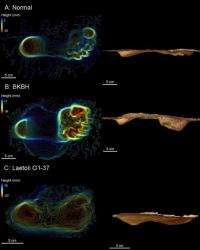
Images show aerial and lateral images of (top to bottom) (A) a human footprint made walking normally with an extended knee and hip gait; (B) a human footprint made walking with bent-knees and hips to mimic a chimpanzee; and (C) a scan of a cast from the Laetoli fossil trackway. Notice that the toe is much deeper than the heel in the middle print and that the Laetoli scan looks more like the human print. (Credit: Randy Haas, University of Arizona)

(PhysOrg.com) -- More than three million years ago, the ancestors of modern humans were still spending a considerable amount of their lives in trees, but something new was happening.

David Raichlen, an assistant professor in the University of Arizona School of Anthropology, and his colleagues at the University at Albany and City University of New York's Lehman College have developed new experimental evidence indicating that these early were walking with a human-like striding gait as long as 3.6 million years ago.

The results of their research appears in Monday's edition of , a journal from the Public Library of Science.

A trackway of footprints preserved in deposited 3.6 million years ago was uncovered in Laetoli, Tanzania, more than 30 years ago. The significance of those prints for has been debated ever since. The most likely individuals to have produced these footprints, which show clear evidence of bipedalism, or walking on two legs, would have been members of the only bipedal species alive in the area at that time, Australopithecus afarensis. That species includes "Lucy," whose are the most complete of any individual A. afarensis found to date.

A number of features in the hips, legs, and back of this group indicate that they would have walked on two legs while on the ground. But the curved fingers and toes as well as an upward-oriented shoulder blade provide solid evidence that Lucy and other members of her species also would have spent significant time climbing in trees.

This morphology differs distinctly from our own genus, Homo, who abandoned arboreal life around 2 million years ago and irrevocably committed to human-like bipedalism. Since the Laetoli tracks were discovered, scientists have debated whether they indicate a modern human-like mode of striding bipedalism, or a less-efficient type of crouched bipedalism more characteristic of chimpanzees whose knees and hips are bent when walking on two legs.

To resolve this, Raichlen and his colleagues devised the first biomechanical experiment explicitly designed to address this question. The team built a sand trackway in Raichlen's motion capture lab at the UA and filmed human subjects walking across the sand. The subjects walked both with normal, erect human gaits and then with crouched, chimpanzee-like gaits. Three-dimensional models of the footprints were collected by biological anthropologist Adam Gordon using equipment brought from his Primate Evolutionary Morphology Laboratory at the University at Albany.

The researchers examined the relative depth of footprints at the heel and toe, and found that depths are about equal when made by a person walking with an erect gait. In contrast, the toe print is much deeper than the heel print when produced by a crouched gait, a product of the timing of weight transfer over the length of the foot.

"Based on previous analyses of the skeletons of Australopithecus afarensis, we expected that the Laetoli footprints would resemble those of someone walking with a bent knee, bent hip gait typical of chimpanzees, and not the striding gait normally used by modern humans," Raichlen said. "But to our surprise, the Laetoli footprints fall completely within the range of normal human footprints."

The fossil footprints at Laetoli preserve a remarkably even depth at the toe and heel, just like those of . "This more human-like form of walking is incredibly energetically efficient, suggesting that reduced energy costs were very important in the evolution of bipedalism prior to the origins of our own genus, Homo," Raichlen said.

If the Laetoli footprints were made by Lucy's species, as most scientists agree to be the case, these experimental results have interesting implications for the timing of evolutionary events.

"What is fascinating about this study is that it suggests that, at a time when our ancestors had an anatomy well-suited to spending a significant amount of time in the trees, they had already developed a highly efficient, modern human-like mode of bipedalism," said Adam Gordon.

"The fossil record indicates that our ancestors did not make a full-time commitment to leaving the trees and walking on the ground until well over a million years after these (Laetoli) prints were made. The fact that partially tree-dwelling animals, like Lucy, had such a remarkably modern gait is a testament to the importance of energetic efficiency in moving around on two legs," Gordon said.

Explore further: UNESCO warns Syrian heritage sites endangered

More information: "Laetoli Footprints Preserve Earliest Direct Evidence of Human-like Bipedal Biomechanics" will be published in PLoS ONE on Monday, March 22 and can be accessed online at dx.plos.org/10.1371/journal.pone.0009769

Related Stories

Study Sheds Light on Why Humans Walk on Two Legs

Jul 20, 2007

A team of anthropologists that studied chimpanzees trained to use treadmills has gathered new evidence suggesting that our earliest apelike ancestors started walking on two legs because it required less energy ...

Early human walking is studied

Feb 16, 2006

Arizona State University scientists studying fossilized anklebones have concluded our early ancestors walked with a rather unsteady gait.

New analysis shows 'hobbits' couldn't hustle

May 06, 2009

A detailed analysis of the feet of Homo floresiensis—the miniature hominins who lived on a remote island in eastern Indonesia until 18,000 years ago -- may help settle a question hotly debated among paleontologists: how si ...

Recommended for you

UNESCO warns Syrian heritage sites endangered

44 minutes ago

UNESCO on Thursday added six ancient sites in Syria including a fortress of Saladin and a Crusader castle to the endangered World Heritage list, warning that more than two years of civil war had inflicted ...

Wooden beam could be detached part of shipwreck

10 hours ago

A wooden beam that has long been the focus of the search for a 17th century shipwreck in northern Lake Michigan was not attached to a buried vessel as searchers had suspected, but still may have come from the elusive Griffin ...

Prehistoric rock art maps cosmological belief

18 hours ago

It is likely some of the most widespread and oldest art in the United States. Pieces of rock art dot the Appalachian Mountains, and research by University of Tennessee, Knoxville, anthropology professor Jan ...

User comments : 3

Adjust slider to filter visible comments by rank

Display comments: newest first

Mstardom
not rated yet Mar 20, 2010
This story shows why humans can climb trees so easily. They were made for the trees! Living in trees afforded safety from being eaten because spending a large amount of time on the ground could pose great threat to survival.
dan42day
1 / 5 (1) Mar 21, 2010
Just how soon after becoming bipedal would we be expected to lose the adaptations that made us efficient at living in trees? What would drive the process? Wouldn't it still be useful to have those abilities even if they are only used rarely in emergencies? What other adaptations can we expect to lose now that we live in a technical society?

Yeah, I know - "Mr Day, you aska lotta questions!"
Loodt
1 / 5 (3) Mar 21, 2010
Dan42day.

Yeah, this evolution business is not as effective as they make out. Just think how handy that tail would have been to drive the mouse on you PC!

Why can't they repeat this test with some chimps?

The foot action of a chimp walking upright must be different to that of a human and these imprints would show that.

More news stories

UNESCO warns Syrian heritage sites endangered

UNESCO on Thursday added six ancient sites in Syria including a fortress of Saladin and a Crusader castle to the endangered World Heritage list, warning that more than two years of civil war had inflicted ...

Prehistoric rock art maps cosmological belief

It is likely some of the most widespread and oldest art in the United States. Pieces of rock art dot the Appalachian Mountains, and research by University of Tennessee, Knoxville, anthropology professor Jan ...

Gay marriage ruling unlikely to cause anti-gay backlash

Concerns that a U.S. Supreme Court ruling favorable to gay marriage might produce a backlash that would impede efforts to achieve equality are unfounded, according to a study by researchers at University of California campuses ...

The broken symphony of swinging metronomes

An experiment with 30 metronomes reveals chimera states which combine aspects of synchrony and of disorder. Researchers had been looking for such states for ten years.

Panic over MERS virus fades in Saudi

People in Saudi Arabia's Eastern Province have again started greeting friends with the traditional kiss on the cheek, and face masks in public are becoming rarer, as panic subsides over the outbreak of a deadly respiratory ...

S.Korean airlines ban shark fin as cargo

South Korea's two largest airlines, Korean Air and Asiana, said Thursday they had both decided to ban shark fin from their cargo flights as part of a growing global campaign against the Asian delicacy.

AP buys stake in live video service Bambuser

The Associated Press said Thursday that it has bought a minority stake in the live video service Bambuser, boosting its ability to acquire and distribute video collected by people who have witnessed news events.