World crude oil production may peak a decade earlier than some predict
Mar 10, 2010
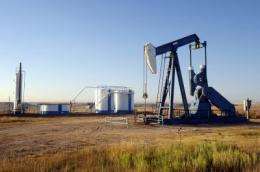
The world's crude oil production, which comes from sources like this oil field, may peak a decade earlier than some scientists had predicted.

In a finding that may speed efforts to conserve oil and intensify the search for alternative fuel sources, scientists in Kuwait predict that world conventional crude oil production will peak in 2014 — almost a decade earlier than some other predictions. Their study is in ACS' Energy & Fuels.

Ibrahim Nashawi and colleagues point out that rapid growth in global oil consumption has sparked a growing interest in predicting "peak oil" — the point where oil production reaches a maximum and then declines. Scientists have developed several models to forecast this point, and some put the date at 2020 or later. One of the most famous forecast models, called the Hubbert model, accurately predicted that oil production would peak in the United States in 1970.

The model has since gained in popularity and has been used to forecast oil production worldwide. However, recent studies show that the model is insufficient to account for more complex oil production cycles of some countries. Those cycles can be heavily influenced by technology changes, politics, and other factors, the scientists say.

The new study describe development of a new version of the Hubbert model that accounts for these individual production trends to provide a more realistic and accurate oil production forecast. Using the new model, the scientists evaluated the oil production trends of 47 major oil-producing countries, which supply most of the world's conventional .

They estimated that worldwide conventional crude oil production will peak in 2014, years earlier than anticipated. The scientists also showed that the world's oil reserves are being depleted at a rate of 2.1 percent a year. The new model could help inform energy-related decisions and public policy debate, they suggest.

Explore further: Century-old science helps confirm global warming

More information: "Forecasting World Crude Oil Production Using Multicyclic Hubbert Model", Energy & Fuels, pubs.acs.org/stoken/presspac/presspac/full/10.1021/ef901240p

Related Stories

Carbon sequestration field test begins

May 16, 2007

The U.S. Department of Energy says its Midwest Geological Sequestration Consortium has started its first enhanced oil recovery field test in Illinois.

Mint oil production moves south

Feb 24, 2010

Peppermint (Mentha x piperita L.) essential oil is a major aromatic agent used extensively in chewing gum, toothpaste, mouth washes, pharmaceuticals, and confectionary and aromatherapy products.

Recommended for you

Century-old science helps confirm global warming

16 hours ago

(Phys.org) —Ocean measurements taken more than 135 years ago during the scientific expedition of HMS Challenger have provided further confirmation of human-produced global warming over the past century.

Be prepared for weather extremes

18 hours ago

Unsettled weather is an Iowa mainstay, and so is Inside's annual reminder of the university's severe weather safety and preparedness guidelines—for storms, extreme heat, flooding and more.

User comments : 7

Adjust slider to filter visible comments by rank

Display comments: newest first

3432682
2.3 / 5 (6) Mar 10, 2010
Oil was first drilled in 1859. Peaks oil was first predicted in about 1870, and ever since. They will never be correct until a replacement energy source is found. US oil is squeezed by government, not by the resource. Same for gas, coal, and nuclear. Big government is the enemy of energy.
John_balls
3.4 / 5 (5) Mar 10, 2010
Oil was first drilled in 1859. Peaks oil was first predicted in about 1870, and ever since. They will never be correct until a replacement energy source is found. US oil is squeezed by government, not by the resource. Same for gas, coal, and nuclear. Big government is the enemy of energy.

I agree, we have been subsidizing oil for decades.
Loodt
1.8 / 5 (8) Mar 10, 2010
The Germans - wrongly rumoured not to have a sense of humour - talk about the 'oil constant' which is the number of years from now when oil will peak.

The 'oil constant' haven't changed for a century!

Why would the 'oil constant' suddenly shrink from 10 to 4 years?
dmcl
2.3 / 5 (6) Mar 10, 2010
when you don't have a real shortage to pump up your profits, just scare one up!
Parsec
5 / 5 (4) Mar 11, 2010
Oil will never run out. A thousand years from now, oil will still be pumped from the ground. However, the cost will continue to climb until it will cheaper to burn money in your car than gasoline.
out7x
not rated yet Mar 12, 2010
Unconventional oil(tar sands, heavy oil sands, oil shale) is far larger than conventional oil.
mary_hinge
5 / 5 (1) Mar 18, 2010
...and far more expensive in terms of finance and energy to extract.

More news stories

A hidden population of exotic neutron stars

(Phys.org) —Magnetars – the dense remains of dead stars that erupt sporadically with bursts of high-energy radiation - are some of the most extreme objects known in the Universe. A major campaign using ...

Hubble reveals the ring nebula's true shape

(Phys.org) —The Ring Nebula's distinctive shape makes it a popular illustration for astronomy books. But new observations by NASA's Hubble Space Telescope of the glowing gas shroud around an old, dying, ...

NASA head views progress on asteroid lasso mission

Surrounded by engineers, NASA chief Charles Bolden inspected a prototype spacecraft engine that could power an audacious mission to lasso an asteroid and tow it closer to Earth for astronauts to explore.

Controlling mood through the motions of mitochondria

(Medical Xpress)—Regulating the distribution of power in neurons is done by a system that makes the national electric grid look simple by comparison. Each neuron has several thousand mitochondria confined ...

A quantum simulator for magnetic materials

Physicists understand perfectly well why a fridge magnet sticks to certain metallic surfaces. But there are more exotic forms of magnetism whose properties remain unclear, despite decades of intense research. ...