NASA, NOAA ready GOES-P satellite for launch
Feb 22, 2010
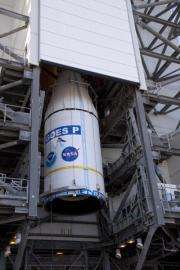
NASA's GOES-P meteorological satellite is lifted into the mobile service tower at Launch Complex 37 on Cape Canaveral Air Force Station. Credit: NASA/Jack Pfaller

NASA is preparing to launch the NOAA Geostationary Operational Environmental Satellite-P (GOES-P) from Space Launch Complex 37 at the Cape Canaveral Air Force Station, Fla. The launch is targeted for March 2, during a launch window from 6:19 to 7:19 p.m. EST.

"GOES are the backbone of NOAA's severe forecasts, monitoring fast-changing conditions in the atmosphere that spawn hurricanes, tornadoes, floods and other hazards," said Steve Kirkner, GOES program manager at NASA's Goddard Space Flight Center, Greenbelt, Md.

GOES-P is the third and final spacecraft to be launched in the GOES N Series of geostationary environmental weather satellites. The GOES satellites continuously provide observations of more than 50 percent of the Earth, including the continental United States, providing weather monitoring and forecast operations and a continuous and reliable stream of environmental information and severe weather warnings.

In addition to weather forecasting on Earth, a key instrument onboard GOES-P, the Solar X-Ray Imager (SXI), will help NOAA continue monitoring solar conditions.

"The SXI is improving our forecasts and warnings for solar disturbances, protecting billions of dollars worth of commercial and government assets in space and on the ground, and lessening the brunt of power surges for the satellite-based electronics and communications industry," said Tom Bodgan, director of NOAA's Space Weather Prediction Center (SWPC) in Boulder, Colo.

GOES-P joins a system of weather satellites that provide timely environmental information to meteorologists and the public. The GOES system provides data used to graphically display the intensity, path and size of storms. Early warning of impending severe weather enhances the public's ability to take shelter and protect property.

GOES-P will be launched on board a United Launch Alliance Delta IV (4, 2) launch vehicle under a FAA commercial license. The satellite will be turned over to NASA after the successful checkout is completed by Boeing Space and Intelligence Systems, El Segundo Calif.

Currently, NOAA operates GOES-12, (GOES East) and GOES-11 (GOES-West.) In late April, NOAA will activate GOES-13 to replace GOES-12 and will drift eastward from 105 degrees West longitude to 75 degrees West longitude. NOAA plans to move GOES-12 to 60 degrees West longitude to provide coverage for South America as part of the Global Earth Observing System of Systems (GEOSS). NASA handed over GOES-14, launched last June, to NOAA on December 14, 2009. It will remain in normal mode at the 105W storage longitude to provide operational X-ray Sensor coverage to NOAA's SWPC.

Once in orbit GOES-P will be designated GOES-15, checked out and then stored on-orbit and ready for activation should one of the operational GOES satellites degrade or exhaust their fuel.

NOAA manages the GOES program, establishes requirements, provides all funding and distributes environmental satellite data for the United States. NASA Goddard procures and manages the design, development and launch of the satellites for NOAA on a cost reimbursable basis. Boeing Space and Intelligence Systems built GOES-P.

Explore further: Field tests in Mojave Desert pave way for human exploration of small bodies

add to favorites email to friend print save as pdf

Related Stories

NASA's Goes-N Satellite Ready for Launch

Jul 27, 2005

NASA announced the Geostationary Operational Environmental Satellite-N (GOES-N) is ready to launch. The GOES-N launch window is from 6:23 to 7:01 p.m. EDT, Friday, July 29, 2005. Liftoff is from Space Launch Complex 37, Cape ...

Sophisticated weather satellite rockets into orbit

Jun 28, 2009

(PhysOrg.com) -- The latest Geostationary Operational Environmental Satellite, GOES-O, soared into space today after a successful launch from Space Launch Complex 37 at the Cape Canaveral Air Force Station ...

GOES-O satellite arrives at KSC for final pre-launch testing

Mar 04, 2009

(PhysOrg.com) -- The latest Geostationary Operational Environmental Satellite (GOES) developed by NASA for the National Oceanic and Atmospheric Administration (NOAA), called GOES-O, arrived this morning by a C17 military ...

NASA, NOAA set to launch NOAA-N Prime satellite

Jan 22, 2009

NASA is preparing to launch NOAA'S latest polar-orbiting operational environmental satellite, called NOAA-N Prime, providing an essential resource for NOAA's weather forecasts and improving the U.S. search ...

NASA, NOAA set to launch new environmental satellite

May 04, 2005

NASA is set to launch the new National Oceanic and Atmospheric Administration (NOAA) Polar-orbiting Operational Environmental Satellite (POES), another critical link in the development of a global Earth-observation program. The spa ...

GOES-O satellite reaches orbit, renamed GOES-14

Jul 10, 2009

On June 27, 2009, the Geostationary Operational Environmental Satellite, GOES-O, soared into space during a spectacular launch from the Cape Canaveral Air Force Station in Florida. GOES-O has now been renamed ...

Recommended for you

Mars rover Opportunity examines clay clues in rock

23 hours ago

(Phys.org) —NASA's senior Mars rover, Opportunity, is driving to a new study area after a dramatic finish to 20 months on "Cape York" with examination of a rock intensely altered by water.

NASA's STEREO detects a CME from the sun

May 17, 2013

On 5:24 a.m. EDT on May 17, 2013, the sun erupted with an Earth-directed coronal mass ejection or CME, a solar phenomenon that can send billions of tons of solar particles into space that can reach Earth ...

Nine-year-old Mars rover passes 40-year-old record

May 17, 2013

While Apollo 17 astronauts Eugene Cernan and Harrison Schmitt visited Earth's moon for three days in December 1972, they drove their mission's Lunar Roving Vehicle 19.3 nautical miles (22.210 statute miles ...

Bright explosion on the Moon

May 17, 2013

For the past 8 years, NASA astronomers have been monitoring the Moon for signs of explosions caused by meteoroids hitting the lunar surface. "Lunar meteor showers" have turned out to be more common than anyone ...

User comments : 0

More news stories

Galaxy's Ring of Fire

Johnny Cash may have preferred this galaxy's burning ring of fire to the one he sang about falling into in his popular song. The "starburst ring" seen at center in red and yellow hues is not the product of ...