Simple math explains dramatic beak shape variation in Darwin's finches
From how massive humpbacks glide through the sea with ease to the efficient way fungal spores fly, applied mathematicians at Harvard have excavated the equations behind a variety of complex phenomena.
The latest numerical feat by Otger Campàs and Michael Brenner, working closely with a team of Harvard evolutionary biologists led by Arhat Abzhanov, zeroes in on perhaps the most famous icon of evolution: the beaks of Darwin's finches.
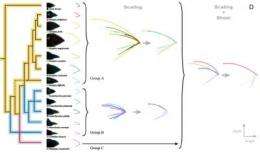
In a study appearing in the February 16 Early Edition of the Proceedings of the National Academy of Sciences (PNAS), the researchers demonstrate that simple changes in beak length and depth can explain the important morphological diversity of all beak shapes within the famous genus Geospiza.
Broadly, the work suggests that a few, simple mathematical rules may be responsible for complicated biological adaptations.
The investigation began at Harvard's Museum of Comparative Zoology, where Campàs, a postdoctoral fellow at the Harvard School of Engineering and Applied Sciences (SEAS), and Ricardo Mallarino, a graduate student in the Department of Organismic and Evolutionary Biology (OEB) at Harvard, obtained photographs of beak profiles from specimens of Darwin's finches.
Using digitization techniques, the researchers found that 14 distinct beak shapes, that at first glance look unrelated, could be categorized into three broader, group shapes. Despite the striking variety of sizes and shapes, mathematically, the beaks within a particular group only differ by their scales.
"It is not possible, however, to explain the full diversity of beak shapes of all Darwin's finches with only changes in beak length and depth," explains Campàs. "By combining shear transformations (basically, what happens when you transform a square into a rhombus by shoving the sides toward one another), with changes in length and depth, we can then collapse all beak shapes onto a common shape."
Using Micro-Computed Tomography (CT) scans on the heads for the different species in the genus Geospiza, Anthony Herrel, an Associate of the Museum of Comparative Zoology, helped the team go one step further, verifying that the bone structure of the birds exhibits a similar scaling pattern as the beaks.
Thus, beak shape variation seems to be constrained by only three parameters: the depth of the length for the scaling transformation and the degree of shear.
Brenner, Glover Professor of Applied Mathematics at SEAS, says he is "astonished" that so few variables can help explain such great diversity. The mechanism that allows organisms to adapt so readily to new environments may be a relatively "easy" process.
"This is really significant because it means that adaptive changes in phenotype can be explained by modifications in a few simple parameters," adds Mallarino. "These results have encouraged us to try to find the remaining molecules responsible for causing these changes."
In fact, the mathematical findings also have a parallel genetic basis. Abzhanov, an assistant professor in OEB, and his collaborators explored the role of the two genes responsible for controlling beak shape variation. Bmp4 expression affects width and depth and Calmodulin expression relates to length. It turns out that the expression levels of the two genes, in particular Bmp4, are fundamentally related to the scaling transformations.
"We wanted to know how beaks changed on a fundamental level during evolution of Darwin's finches and how many unique beak shapes we need yet to explain using our developmental genetics approach," says Abzhanov. "Our joint study demonstrates that we understand the species-level variation really well where scaling transformations match up perfectly with expression and function of developmental genes which regulate precisely such type of change. Now we want to understand how novel beak shapes resulting from higher order transformations evolved in Darwin's finches and beyond."
Campàs reflects that the finding helps to address an idea that Darwin raised nearly 175 years ago in the Voyage of the Beagle: "The most curious fact is the perfect gradation in the size of the beaks in the different species of Geospiza, from one as large as that of a hawfinch to that of a chaffinch, and even to that of a warbler … Seeing this gradation and diversity of structure in one small, intimately related group of birds, one might really fancy that from an original paucity of birds in this archipelago [Galapagos], one species had been taken and modified for different ends."
Provided by Harvard University


