Effects of forest fire on carbon emissions, climate impacts often overestimated
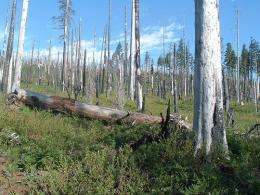
A recent study at Oregon State University indicates that some past approaches to calculating the impacts of forest fires have grossly overestimated the number of live trees that burn up and the amount of carbon dioxide released into the atmosphere as a result.
The research was done on the Metolius River Watershed in the central Oregon Cascade Range, where about one-third - or 100,000 acres - of the area burned in four large fires in 2002-03. Although some previous studies assumed that 30 percent of the mass of living trees was consumed during forest fires, this study found that only 1-3 percent was consumed.
Some estimates done around that time suggested that the B&B Complex fire in 2003, just one of the four Metolius fires, released 600 percent more carbon emissions than all other energy and fossil fuel use that year in the state of Oregon - but this study concluded that the four fires combined produced only about 2.5 percent of annual statewide carbon emissions.
Even in 2002, the most extreme fire year in recent history, the researchers estimate that all fires across Oregon emitted only about 22 percent of industrial and fossil fuel emissions in the state - and that number is much lower for most years, about 3 percent on average for the 10 years from 1992 to 2001.
The OSU researchers said there are some serious misconceptions about how much of a forest actually burns during fires, a great range of variability, and much less carbon released than previously suggested. Some past analyses of carbon release have been based on studies of Canadian forests that are quite different than many U.S. forests, they said.
"A new appreciation needs to be made of what we're calling 'pyrodiversity,' or wide variation in fire effects and responses," said Garrett Meigs, a research assistant in OSU's Department of Forest Ecosystems and Society. "And more studies should account for the full gradient of fire effects."
The past estimates of fire severity and the amounts of carbon release have often been high and probably overestimated in many cases, said Beverly Law, a professor of forest ecosystems and society at OSU.
"Most of the immediate carbon emissions are not even from the trees but rather the brush, leaf litter and debris on the forest floor, and even below ground," Law said. "In the past we often did not assess the effects of fire on trees or carbon dynamics very accurately."
Even when a very severe fire kills almost all of the trees in a patch, the scientists said, the trees are still standing and only drop to the forest floor, decay, and release their carbon content very slowly over several decades. Grasses and shrubs quickly grow back after high-severity fires, offsetting some of the carbon release from the dead and decaying trees. And across most of these Metolius burned areas, the researchers observed generally abundant tree regeneration that will result in a relatively fast recovery of carbon uptake and storage.
"A severe fire does turn a forest from a carbon sink into an atmospheric carbon source in the near-term," Law said. "It might take 20-30 years in eastern Oregon, where trees grow and decay more slowly, for the forest to begin absorbing more carbon than it gives off, and 5-10 years on the west side of the Cascades."
Since fire events are episodic in nature while greenhouse gas emissions are continuous and increasing, climate change mitigation strategies focused on human-caused emissions will have more impact than those emphasizing wildfire, the researchers said. And to be accurate, estimates of carbon impacts have to better consider burn severity, non-tree responses, and below-ground processes, they said.
"Even though it looks like everything is burning up in forest fires, that simply isn't what happens," Meigs said. "The trees are not vaporized even during a very intense fire. In a low-severity fire many of them are not even killed. And in the Pacific Northwest, the majority of burned area is not stand-replacement fire."
Fire suppression has resulted in a short-term reduction of greenhouse gases, the researchers said, but on a long-term basis fire will still be an inevitable part of forest ecosystems. Timber harvest also has much more impact on carbon dynamics than fire. Because of this, forest fires will be a relatively minor player in greenhouse gas mitigation strategies compared to other factors, such as human consumption of fossil fuels, they said.
Global warming could cause higher levels of forest fire and associated carbon emissions in the future, the researchers said, although there are many uncertainties about how climate change will affect forests, and no indication that forest fire carbon emissions will become comparable to those caused by fossil fuel use.
This research was published recently in the journal Ecosystems, and funded by the U.S. Department of Energy.
Provided by Oregon State University


