The fungus among us: An eco-friendly way of decomposing BPA-containing plastic
Jan 27, 2010
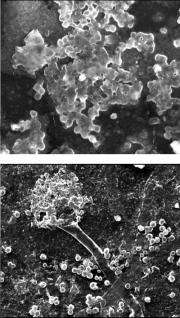
Fungi may provide an eco-friendly way of decomposing polycarbonate plastic waste that contains bisphenol A. Credit: American Chemical Society

Just as cooking helps people digest food, pretreating polycarbonate plastic — source of a huge environmental headache because of its bisphenol A (BPA) content — may be the key to disposing of the waste in an eco-friendly way, scientists have found. Their new study is in ACS' Biomacromolecules, a monthly journal.

Mukesh Doble and Trishul Artham note that manufacturers produce about 2.7 million tons of plastic containing BPA each year. Polycarbonate is an extremely recalcitrant plastic, used in everything from screwdriver handles to eyeglass lenses, DVDs, and CDs. Some studies have suggested that the BPA may have a range of adverse health effects, sparking the search for an environmentally safe way of disposing of waste plastic to avoid release of BPA.

The scientists pretreated polycarbonate with and heat and exposed it to three kinds of fungi — including the fabled white-rot fungus, used commercially for environmental remediation of the toughest pollutants. The scientists found that fungi grew better on pretreated plastic, using its BPA and other ingredients as a source of energy and breaking down the plastic.

After 12 months, there was almost no of the untreated plastic, compared to substantial decomposition of the pretreated plastic, with no release of .

Explore further: Scientists make breast cancer advance that turns previous thinking on its head

More information: "Biodegradation of Physiochemically Treated Polycarbonate by Fungi", Biomacromolecules, pubs.acs.org/stoken/presspac/presspac/full/10.1021/bm9008099

add to favorites email to friend print save as pdf

Related Stories

Canada to ban BPA baby bottles

Apr 18, 2008

Canada became the first country to declare the widely used chemical bisphenol A unsuitable for use in baby bottles and set a ban mechanism in motion Friday.

Recommended for you

Unspooling DNA from nucleosomal disks

9 hours ago

The tight wrapping of genomic DNA around nucleosomes in the cell nucleus makes it unavailable for gene expression. A team of Ludwig-Maximilians-Universitaet (LMU) in Munich now describes a mechanism that allows chromosomal ...

Chemists find new compounds to curb staph infection

11 hours ago

(Phys.org) —In an age when microbial pathogens are growing increasingly resistant to the conventional antibiotics used to tamp down infection, a team of Wisconsin scientists has synthesized a potent new ...

User comments : 0

More news stories

Chemists find new compounds to curb staph infection

(Phys.org) —In an age when microbial pathogens are growing increasingly resistant to the conventional antibiotics used to tamp down infection, a team of Wisconsin scientists has synthesized a potent new ...

Controlling mood through the motions of mitochondria

(Medical Xpress)—Regulating the distribution of power in neurons is done by a system that makes the national electric grid look simple by comparison. Each neuron has several thousand mitochondria confined ...

Google Drive sports new view and scan enhancements

(Phys.org) —Google Drive has a new look and functions. The makeover in Google Drive features scanning and interface enhancements that put the user into "card" mode. The enhancements make it easy for the ...