TRMM satellite doesn't need 3-D glasses for Magda
Jan 22, 2010
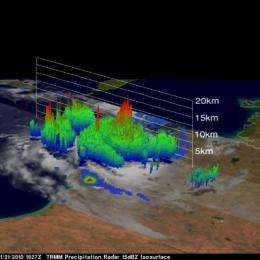
The TRMM precipitation analysis showed Magda was dropping about 2 inches of rainfall per hour west of the eye, and some of the intense thunderstorms near the eye were as high as 16 kilometers (~52,493 feet). Credit: NASA/SSAI/Hal Pierce

People may need 3-D glasses to see life-like images, but rainfall and cloud data from the Tropical Rainfall Measuring Mission or TRMM satellite gives scientists a three-dimensional look at tropical cyclones without the glasses.

TRMM passed over tropical cyclone Magda on January 21 at 1927 UTC (2:27 p.m. ET) when it was off Western Australia's northern coast and soon to make landfall TRMM captured a look at its rainfall and cloud heights. That data was used to create a 3-D image of how high Magda's clouds were, and how heavily the rain was falling within the storm.

The TRMM rainfall analysis is derived from TRMM's Precipitation Radar (PR) and instruments (TMI). It revealed that Magda had developed an eye before coming ashore with hurricane force winds. TRMM also showed that there were powerful thunderstorms were dropping rainfall at a rate greater than 50mm per hour (~2 inches per hour) in an area west of the eye.

TRMM's 3-D perspective of Magda showed that some of the intense thunderstorms near its eye reached to heights above 16 kilometers (~52,493 feet). Magda has since moved inland and is forecast to dissipate in Western Australia's Great Sandy Desert. TRMM is managed by and JAXA, the Japanese Space Agency.

Explore further: Astonishing hi-resolution satellite views of the destruction from the Moore, Oklahoma tornado

add to favorites email to friend print save as pdf

Related Stories

NASA's TRMM satellite sees heavy rainfall in Choi-Wan

Sep 17, 2009

NASA and the Japanese Space Agency's Tropical Rainfall Measuring Mission (TRMM) satellite flew over the center of Super Typhoon Choi-Wan at 2:34 EDT on September 17, 2009 and captured heavy rainfall around ...

TRMM sees 05B winding down off the Sri Lanka coast

Dec 14, 2009

Tropical Depression 05B is dissipating on the east coast of Sri Lanka today and over the next couple of days, but not before bringing some moderate and heavy rain over the next couple of days to some areas ...

NASA satellite sees rainfall in ebbing Edzani

Jan 12, 2010

NASA's Tropical Rainfall Measuring Mission satellite captured a clear picture of what's happening within Tropical Storm Edzani, including where the rainfall is happening and where the center of the storm has ...

Recommended for you

Strong earthquake at exceptional depth

May 24, 2013

This morning at 05:45 CEST, the earth trembled beneath the Okhotsk Sea in the Pacific Northwest. The quake, with a magnitude of 8.2, took place at an exceptional depth of 605 kilometers. Because of the great ...

Marine forecasting on the horizon for Indian Ocean Rim

May 24, 2013

Nearly all of the member countries of the Indian Ocean Rim Association for Regional Cooperation (IOR-ARC) will attend the week-long workshop to further cooperation and understanding on international ocean ...

Russia evacuates drifting Arctic research station

May 23, 2013

Russia has ordered the urgent evacuation of the 16-strong crew of a drifting Arctic research station after ice floe that hosts the floating laboratory began to disintegrate, officials said Thursday.

User comments : 0

More news stories

Galaxies fed by funnels of fuel

(Phys.org) —Computer simulations of galaxies growing over billions of years have revealed a likely scenario for how they feed: a cosmic version of swirly straws.

Century-old science helps confirm global warming

(Phys.org) —Ocean measurements taken more than 135 years ago during the scientific expedition of HMS Challenger have provided further confirmation of human-produced global warming over the past century.