Kepler Mission Update: First exoplanet discovery, focal plane anomaly
Jan 20, 2010
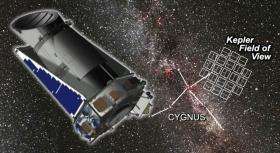
Artist concept of Kepler in space. Image credit: NASA/JPL

(PhysOrg.com) -- Kepler is continuing to collect science data. The Kepler Science Team announced Kepler’s first exoplanet discoveries at the 215th American Astronomical Society Meeting in Washington DC on Jan. 4, 2010.

The Kepler announcements garnered a great deal of interest at the meeting, and received widespread news media coverage. The five new exoplanets were discovered from Kepler’s first 43 days of data. It has been more than 10 months since Kepler’s launch, and the science team continues to analyze the treasure trove of data that Kepler is collecting. The project is preparing for another monthly download of science data, scheduled for Jan. 19-20, 2010.

On Jan. 12, 2010, the Kepler project team detected an with a portion of the Kepler focal plane. One of the modules, MOD-3, that contains two of Kepler’s 42 Charge-Coupled-Devices (CCDs), transmitted anomalous data. There are 21 modules that comprise Kepler’s electronic light sensors, or “eyes.” The possible loss of the module represents a loss of five percent of the Kepler Field-of-View.

An Anomaly Response Team continues to investigate the anomaly. Initial indications are that the anomaly is isolated and not expected to affect other modules. The Kepler project team is working on plans to correct the anomaly or to minimize the impact of the possible loss of the module and the reduction in Field-of-View.

Provisions were included in Kepler’s design to accommodate degradation in Kepler’s performance as the mission progresses. Additional telemetry is being gathered from the spacecraft to facilitate analysis of the anomaly. The module will remain offline pending further trouble-shooting and analysis. In the event the module functionality cannot be restored, Kepler still is expected to fully meet its mission goals for detecting Earth-size planets in the of other stars.

Explore further: Building a better team—on Mars

add to favorites email to friend print save as pdf

Related Stories

Kepler Set to Launch Tonight on Planet Finding Mission

Mar 06, 2009

(PhysOrg.com) -- The Kepler spacecraft and its Delta II rocket are "go" for a launch tonight that is expected to light up the sky along Florida's Space Coast at 10:49 p.m. EST as the rocket lifts off from ...

Kepler Mission Update

Nov 06, 2009

(PhysOrg.com) -- Kepler completed another science data download over October 18-19. In this download, a month's worth of science data was transmitted through the NASA Deep Space Network and into the Science ...

Kepler Mission Update

Sep 23, 2009

(PhysOrg.com) -- Kepler is approximately 18 million kilometers (11 million miles) from Earth, and continuing its drift-away orbit. All systems are operating normally. Last week, the Kepler project team completed ...

NASA's Kepler Spacecraft Ready to Ship to Florida

Dec 18, 2008

(PhysOrg.com) -- Engineers are getting ready to pack NASA's Kepler spacecraft into a container and ship it off to its launch site at Cape Canaveral Air Force Station, Fla. The mission, scheduled to launch ...

Recommended for you

Forecast for Titan: Wild weather could be ahead

8 hours ago

(Phys.org) —Saturn's moon Titan might be in for some wild weather as it heads into its spring and summer, if two new models are correct. Scientists think that as the seasons change in Titan's northern hemisphere, ...

SDO observes mid-level solar flare

9 hours ago

UPDATE 16:30 p.m. EDT: The M7-class flare was also associated with a coronal mass ejection or CME, another solar phenomenon that can send billions of tons of particles into space. While this CME was not Ea ...

NASA's IRIS mission readies for a new challenge

18 hours ago

(Phys.org) —The time draws near. NASA is getting ready to launch a new mission, a mission to observe a largely unexplored region of the solar atmosphere that powers its dynamic million-degree outer atmosphere and drives ...

User comments : 0

More news stories

Forecast for Titan: Wild weather could be ahead

(Phys.org) —Saturn's moon Titan might be in for some wild weather as it heads into its spring and summer, if two new models are correct. Scientists think that as the seasons change in Titan's northern hemisphere, ...

Theorists weigh in on where to hunt dark matter

(Phys.org) —Now that it looks like the hunt for the Higgs boson is over, particles of dark matter are at the top of the physics "Most Wanted" list. Dozens of experiments have been searching for them, but ...