Self-assembling solar panels a step closer

Jan 14, 2010 by Lin Edwards report
The self assembly process made a device of 64,000 parts in 3 minutes. Image: Heiko O. Jacobs

(PhysOrg.com) -- Scientists Robert J. Knuesel and Heiko O. Jacobs of the University of Minnesota have developed a way to make tiny solar cells self-assemble.

The researchers had previously been unsuccessful in their attempts to make self-assembling electronic components. In large systems gravity can be used to drive , and in nanoscale systems chemical processes can be used, but between the two scales, in the micrometer range, it is much more difficult.

To overcome the difficulties, Kneusel and Jacobs designed a flexible substrate of a thin layer of copper covered with propylene-terephthalate (PET). Regular depressions the same size as the "chiplets" were etched into the PET layer and then the sheet was dipped into a bath of molten solder, which coated the exposed copper in the etched depressions. Each chiplet consisted of a 20-60 µm silicon cube with one gold face. The silicon sides had a coating of hydrophobic (water-repelling) molecules, while the gold side had a hydrophilic (water-attracting) coating.

When the elements were placed in a container containing oil and water, they neatly arranged themselves in a sheet at the boundary between the liquids, with the gold side pointed down to the water layer. The substrate was then pulled slowly up through the boundary like a conveyor belt, and the elements neatly dropped in place in the depressions as the solder attracted the side. Accuracy was 98%. The assembly was covered with epoxy to keep the chiplets in place, and then a conducting layer was added.

The device was able to assemble 62,000 elements, each of them thinner than a human hair, in only three minutes. The elimination of a dependency on gravity and sedimentation meant the chiplets could be reduced to below 100 micrometers in size. It was important to limit the assembly time to avoid oxidation of the surfaces, which would reduce surface energies and interfere with self-assembly. The water layer had to be acidic, at pH 2.0, and the temperature had to be kept at 95C to keep the solder molten.
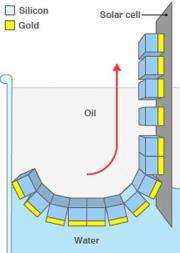
The self assembly process. Elements align at the oil/water boundary. The "blank" solar cell has pre-cut places for the elements and is dipped through the boundary. As it is slowly drawn upwards, the elements pop into place. Image: Heiko O. Jacobs.

The researchers think they can adapt their method to smaller components and larger assembled devices, and it could be used to cheaply and quickly assemble all kinds of high-quality electronic components on a wide range of flexible or inflexible substrates including plastics, semiconductors and metals. The assemblages could find uses in numerous applications such as , video displays and tiny semiconductors.

The use of this method in solar cell production would reduce the cost considerably since less silicon is needed, and it should also be possible to assemble solar chiplets into transparent, flexible materials, which would extend their range of uses.

The paper is published in the Proceedings of the National Academy of Sciences (PNAS).

Explore further: Femtosecond 'snapshots' reveal a dramatic bond tightening in photo-excited gold complexes

More information: Self-assembly of microscopic chiplets at a liquid-liquid-solid interface forming a flexible segmented monocrystalline solar cell, Robert J. Knuesel and Heiko O. Jacobs, PNAS, DOI:10.1073/pnas.0909482107

Related Stories

New nanoassembly technique is created

Nov 27, 2006

U.S. chemists at Rice University say they have discovered how to assemble gold and silver nanoparticle building blocks into larger structures.

Laser joining of solar cells

Oct 01, 2007

A single solar cell produces a relatively low output – it’s a case of strength in numbers. Tiny strips of metal are used to link cells together. If the laser soldering temperature is too high, the solder ...

Molecular breakthrough for plastic electronics

Apr 12, 2005

The potential applications for flexible plastic electronics are enormous -- from electronic books to radio frequency identification (RFID) tags to electronics for cell phones, personal digital assistants (PDAs) and laptop ...

Nanoparticles assemble by millions to encase oil drops

May 29, 2008

In a development that could lead to new technologies for cleaning up oil spills and polluted groundwater, scientists at Rice University have shown how tiny, stick-shaped particles of metal and carbon can trap oil droplets ...

Organic flash memory developed

Dec 17, 2009

(PhysOrg.com) -- Researchers at the University of Tokyo have developed a non-volatile memory that has the same basic structure as a flash memory but is made from cheap, flexible, organic materials.

Recommended for you

Beautiful 'flowers' self-assemble in a beaker

May 16, 2013

By simply manipulating chemical gradients in a beaker of fluid, materials scientists at Harvard have found that they can control the growth behavior of crystals to create precisely tailored structures—such ...

User comments : 2

Adjust slider to filter visible comments by rank

Display comments: newest first

ArkavianX
4 / 5 (1) Jan 14, 2010
And the efficiency of the resultant cell was wha?

c'mon!!!
antialias_physorg
not rated yet Jan 14, 2010
The linked abstract says:
As an example we demonstrate a fault-tolerant segmented flexible monocrystalline silicon solar cell, reducing the amount of Si that is used when compared to conventional rigid cells.


This seems a bit ambiguous, but _could_ mean that the produced solar cells are of comparable efficiency. Unfortunately they want cash for the full article.

More news stories

Attacking MRSA with metals from antibacterial clays

In the race to protect society from infectious microbes, the bugs are outrunning us. The need for new therapeutic agents is acute, given the emergence of novel pathogens as well as old foes bearing heightened antibiotic resistance.

Beautiful 'flowers' self-assemble in a beaker

By simply manipulating chemical gradients in a beaker of fluid, materials scientists at Harvard have found that they can control the growth behavior of crystals to create precisely tailored structures—such ...

Making gold green: New non-toxic method for mining gold

Northwestern University scientists have struck gold in the laboratory. They have discovered an inexpensive and environmentally benign method that uses simple cornstarch—instead of cyanide—to isolate gold from raw materials ...

Galaxy's Ring of Fire

Johnny Cash may have preferred this galaxy's burning ring of fire to the one he sang about falling into in his popular song. The "starburst ring" seen at center in red and yellow hues is not the product of ...

US seizes Bitcoin operator accounts

US authorities seized the accounts of a Bitcoin digital currency exchange operator, claiming it was functioning as an "unlicensed money service business," court documents showed Friday.