Giant Magnetic Loop Sweeps Through Space Between Stellar Pair
Jan 13, 2010 by Dave Finley
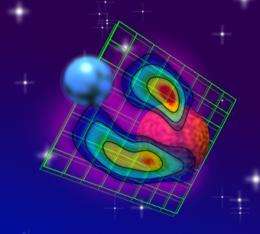
Artist's conception of Algol star system with radio image superimposed on grid. Credit: Peterson et al., NRAO/AUI/NSF

(PhysOrg.com) -- Astronomers have found a giant magnetic loop stretched outward from one of the stars making up the famous double-star system Algol. The scientists used an international collection of radio telescopes to discover the feature, which may help explain details of previous observations of the stellar system.

"This is the first time we've seen a feature like this in the magnetic field of any star other than the Sun," said William Peterson, of the University of Iowa.

The pair, 93 light-years from Earth, includes a star about 3 times more massive than the Sun and a less-massive companion, orbiting it at a distance of 5.8 million miles, only about six percent of the distance between Earth and the Sun. The newly-discovered magnetic loop emerges from the poles of the less-massive star and stretches outward in the direction of the primary star. As the secondary star orbits its companion, one side -- the side with the magnetic loop -- constantly faces the more-massive star, just as the same side of our Moon always faces the Earth.

The scientists detected the magnetic loop by making extremely detailed images of the system using an intercontinental set of , including the National Science Foundation's , Very Large Array, and Robert C. Byrd Green Bank Telescope, along with the Effelsberg radio telescope in Germany. These radio telescopes were used as a single observing system that offered both great detail, or resolving power, and high sensitivity to detect very faint radio waves. When working together, these telescopes are known as the High Sensitivity Array.

Algol, in the constellation Perseus, is visible to the naked eye and well-known to amateur astronomers. As seen from Earth, the two regularly pass in front of each other, causing a notable change in brightness. The pair completes a cycle of such eclipses in less than three days, making it a popular object for amateur observers. The variability in brightness was discovered by an Italian astronomer in 1667, and the eclipsing-binary explanation was confirmed in 1889.

The newly-discovered magnetic loop helps explain phenomena seen in earlier observations of the Algol system at X-ray and radio wavelengths, the scientists said. In addition, they now believe there may be similar magnetic features in other double-star systems.

Explore further: South Africa's new radio telescope reveals giant outbursts from binary star system

More information: The scientists reported their findings in the 14 January edition of the scientific journal Nature.

Related Stories

Magnetic field on bright star Vega

Jun 23, 2009

Astronomy & Astrophysics journal publishes the first detection of a magnetic field on the bright star Vega. Using the NARVAL spectropolarimeter of the Bernard-Lyot telescope on top of the Pic du Midi (Franc ...

The Magnetic Nature of a Mysterious Cosmic X-ray Emitter

Jun 06, 2006

Our Sun has its explosive flares and spots and high speed wind, but it is a placid star compared to some. Stars that are much more massive live fast and die young, with blue-white, intensely hot surfaces that ...

Unusual Binary Star: White Dwarf With a Cool Companion

Mar 23, 2006

An international researcher team under the direction of Dr. Thorsten Nagel of the Institute for Astronomy and Astrophysics of the University of Tübingen recently discovered an unusual close binary star system. It consists ...

Fermi telescope unveils a dozen new pulsars

Jan 06, 2009

(PhysOrg.com) -- NASA's Fermi Gamma-ray Space Telescope has discovered 12 new gamma-ray-only pulsars and has detected gamma-ray pulses from 18 others. The finds are transforming our understanding of how these ...

Astronomers get new tools for gravitational-wave detection

Jan 05, 2010

Teamwork between gamma-ray and radio astronomers has produced a breakthrough in finding natural cosmic tools needed to make the first direct detections of the long-elusive gravitational waves predicted by Albert Einstein ...

Recommended for you

4C+29.30: Black hole powered jets plow into galaxy

May 15, 2013

(Phys.org) —This composite image of a galaxy illustrates how the intense gravity of a supermassive black hole can be tapped to generate immense power. The image contains X-ray data from NASA's Chandra X-ray ...

A space-time magnifying glass

May 15, 2013

(Phys.org) —Bright arcs are smeared around the heart of galaxy cluster Abell S1077 in this image taken by the NASA/ESA Hubble space telescope. The arcs are stretched images of distant galaxies distorted ...

Orion's hidden fiery ribbon

May 15, 2013

(Phys.org) —This dramatic new image of cosmic clouds in the constellation of Orion reveals what seems to be a fiery ribbon in the sky. This orange glow represents faint light coming from grains of cold ...

User comments : 2

Adjust slider to filter visible comments by rank

Display comments: newest first

in7x
5 / 5 (3) Jan 13, 2010
Is the field the result of a "dynamo" effect? Where is the current?
PinkElephant
5 / 5 (4) Jan 13, 2010
Is the field the result of a "dynamo" effect? Where is the current?


A star is basically a giant ball of ionized gas, a.k.a. plasma. This plasma (consisting purely of charged particles) roils in large-scale patterns of convection -- similar e.g. to how Earth's atmosphere has stable patterns of movement like the trade winds and the jet streams. Also, as stars spin around some axis, the plasma at the star's equator basically moves in circles around the star's center.

As you might know, any time there is coherent movement of charged particles (also known as electric current), there arises a magnetic field.

More news stories

Chinese, Indian airlines face EU pollution fines

Eight Chinese and two Indian airlines face fines of up to several million euros for not paying for their greenhouse gas emissions during flights within the bloc, the European Commission said on Friday.

Alaska volcano shoots ash 15,000 feet into the air

(AP)—One of Alaska's most restless volcanoes has shot an ash cloud 15,000 feet into the air in an ongoing eruption that has drawn attention from a nearby community but isn't expected to threaten air traffic.

Fracking risks to ground water assessed

(Phys.org) —Extraction of "unconventional" gas from sedimentary rocks such as shale could provide a clean energy source and help some regions to become energy independent, but concerns have been raised ...

Bright explosion on the Moon

For the past 8 years, NASA astronomers have been monitoring the Moon for signs of explosions caused by meteoroids hitting the lunar surface. "Lunar meteor showers" have turned out to be more common than anyone ...

Earth's iron core is surprisingly weak, researchers say

The massive ball of iron sitting at the center of Earth is not quite as "rock-solid" as has been thought, say two Stanford mineral physicists. By conducting experiments that simulate the immense pressures deep in the planet's ...

US seizes Bitcoin operator accounts

US authorities seized the accounts of a Bitcoin digital currency exchange operator, claiming it was functioning as an "unlicensed money service business," court documents showed Friday.