Fathers are no role models
Jan 12, 2010
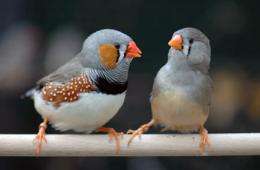
The type of male a female zebra finch prefers is neither determined by genes or by early rearing effects. Image: Max Planck Institute for Ornithology

(PhysOrg.com) -- Female zebra finches do not only differ in the way they chose their mate but also in their preference for a partner.

Scientists from the Max Planck Institute for in Seewiesen investigated the influence of heritability versus sexual imprinting on mate choice by observing over 350 zebra finches. How female zebra finches chose their male is partly heritable, according to the scientists. However, the type of male the females prefer is neither determined by nor by early rearing effects (published in Evolution, January 11, 2010).

As in most animals, it is the zebra finch female that chooses the mating partner. Thereby, each female has her own individual preference - not different to us humans. These mating preferences can be heritable or they can result from sexual imprinting. This means for example, a female prefers a male that resembles her father. Scientists from the Max Planck Institute for Ornithology in Seewiesen investigated for the first time the relative importance of the two factors for mate choice.

The researchers used an elaborate experimental design to separate the influence of genetically determined preference and the experiences made in the early life phase. More than 350 zebra finch chicks of one generation were raised with unrelated foster sisters from unrelated foster parents. This is why the researchers were then able to compare and mate preference of genetic sisters and foster sisters. When the zebra finches reached , the females could choose between two unrelated males in a set of experiments.

The Max Planck researchers found that the choice behavior of females is partly influences by genes: genetic sisters chose their partners in a similar way regarding their activity pattern, the time spent with a male and the proportion of visits of the different males. Regarding the preference functions - i.e. which male to prefer - the researchers did not find any influence of genes or sexual imprinting. Both, the genetic and the foster sisters did not show more conformity in their partner preferences than females that are unrelated and raised separately. "So far, both mechanisms have been overestimated as factors for partner preference", says Wolfgang Forstmeier, one of the co-authors of the study. There have to be other explanations for individual partner preference than genetic relatedness or early sexual imprinting. The search for those reasons is a task for the future.

Explore further: Bird's playlist could signal mental strengths and weaknesses

More information: Holger Schielzeth, Elisabeth Bolund and Wolfgang Forstmeier, Heritability of and early environment effects on variation in mating preferences. Evolution, January 11, 2010; www3.interscience.wiley.com/journal/122678927/abstract

Related Stories

When mice choose mates, experience counts

Mar 21, 2006

Choosing a mate is a big decision. And, at least for mice, it's one that is best made with input from one's peers. In a series of experiments designed help scientists understand the brain chemicals that guide ...

Scientists report new take on sexual signaling

May 09, 2007

In dangerous environments, females looking for a mate run great risks. Scientists from Seoul National University, in Korea, and the Smithsonian Tropical Research Institute in Panama present a new take on sexual ...

Female mammals follow their noses to the right mates

Mar 17, 2009

Female birds often choose their mates based on fancy feathers. Female mammals, on the other hand, may be more likely to follow their noses to the right mate. That's one conclusion of Cambridge zoologist Tim Clutton-Brock ...

Females avoid incest by causing male relatives to leave home

Aug 15, 2007

Researchers at the University of Sheffield in the UK and Leibniz Institute for Zoo and Wildlife Research (IZW) in Berlin, Germany, have found that female hyenas avoid inbreeding with their male relatives by giving them little ...

The best both of worlds -- how to have sex and survive

Sep 20, 2007

Researchers have discovered that even the gruesome and brutal lifestyle of the Evarcha culicivora, a blood gorging jumping spider indigenous to East Africa, can’t help but be tempted by that ‘big is beautiful’ mantra ...

Male seahorses like big mates

Jul 07, 2009

Male seahorses have a clear agenda when it comes to selecting a mating partner: to increase their reproductive success. By being choosy and preferring large females, they are likely to have more and bigger eggs, as well as ...

Recommended for you

User comments : 2

Adjust slider to filter visible comments by rank

Display comments: newest first

wiserd
not rated yet Jan 13, 2010
some animals prefer mates whose immune systems compliment themselves. Differences, not similarities. Of course, as poorly as this article was written I question how well the author understood the subject matter.
El_Nose
not rated yet Jan 13, 2010
so the finches - like who they like -- without a reason - its just chemistry

More news stories

Australia set to cull 10,000 wild horses

A controversial cull of up to 10,000 wild horses in Australia's harsh Outback reportedly began Wednesday in a bid to control the feral animals which officials say are destroying the land.

Encouraging signs for bee biodiversity

Declines in the biodiversity of pollinating insects and wild plants have slowed in recent years, according to a new study. Researchers led by the University of Leeds and the Naturalis Biodiversity Centre in the Netherlands ...

Study says empathy plays a key role in moral judgments

Is it permissible to harm one to save many? Those who tend to say "yes" when faced with this classic dilemma are likely to be deficient in a specific kind of empathy, according to a report published in the scientific journal ...

Apple case seen as possible spur to tax action

Now that tech favorite Apple Inc. has been dragged front and center into the debate over the U.S. tax code, lawmakers are hoping that the spotlight on such a high-profile company could be the catalyst for ...

If you can remember it, you can remember it wrong

(Medical Xpress)—Native peoples in regions where cameras are uncommon sometimes react with caution when their picture is taken. The fear that something must have been stolen from them to create the photo ...