Outsmarting bacteria: Researchers develop faster method to generate new antibiotics
Jan 11, 2010
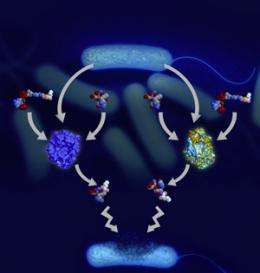
This illustration shows the concept of using enzymes that evolved in bacteria to confer resistance to antibiotics as a chemical tool to generate novel antibacterials with broad-spectrum activity. M. Fridman and S. Garneau-Tsodikova et al. show how two aminoglycoside acetyltransferases (in purple on the left and multi-color on the right) isolated from resistant bacterial strains catalyze the region-specific acyl transfer from an acyl-coenzyme A (the two molecules on the left and the right sides of the picture, the acyl atoms are shown in brighter colors) to aminoglycosides to create novel N-acylated antibiotics. Illustration courtesy of Sylvie Garneau-Tsodikova.

(PhysOrg.com) -- Researchers at the University of Michigan's Life Sciences Institute have developed a new method to rapidly generate and test novel antibiotic-drug candidates. The technique could provide scientists with a new tool in the fight against antibiotic-resistant bacteria.

LSI research assistant professor Sylvie Garneau-Tsodikova and her colleagues essentially outsmarted by using the microbes' own defenses against them. The research team reports its findings in the January edition of the journal ChemBioChem.

"We've taken what the bacteria used to kill the antibiotic as a tool to make new ," said Garneau-Tsodikova, who is also the John G. Searle assistant professor of medicinal chemistry.

Decades of clinical use—and overuse—have made bacteria smarter and trickier to subvert. As a result, many antibiotics are losing their efficacy against bacteria that have built up resistance to them.

"There's currently a huge problem associated with bacterial resistance to antibiotics as bacteria come up with tricks to become resistant to all the drugs that scientists discover," said Garneau-Tsodikova.

Resistance is a problem in the aminoglycoside family of antibiotics, which are commonly used to fight serious bacterial infections and , and as anti-HIV drugs.

Because they have complex structures containing numerous chemically identical amine and hydroxyl functionalities, attempts to create new aminoglycoside antibiotics have been limited. They are hard to synthesize, and one compound takes multiple chemical steps to build, which can translate into years of work. And results are not guaranteed: The compound could turn out to be inactive, and the search would start all over again.

Bacterial resistance to this type of antibiotic happens because the substrate promiscuity is strong, which means the bacteria are able to take a lot of aminoglycosides, modify them, and kill them by using, among others, enzymes called aminoglycoside acetyltransferases. The enzymes modify and eventually kill the drug by adding a small part of the co-substrate, co-enzyme A, to the drug. "If the enzyme acetylates the drugs, the drugs become inactive," said Garneau-Tsodikova.

While much is known about the substrate promiscuity of these enzymes, little was known about the co-substrate promiscuity itself—the enzyme created by the bacteria to kill the antibiotics and render them ineffective.

Garneau-Tsodikova's lab, along with collaborator Micha Fridman at the University of Tel Aviv, sought to determine whether these enzymes would be co-substrate promiscuous and found that they are. Because they are now using an enzyme—which is easier to target and control—they are able to make new compounds and test them in one step, taking a day or two at the most.

"We've taken what the bacteria used to kill the antibiotic as a tool to make new antibiotics by using the co-substrate promiscuity to generate novel . The method rapidly tells us which drugs are worth further pursuing," said Garneau-Tsodikova.

Their method also requires a much smaller amount of the drugs generated for testing—as little as a couple of micrograms. Garneau-Tsodikova has also used this method on other acetyltransferase systems with success. Her lab continues to build on this concept.

Explore further: Protein study suggests drug side effects are inevitable

More information: ChemBioChem paper: www3.interscience.wiley.com/journal/72510898/home/cover/current.html

Related Stories

The structure of resistance

Feb 22, 2008

A team of scientists from the University Paris Descartes has solved the structure of two proteins that allow bacteria to gain resistance to multiple types of antibiotics, according to a report in EMBO reports this month. ...

Nanotechnology used to probe effectiveness of antibiotics

Feb 04, 2009

A group of researchers led by scientists from the London Centre for Nanotechnology, in collaboration with a University of Queensland researcher, have discovered a way of using tiny nano-probes to help understand how an antibiotic ...

New antibiotic beats superbugs at their own game

Jul 03, 2008

The problem with antibiotics is that, eventually, bacteria outsmart them and become resistant. But by targeting the gene that confers such resistance, a new drug may be able to finally outwit them. Rockefeller ...

Recommended for you

Protein study suggests drug side effects are inevitable

2 hours ago

A new study of both computer-created and natural proteins suggests that the number of unique pockets – sites where small molecule pharmaceutical compounds can bind to proteins – is surprisingly small, meaning drug side ...

Attacking MRSA with metals from antibacterial clays

May 17, 2013

In the race to protect society from infectious microbes, the bugs are outrunning us. The need for new therapeutic agents is acute, given the emergence of novel pathogens as well as old foes bearing heightened antibiotic resistance.

Keeping fruit, vegetables and cut flowers fresh longer

May 15, 2013

New technology offers the promise of reducing billions of dollars of losses that occur each year from the silent, invisible killer of fruits, vegetables and cut flowers—a gas whose effects are familiar to everyone who has ...

Why don't beetles freeze in the winter?

May 14, 2013

For 37 years, Queen's University Biochemistry professor Peter Davies has been unraveling the mystery of why some organisms including insects and fish don't freeze in the winter. His research into insect antifreeze protein ...

The molecular basis of strawberry aroma

May 13, 2013

You know that summer is here when juicy red strawberries start to appear on the shelves. In Germany, this seasonal fruit has never been more popular: on average 3.5 kilos per head were consumed in 2012—a ...

User comments : 0

More news stories

Non-wetting fabric drains sweat

(Phys.org) —Waterproof fabrics that whisk away sweat could be the latest application of microfluidic technology developed by bioengineers at the University of California, Davis.

Protein study suggests drug side effects are inevitable

A new study of both computer-created and natural proteins suggests that the number of unique pockets – sites where small molecule pharmaceutical compounds can bind to proteins – is surprisingly small, meaning drug side ...

Beautiful 'flowers' self-assemble in a beaker

By simply manipulating chemical gradients in a beaker of fluid, materials scientists at Harvard have found that they can control the growth behavior of crystals to create precisely tailored structures—such ...

Attacking MRSA with metals from antibacterial clays

In the race to protect society from infectious microbes, the bugs are outrunning us. The need for new therapeutic agents is acute, given the emergence of novel pathogens as well as old foes bearing heightened antibiotic resistance.

Practice makes perfect? Not so much

Turns out, that old "practice makes perfect" adage may be overblown. New research led by Michigan State University's Zach Hambrick finds that a copious amount of practice is not enough to explain why people ...

Lab sets a new record for creating heralded photons

(Phys.org) —Entanglement, by general consensus of physicists, is the weirdest part of quantum science. To say that two particles, A and B, are entangled means that they are actually two parts of an inseparable ...