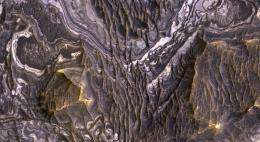
This view shows color variations in bright layered deposits on a plateau near Juventae Chasma in the Valles Marineris region of Mars. Image credit: NASA/JPL-Caltech/University of Arizona
(PhysOrg.com) -- Martian landforms shaped by winds, water, lava flow, seasonal icing and other forces are analyzed in 21 journal reports based on data from a camera orbiting Mars.
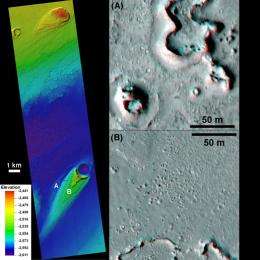
This combination of images helped researchers analyze the youngest flood lava on Mars, which is in Athabasca Valles, in the Elysium Planitia region of equatorial Mars. On the left, color coding indicates relative elevation, based on three-dimensional modeling from stereo pairs of images taken by the High Resolution Imaging Science Experiment (HiRISE) camera on NASA's Mars Reconnaissance Orbiter. The scale bar is 1 kilometer (0.62 mile). The reference key to the color coding is in meters relative to a zero index altitude for Mars (negative numbers, so lower elevations than the zero index). The range from highest (red) to lowest (dark blue) is about 170 meters (558 feet). The labels "A" and "B" indicate the locations of the two images on the right. The images on the right are made from stereo-paired HiRISE observations and appear three dimensional when viewed through red-blue glasses. The features evident here are "phreatovolcanic cones" related to lava-water interactions. They can be used as indicators of where the lava flowed. The difference in elevation between "A" and "B" is more than 100 meters (328 feet), so the lava flow reached a peak depth of more than 100 meters in this area. It is also interesting that the cones are small where the lava was thin (B) and big where the lave was deeper (A). The scale bars are 50 meters (164 feet). Image Credit: NASA/JPL-Caltech/University of Arizona
-- Valleys associated with light-toned layered deposits in several locations along the plateaus adjacent to the largest canyon system on Mars suggest low-temperature alteration of volcanic rocks by acidic water both before and after formation of the canyons.
-- The youngest flood-lava flow on Mars, found in the Elysium Planitia region and covering an area the size of Oregon, is the product of a single eruption and was put in place turbulently over a span of several weeks at most.
-- New details are observed in how seasonal vanishing of carbon-dioxide ice sheets in far-southern latitudes imprints the ground with fan-shaped and spider-shaped patterns via venting of carbon-dioxide gas from the undersurface of the ice.
Citation:
Martian Landform Observations Fill Special Journal Issue (2010, January 11)
retrieved 19 September 2024
from https://phys.org/news/2010-01-martian-landform-special-journal-issue.html
This document is subject to copyright. Apart from any fair dealing for the purpose of private study or research, no
part may be reproduced without the written permission. The content is provided for information purposes only.