Ongoing evolution among modern humans
Jan 05, 2010
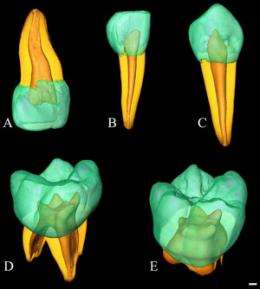
Virtual 3D reconstruction of four deciduous and one permanent teeth assessed for linear, surface, and volumetric tissue proportions. A. deciduous upper right central incisor (Ui1, labial view); B. deciduous lower right lateral incisor (Li2, labial view); C. deciduous lower right canine (Lc, labial view); D. deciduous lower right second molar (Lm2, oblique mesio-buccal view); E. permanent lower right first molar (LM1, oblique mesio-buccal view). The volumes of the virtually reconstructed teeth are rendered in transparency and each tooth component (enamel cup, dentine, and pulp chamber) is shown in a different color. Scale bar is 1 mm.

(PhysOrg.com) -- It has long been the common perception that once modern humans appeared more than 50,000 years ago, little has changed in human biology.

As a result, in considerations of the biology of late archaic humans such as the , it is common to compare them to living humans and largely ignore the biology of the early modern humans, the ones who were close in time to the Neandertals and other non-modern humans across the Old World.

In this context, an international team of researchers, including Erik Trinkaus, Ph.D., professor of in Arts & Sciences at Washington University in St. Louis, has reanalyzed the complete immature dentition (comprising all of the deciduous and almost all of the permanent ) of a 30,000 year-old-child from the Abrigo do Lagar Velho, Portugal.

Their research was published the week of Jan. 4 in the Proceedings of the National Academy of Sciences.

The micro-tomographic (μCT) study of the dentition investigated the relative stages of formation of the developing teeth and the proportions of crown enamel, dentin and pulp in the teeth. The study documented that, for a given stage of development of the cheek teeth, the front teeth were relatively delayed in their degree of formation. The front teeth show a greater percentage of the total tooth volume with dentin and pulp, meaning the front teeth have proportionately less enamel than among recent humans. These patterns in the Lagar Velho dentition fit the pattern evident in the preceding Neandertals and they contrast with the ones known for later 12,000-year-old Pleistocene and living modern humans.

The new analysis of the Lagar Velho child thus joins a growing body of information, from other early fossils in Europe (from Mladec in the Czech Republic, Pestera cu Oase and Pestera Muierii in Romania and Les Rois in France) which shows that these "early modern humans" were modern without being "fully modern," Trinkaus said.

Human anatomical continued after they lived 30,000 to 40,000 years ago.

Explore further: Evolution shapes new rules for ant behavior

Related Stories

How modern were European Neandertals?

Aug 25, 2006

Neandertals were much more like modern humans than had been previously thought, according to a re-examination of finds from one of the most famous palaeolithic sites in Europe by Bristol University archaeologist, ...

Teeth: a future renewable natural resource?

Nov 21, 2006

Most vertebrates have continuous tooth generation, meaning that lost teeth are replaced with new teeth. Mammals, however, including humans, have teeth that are generally only replaced once, when milk teeth are replaced with ...

Recommended for you

Front-row seats to climate change

May 17, 2013

By day, insects provide the white noise of the South, but the night belongs to the amphibians. In a typical year, the Southern air hangs heavy from the humidity and the sounds of wildlife.

Climate change may have little impact on tropical lizards

May 17, 2013

A new Dartmouth College study finds human-caused climate change may have little impact on many species of tropical lizards, contradicting a host of recent studies that predict their widespread extinction in a rapidly warming ...

Wetlands: value to locals matters most

May 17, 2013

A new way of valuing ecosystem services, incorporating the local perspective, is the driving force behind a project assessing aquatic ecosystems in highland areas of Asia

User comments : 5

Adjust slider to filter visible comments by rank

Display comments: newest first

joekid
1 / 5 (1) Jan 06, 2010
un-informative. does not take advantage of data to place in context that makes it: A. UNDERSTANDABLE, B. RELEVANT, C. INTERESTING.
frajo
3 / 5 (2) Jan 06, 2010
It's very informative as it contradicts the wide-spread assumption that the biological evolution of mankind has come to a standstill.
mabarker
1 / 5 (1) Jan 07, 2010
I have a dental anthropology book. On the cover it has a human upper jaw with several teeth showing. The lateral incisor almost looks like a bicuspid. Clearly, the variation in the human dentition (primary & permanent) is astounding. There are 300 genes (or more) controling dental and jaw morphology. According to evolution 1 percent changes were made to these genes over a long, long time. But where is the dental evidence of this?
Teeth are QUANTUM entities. They appear fully formed and working in EVERY FOSSIL ever seen. Also remember that the primary teeth occupy space for the adult teeth which are erupting below them. In fact, the distance from the end of the left primary molar and the right primary molar is the distance in the ADULT where the first permanent will be erupting. There should be millions of fossil mandibles with atypical eruption patterns and evolutionary false starts. There are none. NO evidence of any transitionals, just beautifully designed teeth.
johnsopinion
not rated yet Jan 11, 2010
"Virtual 3D reconstruction of four deciduous and one permanent teeth"
It's really discouraging to try to read an article that starts out with an error (images)!
It is "four deciduous teeth (plural) and one permanent tooth" (singular).
Was that so hard? Now, what was this article about?
smiffy
not rated yet Jan 12, 2010
NO evidence of any transitionals, just beautifully designed teeth.

No need to examine fossils. Lots of contemporary evidence here -
http://en.wikiped...mpaction

More news stories

Morocco to harness the wind in energy hunt

Morocco is ploughing ahead with a programme to boost wind energy production, particularly in the southern Tarfaya region, where Africa's largest wind farm is set to open in 2014.

Galaxy's Ring of Fire

Johnny Cash may have preferred this galaxy's burning ring of fire to the one he sang about falling into in his popular song. The "starburst ring" seen at center in red and yellow hues is not the product of ...