CU Students to Build Tiny Spacecraft to Observe 'Space Weather' Environment
(PhysOrg.com) -- The University of Colorado at Boulder has been awarded $840,000 from the National Science Foundation for students to build a tiny spacecraft to observe energetic particles in space that should give scientists a better understanding of solar flares and their interaction with Earth's atmosphere.
The three-year grant to CU-Boulder's Laboratory for Atmospheric and Space Physics and the aerospace engineering sciences department involves the development of a 5-pound, loaf of bread-sized spacecraft carrying a miniature instrument package to observe energetic particles tied to "space weather" in the near-Earth environment. CU-Boulder graduate students working with CU-Boulder faculty and LASP scientists and engineers will develop, integrate and test the experiment as well as conduct subsequent mission operations and data analysis.
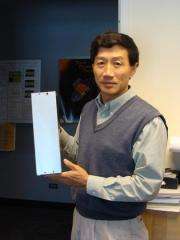
Known as the Colorado Student Space Weather Experiment, or CSSWE, the instruments package is expected to weigh less than 5 pounds. Data from the mission will be combined with information from other space weather missions, said Professor Xinlin Li of LASP and the aerospace engineering sciences department. Li is the principal investigator for the CU-Boulder project.
"Education is a central part of the CSSWE program," said Li. "This is a unique, hands-on learning experience for graduate students who will benefit through their extensive interactions with faculty and staff here at LASP."
Data from the CSSWE mission will shed light on the electrons trapped in the Earth's magnetosphere, often referred to as "killer electrons" because of their impact on spacecraft subsystems and on astronauts in space. Gaining knowledge about such electrons will help scientists understand how the particles accelerate to speeds that are dangerous to spacecraft and humans, said Li.
"The aerospace engineering sciences department has been a leader in the development of hands-on learning at all levels of the curriculum, and this is another big step forward," said aerospace engineering sciences Professor Scott Palo, a co-principal investigator of the project.
The CSSWE mission will be built using low-cost, commercially available parts. Students are expected to begin building the spacecraft during the spring 2010 semester and will use the aerospace engineering sciences department's machine and electronics shops.
Roughly 50 students, primarily from the aerospace engineering sciences department and the electrical, computer and energy engineering department, are expected to participate in different phases of the spacecraft project, said Palo. The mission is slated to launch in 2012 and will "piggyback" on another spacecraft to minimize launch costs.
LASP has led many successful missions with direct student involvement over the past five decades, said LASP Director Daniel Baker. Most recently, students built and tested the Student Dust Counter currently flying onboard NASA's New Horizons mission to Pluto. LASP has the expertise and facilities to support the mission design, management, fabrication, testing and operation of student space missions, Baker said.
"The CSSWE experiment has now been selected for flight, and LASP will support this effort to the hilt," said Baker.
LASP has successfully operated more than 11 NASA missions and trained more than 100 student mission operators from its operations center located in the LASP Space Technology Building. LASP currently operates five NASA missions, including the Kepler planet-hunting spacecraft. LASP is the only university space institute in the world to have designed, built and launched space instruments to every planet in the solar system.
Provided by University of Colorado at Boulder


