How could Santa know if you've been good or bad?
Dec 21, 2009
How could Santa know if you've been good or bad?
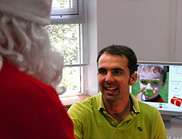
The leader of CSIRO's facial expression recognition technology research team, Dr Simon Lucey, welcoming Santa to the team's research facilities in Sydney. (CSIRO)

(PhysOrg.com) -- By using technology to detect guilty expressions, of course. CSIRO is using automated expression recognition technology to tell whether someone is in pain and, according to computer scientist, CSIRO’s Dr Simon Lucey, there’s no reason why Santa couldn’t train the system to find out who’s been naughty or nice.

“Each facial expression is made up of many different components - a twitch of the mouth here, a widening of the eyes there - some lasting only a fraction of a second,” Dr Lucey said.

“Our looks at these components, matches them against a list drawn up by expert psychologists and decides what expression just flitted across a face.”

It turns out that most human expressions are the same regardless of background.

And, as anyone who has been naughty knows, it’s also very hard to fake an expression.

While a guilty person might fool a human with their look of pure innocence, it’s very hard to fool Dr Lucey’s computer.

“There are always some micro expressions that we are unable to control and some of these are associated with deception. It is these tiny facial expression components that the computer can spot.”

The system uses a technique called machine learning. After being programmed with what to look for and what it means, each observation taken or analysis performed is used to refine the computer’s technique so it gets better at its assigned task over time.

Dr Lucey’s system uses a webcam and will work against any background, providing there’s enough light.

“Our expression work is still mostly from front-on, but we’re teaching the system to do what we do and recognise expressions when only one side of the face is visible.

“When it comes to finding out who’s been naughty or nice, we show the computer what expressions are associated with good behaviour and it watches for a departure from that,” Dr Lucey said.

One of the applications for Dr Lucey’s research is in detecting whether someone who cannot communicate is in pain and how intense that pain is.
Another is in making ‘telecollaboration’ between people using video and computers in different locations more natural by recognising gestures such as someone pointing at an object.

Explore further: Computer scientist publishes new algorithm cluster to data mine health records

add to favorites email to friend print save as pdf

Related Stories

How do patients diagnosed with schizophrenia communicate?

Feb 23, 2009

Negative emotional facial expressions dominate in the interplay with patients diagnosed with schizophrenia. This has been shown in previous research and has now been confirmed in a dissertation from the Department of Psychology, ...

Robot Learns to Smile and Frown (w/ Video)

Jul 08, 2009

(PhysOrg.com) -- A hyper-realistic Einstein robot at the University of California, San Diego has learned to smile and make facial expressions through a process of self-guided learning. The UC San Diego researchers ...

Recommended for you

The brain as a model for future supercomputers

May 14, 2013

(Phys.org) —The brain's repute took a big hit in 1997 when an IBM supercomputer defeated world chess champion Gary Kasparov in a match reported around the world. But in the second round, the brain is back.

User comments : 0

More news stories

German energy shift faces headwinds

Tense engineers have their eyes peeled on complex colour-coded diagrams on a wall-sized screen that makes their control room look like the inside of a spaceship.

Internet in 'coma' as Iran election looms

Iran is tightening control of the Internet ahead of next month's presidential election, mindful of violent street protests that social networkers inspired last time around over claims of fraud, users and ...

China police billions spell profit opportunity

Mannequins in riot gear, armoured cars and drones line a police equipment and "anti-terrorism technology" trade fair in Beijing as vendors seek to profit from China's huge internal security budget.

Honeybees trained in Croatia to find land mines

(AP)—Mirjana Filipovic is still haunted by the land mine blast that killed her boyfriend and blew off her left leg while on a fishing trip nearly a decade ago. It happened in a field that was supposedly ...

Mice, gerbils perish in Russia space flight

A number of mice and eight gerbils sent into space in a Russian capsule destined to find out how well organisms can withstand extended flights perished during their journey, scientists said Sunday as the ...

Bold action, big money needed to curb Asia floods

Asia's flood-prone megacities should fund major drainage, water recycling and waste reduction projects to stem deluges and secure clean supply for their booming populations, experts said Sunday.