NASA NuSTAR Telescope Being Built at Nevis
Dec 17, 2009 by Anna Kuchment
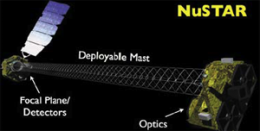
NuSTAR with primary instrument components labeled. Image credit: NASA

(PhysOrg.com) -- It's an unlikely place to build a NASA telescope: a leafy estate in Irvington, N.Y., that once belonged to the son of Alexander Hamilton. Inside a hangar-like building on the site, which is home to Columbia’s Nevis Laboratories for experimental physics, Charles Hailey is assembling mirrors for NuSTAR, the most sensitive X-ray telescope ever constructed.

Its mission: to conduct a census of , map exploding stars known as supernovae and observe other dynamic events in space.

“NuSTAR will open up a whole new window into the universe,” says Hailey, the Pupin Professor of Physics and co-director of Columbia’s astrophysics lab.

X-rays, a high-energy form of light, help astrophysicists observe phenomena that are typically invisible to the naked eye. Black holes, for example, hide behind clouds of dust and gas, and their centers of gravity are so strong that optical light cannot escape. Black holes do, however, emit X-rays, which can penetrate dust and gas, making them visible to NuSTAR.

Compared with Chandra, the X-ray mission that launched in 1999, NuSTAR will record a much higher energy band. The stronger the X-rays, the denser the matter they can penetrate, enabling NuSTAR to find black holes and other cosmic events that have previously escaped detection.

Building such a sensitive instrument requires patience and precision. Starting this month and working until spring, Hailey will assemble NuSTAR’s “eyes” out of 4,000 sheets of glass, some as small as bookmarks, others the size of a computer screen. Each strip of glass, akin to the type used for laptop and cell phone displays, is curved according to a fast, inexpensive method that Hailey pioneered 10 years ago. Called thermal glass slumping, the technique involves placing the flat sheets into a hot oven until they melt. The glass is then shaped to curved molds beneath it. Thermal glass slumping will help bring NuSTAR’s cost to about one-tenth the price of Chandra, which cost $2 billion.

Once the pieces are slumped, they are shipped to Copenhagen, where scientists coat them with a reflective material before sending them back to Nevis. Hailey will then layer the curved glass sheets into concentric rings—12 to 24 sheets per ring, 130 rings in all. The result: two cones that will be mounted onto the finished body of the telescope in California.

NuSTAR, which stands for nuclear spectroscopic telescope array, is scheduled for launch in August 2011 from Kwajalein Island in the Pacific Ocean, one of the Marshall islands. The project’s principal investigator, Fiona Harrison of the California Institute of Technology, is responsible for building the ’s detectors, which will record the images collected by Hailey’s optics. Components assembled by collaborators at the University of California, Berkeley and other institutions include shields to protect NuSTAR from meteors; a deployable mast; and the launch vehicle, a lightweight Pegasus XL rocket.

Hailey, who dislikes travel, will watch the launch on NASA TV from his office, but distance won’t lessen the thrill of watching NuSTAR lift off into the sky.

“It’s enormously exciting,” he says. “I can tell you that we’ll discover black holes of all masses, supernova remnants and young stars. But what really sends chills up my spine are the things we’ll discover that I can’t conceive of yet, that no one can envision.”

Explore further: NASA's STEREO detects a CME from the sun

Provided by The Earth Institute at Columbia University

5 /5 (4 votes)
add to favorites email to friend print save as pdf

Related Stories

NASA Approves X-ray Space Mission

Sep 07, 2009

NASA recently confirmed that the Nuclear Spectroscopic Telescope Array, or NuSTAR, mission will launch in August 2011.

Small Explorer Mission to Set Solar System Boundaries

Jan 27, 2005

A satellite that will make the first map of the boundary between the Solar System and interstellar space has been selected as part of NASA's Small Explorer program. The Interstellar Boundary Explorer (IBEX) mission will be ...

NASA Observatory Confirms Black Hole Limits

Feb 16, 2005

The very largest black holes reach a certain point and then grow no more. That's according to the best survey to date of black holes made with NASA's Chandra X-ray Observatory. Scientists also discovered previously ...

Searching the heavens -- GLAST

May 01, 2008

A new space mission, due to launch this month, is going to shed light on some of the most extreme astrophysical processes in nature - including pulsars, remnants of supernovae, and supermassive black holes. It could even ...

Chandra finds black holes are 'green'

Apr 24, 2006

Black holes are the most fuel efficient engines in the Universe, according to a new study using NASA's Chandra X-ray Observatory. By making the first direct estimate of how efficient or "green" black holes ...

Recommended for you

NASA's STEREO detects a CME from the sun

11 hours ago

On 5:24 a.m. EDT on May 17, 2013, the sun erupted with an Earth-directed coronal mass ejection or CME, a solar phenomenon that can send billions of tons of solar particles into space that can reach Earth ...

Nine-year-old Mars rover passes 40-year-old record

20 hours ago

While Apollo 17 astronauts Eugene Cernan and Harrison Schmitt visited Earth's moon for three days in December 1972, they drove their mission's Lunar Roving Vehicle 19.3 nautical miles (22.210 statute miles ...

Bright explosion on the Moon

20 hours ago

For the past 8 years, NASA astronomers have been monitoring the Moon for signs of explosions caused by meteoroids hitting the lunar surface. "Lunar meteor showers" have turned out to be more common than anyone ...

User comments : 0

More news stories

Chinese, Indian airlines face EU pollution fines

Eight Chinese and two Indian airlines face fines of up to several million euros for not paying for their greenhouse gas emissions during flights within the bloc, the European Commission said on Friday.

Alaska volcano shoots ash 15,000 feet into the air

(AP)—One of Alaska's most restless volcanoes has shot an ash cloud 15,000 feet into the air in an ongoing eruption that has drawn attention from a nearby community but isn't expected to threaten air traffic.

Fracking risks to ground water assessed

(Phys.org) —Extraction of "unconventional" gas from sedimentary rocks such as shale could provide a clean energy source and help some regions to become energy independent, but concerns have been raised ...

Bright explosion on the Moon

For the past 8 years, NASA astronomers have been monitoring the Moon for signs of explosions caused by meteoroids hitting the lunar surface. "Lunar meteor showers" have turned out to be more common than anyone ...

US seizes Bitcoin operator accounts

US authorities seized the accounts of a Bitcoin digital currency exchange operator, claiming it was functioning as an "unlicensed money service business," court documents showed Friday.

Temporal processing in the olfactory system

The neural machinery underlying our olfactory sense continues to be an enigma for neuroscience. A recent review in Neuron seeks to expand traditional ideas about how neurons in the olfactory bulb might encode information about ...