Long-Term Effects of Carbon Dioxide on Plants Studied
Dec 09, 2009 By Don Comis
Long-Term Effects of Carbon Dioxide on Plants Studied by ARS
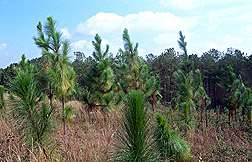
For some forest species such as the longleaf pine, it turns out higher CO2 levels that can come with global climate change could be a boon, increasing growth and survival, according to long-term ARS studies. Photo courtesy of David Stephens, Bugwood.org

(PhysOrg.com) -- Long-term, open-top chamber studies of how rising carbon dioxide (CO2) could affect crops, forests, and pastures reveal a wide range of impacts, according to Agricultural Research Service (ARS) scientists.

Plant physiologist Steve Prior at the ARS National Soil Dynamics Laboratory in Auburn, Ala., heads this research effort. He, plant pathologist Brett Runion, and other colleagues at the Auburn laboratory have found that fast-growing exotic weedy invasives such as Chinese privet, nutsedge and tropical spiderwort could become even more troublesome as CO2 levels increase to 550 parts per million as predicted by 2050.

For forest species such as longleaf pine, higher CO2 levels improve water use efficiency, which may improve drought tolerance, by causing leaf pores or stomates to stay partially closed longer.

In their studies, growth and survival of pine trees went up, while growth and survival of understory plants declined by half.

In addition to increased pine needle production under high CO2, the scientists also found some chemical changes in these needles that litter the forest floor, resulting in less nutritional content for millipedes and other bugs and microbes that feed on them. These changes may alter carbon and nutrient cycling in these natural systems.

And they found that higher CO2 can increase residues left from soybeans and other crops and affect the amount of nitrogen available to plants as microbes decompose the residue. Different soybean varieties may also have different effects on nitrogen availability in a high CO2 world.

In addition to weeds, Prior and Runion also saw effects on disease and , such as fusiform rust and the red headed pine sawfly.

The study supports the U.S. Department of Agriculture’s priority of responding to climate change.

Read more about this and other research in the November-December 2009 issue of Agricultural Research magazine.

Provided by USDA Service

Explore further: Bay Area thrushes nest together, winter together, and face change together

add to favorites email to friend print save as pdf

Related Stories

Time-Tunneling for Climate Change Clues

Nov 23, 2009

(PhysOrg.com) -- If you look closely at individual plant species' responses in the past, you may find that the largest effects of high carbon dioxide (CO2) levels occurred decades ago, according to Agricultural ...

Crops and Weeds: Climate Change's First Responders

Nov 11, 2009

(PhysOrg.com) -- A team of Agricultural Research Service (ARS) plant physiologists is studying how global climate change could affect food crop production--and prompt the evolution of even more resilient weeds.

Reducing Agriculture's Climate Change Footprint

Nov 04, 2009

(PhysOrg.com) -- Curbing greenhouse gas emissions from cultivated fields may require going beyond cutting back on nitrogen fertilizer and changing crop rotation cycles, according to research by Agricultural ...

ARS Explores Ways to Keep Carbon in the Soil

Dec 03, 2009

(PhysOrg.com) -- Agricultural Research Service (ARS) scientists are testing out alternative ways of tilling the soil and rotating crops to see if they can help wheat farmers in Oregon sequester more carbon ...

Recommended for you

Hong Kong dolphin numbers dwindling quickly

17 hours ago

Conservationists Tuesday warned that the number of rare Chinese white dolphins in Hong Kong waters has fallen to its lowest level in a decade of monitoring, and urged the government to immediately create more protected areas.

WWF urges Romania, Bulgaria to protect wild sturgeon

20 hours ago

Conservationist group WWF on Tuesday urged Romania and Bulgaria, home to the last viable wild sturgeon populations in the European Union, to protect the species, threatened by illegal fishing and caviar trade.

New resource to record Britain's trees launched

22 hours ago

Treezilla, the monster map of trees, was launched by The Open University and partners on 14 June 2013. The citizen science project aims to map every tree in Britain through Treezilla.org and the related apps.

Study reveals disease-causing parasites in dead otters

Jun 18, 2013

Research undertaken by the Cardiff University Otter Project has revealed a number of disease-causing parasites in the bodies of dead otters. The findings were revealed at the BBC Summer of Wildlife event ...

User comments : 0

More news stories

Origins of 'The Hoff' crab revealed (w/ Video)

The history of a new type of crab, nicknamed 'The Hoff' because of its hairy chest, which lives around hydrothermal vents deep beneath the Southern Ocean and Indian Ocean, has been revealed for the first ...

Dish won't submit revised bid for Sprint

Satellite TV operator Dish Network Corp. said Tuesday it would not submit a revised bid for Sprint, leaving the path open for the wireless carrier to accept what it already considers a superior offer from Japan's Softbank.

Cape Wind gets $200M investment from Danish fund

The Cape Wind offshore wind project has secured a $200 million investment from a Danish pension fund in what the wind farm's president said Tuesday is a milestone for the long-delayed project.